The phone call lasted less than a minute, but it changed everything.
For years, David had believed he understood what it meant to be afraid.
He had felt panic when he briefly lost sight of his daughter in a crowded store. He had worried when she climbed too high at the playground or raced down a hill on her bicycle with more confidence than caution. Like most parents, he expected the occasional scraped knee, bruised elbow, or childhood mishap.
Those were the fears he knew.
What he didn’t know was how terrifying it could be when something felt wrong and no one could explain why.
It started on a rainy Thursday afternoon.
David was finishing paperwork at work when his phone rang. Seeing the school’s number immediately made his stomach tighten.
The nurse’s voice was calm and professional.
“Mr. Chen, Lily had a small accident during recess. She fell on the playground and bumped her face near her eye. She’s awake and doing fine, but we wanted to let you know.”
The explanation sounded reassuring.
Yet something about it unsettled him.
Maybe it was instinct.
Maybe it was the slight hesitation in the nurse’s voice.
Whatever it was, David couldn’t shake the feeling.
Within minutes, he informed his supervisor, grabbed his keys, and headed for the parking lot.
Rain streaked across the windshield as he drove.
He kept telling himself it was nothing serious.
Kids fall.
Kids get hurt.
That’s part of growing up.
But the knot in his stomach only tightened.
By the time he arrived at the school, concern had evolved into genuine worry.
He hurried through the front entrance and made his way to the nurse’s office.
When he stepped inside, he immediately spotted Lily.
An ice pack rested against her face.
The area around her eye was swollen and slightly discolored.
But it wasn’t the injury that caught his attention.
It was her.
His daughter was usually impossible to keep still. She talked constantly, laughed loudly, and filled every room with energy.
Now she sat motionless.
Silent.
Staring at the floor.
She barely looked up when he entered.
David knelt beside her.
“Hey, sweetheart. What happened?”
Lily glanced at him briefly before lowering her eyes.
“Playground trouble.”
The answer came too quickly.
Too neatly.
Almost rehearsed.
David frowned.
Something about the way she said it felt wrong.
The nurse repeated the school’s version of events, explaining that Lily had fallen while playing outside.
Everything sounded reasonable.
Yet the uneasy feeling remained.
On the drive home, Lily barely spoke.
Rain tapped softly against the windows while silence filled the car.
David tried discussing her favorite television show.
No response.
He suggested stopping for ice cream.
Normally, she would have cheered.
This time she simply shook her head.
The silence felt heavier with every mile.
That evening, David cooked her favorite dinner.
He hoped familiar food and a comfortable environment might help her relax.
Instead, Lily barely touched her plate.
She pushed food around absentmindedly and avoided eye contact.
Several times he asked whether something else had happened.
Each time she insisted she was fine.
But her behavior told a different story.
As the evening wore on, David found himself replaying every moment from the day.
The phone call.
The nurse’s explanation.
The strange way Lily had answered his questions.
The more he thought about it, the less sense it made.
Something was missing.
He just didn’t know what.
Later that night, they followed their usual bedtime routine.
Ever since Lily’s mother had passed away several years earlier, these quiet moments had become especially important.
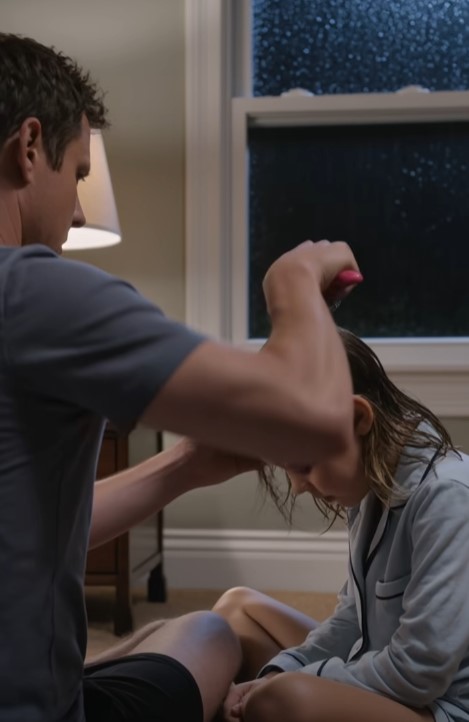
After her bath, Lily sat on a stool while David brushed her long blonde hair.
It was a simple ritual.
Comforting.
Familiar.
One of the few things in life that never seemed to change.
David worked gently through a tangle near the back of her head.
Then his fingers stopped.
Something felt unusual.
At first, he assumed it was another knot.
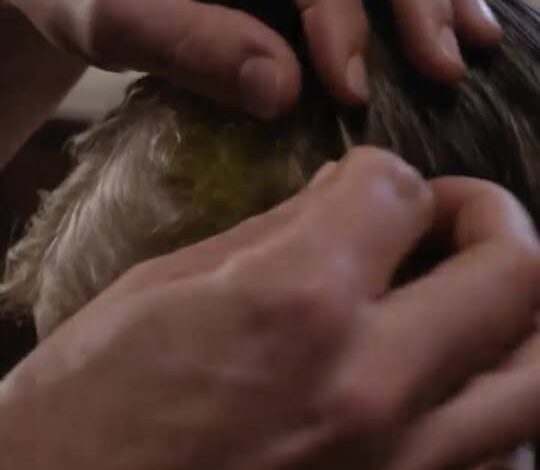
Curious, he parted a section of hair and looked closer.
His heart skipped.
A bruise.
Not near her eye.
Near the back of her head.
David stared at it.
The coloring suggested it wasn’t fresh.
Carefully, he separated more strands.
Then he found another.
And another.
His pulse quickened.
Some bruises appeared older, fading into yellow and green.
Others looked more recent.
Together, they formed a pattern that immediately alarmed him.
These didn’t look like injuries from a single fall.
The realization sent a chill through him.
Trying to remain calm, he set the brush down.
“Lily,” he said softly, “can you tell me about these bruises?”
The room became very quiet.
Her shoulders stiffened.
She stared at the floor.
David immediately regretted the fear he saw enter her eyes.
He knelt beside her.
“Sweetheart, you’re safe. You can tell me anything.”
For several seconds, she remained silent.
Then tears appeared.
Small at first.
Then uncontrollable.
The sight shattered him.
Eventually, through trembling breaths, Lily whispered the truth.
Someone had told her not to talk.
Someone had warned her that if she told anyone what happened, terrible things would follow.
She believed speaking up could get people in trouble.
She believed it might even separate her from her father.
The fear she carried was far bigger than any seven-year-old should ever have to bear.
David wrapped his arms around her.
In that moment, he realized this was never about a playground accident.
The next morning, he scheduled an appointment with a pediatrician.
The doctor conducted a thorough examination and carefully documented the injuries.
While avoiding assumptions, the physician agreed that the pattern of bruising warranted closer attention.
As David reflected on recent weeks, troubling details began resurfacing.
The headaches Lily had complained about.
The sudden reluctance to go to school.
The quietness he had dismissed as a passing phase.
Viewed individually, none of those signs seemed alarming.
Together, they painted a different picture.
Determined to find answers, David arranged a meeting with school administrators.
He approached the discussion respectfully but firmly.
Questions were asked.
Records were reviewed.
Timelines were examined.
The school launched a more detailed investigation to ensure every aspect of the incident had been properly handled.
The process was slow.
At times, frustratingly slow.
But David understood that facts required patience.
Meanwhile, Lily began meeting with supportive professionals who encouraged her to express her feelings openly.
At first, she struggled.
The fear she’d carried didn’t disappear overnight.
Some days she seemed like herself again.
Other days, anxiety returned unexpectedly.
Recovery wasn’t a straight line.
But progress came.
Little by little.
Week by week.
David remained beside her through every step.
He listened.
He reassured.
He showed up.
Most importantly, he made sure she knew she would never have to carry fear alone again.
Gradually, her laughter returned.
The bright spark that defined her personality began shining through once more.
She spent time with friends.
Participated in activities she loved.
Started looking forward instead of over her shoulder.
Watching that transformation felt like witnessing sunlight after a long storm.
The experience changed David too.
He learned that parenting isn’t only about protecting children from visible dangers.
Sometimes the greatest responsibility is noticing the things they don’t know how to say.
The silence.
The hesitation.
The subtle changes hidden beneath ordinary routines.
Years later, one ritual remained unchanged.
Every evening, David still brushed Lily’s hair before bed.
What had once been a simple habit now carried deeper meaning.
It reminded him of trust.
Of attention.
Of the night everything changed.
Most of all, it reminded him that courage doesn’t always look dramatic.
Sometimes courage is a frightened child finding the strength to speak.
Sometimes it’s a parent refusing to ignore the feeling that something isn’t right.
And sometimes it’s the quiet bond between a father and daughter that survives difficult moments and emerges even stronger.
Looking back, David realized their story wasn’t defined by fear.
It wasn’t defined by bruises, uncertainty, or difficult conversations.
It was defined by resilience.
By trust.
By the determination to face uncomfortable truths together.
Whenever he sees Lily smile now, he feels grateful—not because life became perfect, but because they learned something invaluable.
No matter how hidden a problem may seem, no matter how frightened someone feels, truth has a way of finding its voice.