When the phone rang at the Heart of the Forest animal rescue center that morning, nobody expected the call to become one of the most unforgettable cases they had ever handled.
The voice on the other end sounded concerned.
“We found a baby animal,” the caller explained. “But we have no idea what it is.”
For wildlife rescuers, unusual animals weren’t uncommon. Over the years, they had cared for injured foxes, abandoned squirrels, orphaned birds, and countless domestic pets. Yet when the tiny creature finally arrived at the center, even the most experienced staff members found themselves staring in confusion.
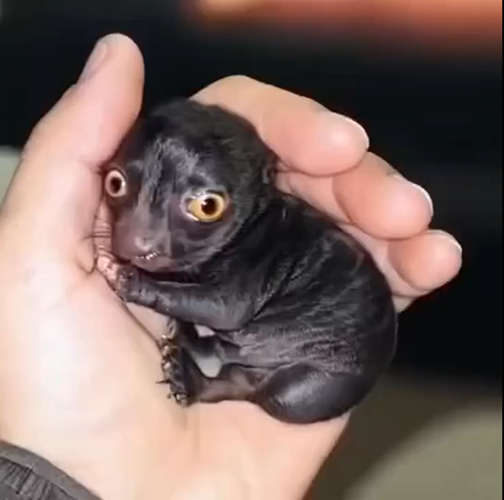
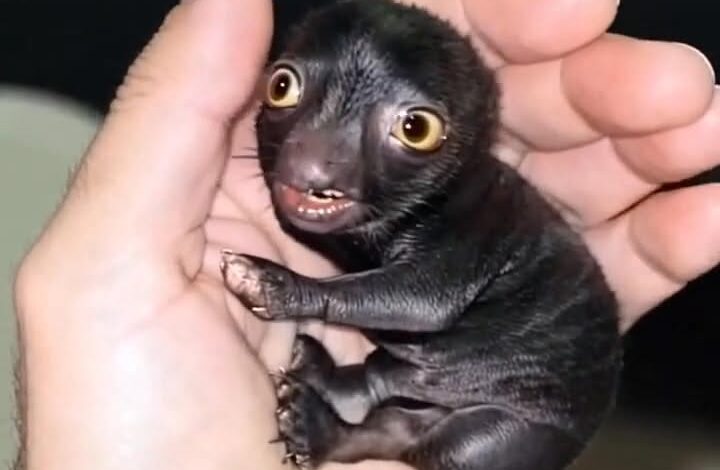
The animal was impossibly small.
It fit comfortably in the palm of a hand.
Covered in short black fur, its body trembled weakly as it struggled to move. Its eyes remained tightly shut, and its tiny limbs seemed fragile enough to break under the slightest pressure.
Nobody could immediately identify it.
One rescuer thought it resembled a newborn kitten.
Another suggested it might be some type of rodent.
A third admitted she had absolutely no idea.
The uncertainty created a sense of urgency.
Proper care depended on knowing exactly what species they were dealing with.
Without that information, every decision—from feeding schedules to temperature requirements—became more complicated.
The little animal was clearly fighting for survival.
And time mattered.
The team quickly prepared a warm enclosure, carefully wrapping the infant in soft bedding while conducting a preliminary examination.
Tiny scratches marked parts of its body.
Nothing life-threatening.
But concerning enough to suggest it had already endured a difficult beginning.
As rescuers worked, they couldn’t shake their curiosity.
What exactly was this creature?
Photos were taken and shared online.
Within hours, social media exploded with speculation.
Thousands of people began offering theories.
“A kitten.”
“A squirrel.”
“A baby raccoon.”
“A tiny bear.”
Some joked that it looked like a living teddy bear brought to life.
Others were convinced it belonged to a species nobody had identified yet.
The mystery captured people’s imaginations.
Every update attracted more attention.
Everyone wanted answers.
Meanwhile, the rescue team focused on what mattered most: keeping the tiny animal alive.
Its breathing remained steady.
Its body temperature improved.
But the question of identity still lingered.
The staff examined every detail.
The shape of the ears.
The structure of the paws.
The development of the fur.
Slowly, a clearer picture began to emerge.
Then came the breakthrough.
The answer surprised everyone.
The mysterious creature wasn’t a wild animal at all.
It was a domestic rabbit.
And not just any rabbit.
A newborn domestic rabbit estimated to be only three or four days old.
The revelation stunned many followers online.
Most people had never seen a rabbit at such an early stage of life.
Unlike the fluffy rabbits people commonly imagine, newborn domestic rabbits look almost unrecognizable.
Tiny.
Fragile.
Completely dependent on their mothers.
The discovery solved the mystery, but it introduced an even bigger question.
How had such a young domestic rabbit ended up alone in the wilderness?
The rescuers knew one thing immediately.
If the baby had remained outside much longer, she likely wouldn’t have survived.
At only a few days old, she needed constant warmth, specialized nutrition, and round-the-clock care.
Domestic rabbits aren’t equipped to survive independently.
Without human intervention, her chances were slim.
Yet the most astonishing part of the story hadn’t even been revealed yet.
The rabbit hadn’t been brought to safety by a person.
She had been rescued by a dog.
When staff learned the details, they could hardly believe it.
According to reports, the dog had discovered the tiny rabbit while outside.
The helpless newborn could have easily been mistaken for prey.
Instead, something remarkable happened.
The dog gently picked her up.
Carefully carried her.
And brought her directly to humans.
Alive.
Unharmed.
Safe.
The rescue workers were stunned.
Years of experience had taught them that nature could be unpredictable, but this act of apparent compassion touched everyone who heard it.
The dog hadn’t acted out of training.
There was no reward involved.
No command.
Only instinct.
Yet somehow, that instinct resulted in a life being saved.
The story spread rapidly online.
Animal lovers around the world were moved by the unexpected act of kindness.
Many commented that the dog seemed to recognize the rabbit’s vulnerability.
Others saw it as proof that compassion exists in forms humans don’t always understand.
Whatever the explanation, one fact remained undeniable.
Without the dog’s intervention, the rabbit might never have been found.
As the rabbit settled into recovery, rescuers began educating the public about an important misconception.
Many people assume all baby rabbits look alike.
They don’t.
Wild rabbits and domestic rabbits are dramatically different during infancy.
Wild baby rabbits are typically born with fur, open eyes, and stronger mobility. Their mothers often leave them hidden for extended periods while searching for food, which frequently causes people to mistakenly believe they’ve been abandoned.
Domestic rabbits, however, are far more vulnerable.
Blind.
Fragile.
Dependent.
Removing a healthy wild rabbit from nature can sometimes do more harm than good.
Ignoring a truly abandoned domestic rabbit can be fatal.
Recognizing the opportunity to educate, the rescue center shared comparison photos and detailed explanations.
The response was overwhelming.
Thousands of people learned how to distinguish between the two.
What began as a rescue mission evolved into a valuable lesson about wildlife awareness and responsible intervention.
Meanwhile, the tiny rabbit continued to fight.
Every feeding mattered.
Every ounce of weight gained felt like a victory.
The staff monitored her constantly, celebrating each small milestone.
Her strength gradually returned.
Her movements became more confident.
The frightened newborn that had arrived on death’s doorstep slowly began transforming into a healthy young rabbit.
Followers eagerly awaited every update.
People who had never met the animal found themselves emotionally invested in her journey.
Perhaps it was because she represented something larger than herself.
She was proof that survival often depends on countless small acts of kindness.
The dog who stopped.
The people who sought help.
The rescuers who provided expert care.
Every link in the chain mattered.
Without any one of them, the outcome could have been very different.
As weeks passed, the rabbit’s recovery became a symbol of resilience.
Her story reminded people that even the smallest lives deserve protection.
That compassion can appear from the most unexpected sources.
And that paying attention can make all the difference.
For the rescue staff, the case left a lasting impression.
Not because the animal was rare.
Not because the mystery attracted attention.
But because it demonstrated how interconnected life truly is.
A vulnerable newborn.
A compassionate dog.
Dedicated rescuers.
A concerned community.
Together, they created a story that inspired thousands.
Today, the tiny rabbit continues her journey toward a healthy future.
The mystery surrounding her abandonment may never be solved.
But her survival tells a far more important story.
A story about empathy.
About responsibility.
About the quiet moments when someone—or something—chooses to help instead of walk away.
What began as a confusing discovery in the wilderness became a powerful reminder that kindness can arrive in unexpected forms.
Sometimes it comes from trained professionals.
Sometimes from strangers.
And sometimes, as this little rabbit proved, it comes from a dog who simply refused to leave a helpless creature behind.
Because in a world filled with uncertainty, even the smallest act of compassion can change a life forever.