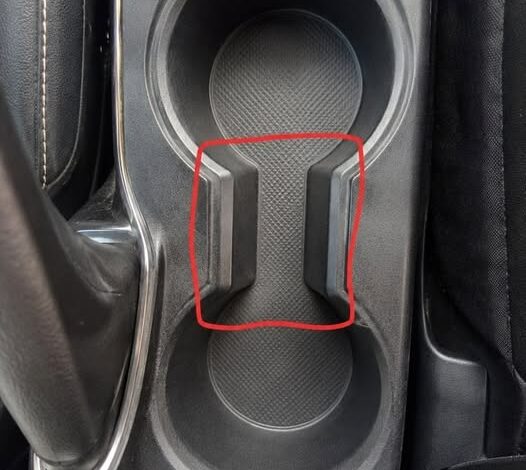
Most drivers assume that narrow slot tucked between their car’s cup holders is just leftover plastic from the molding process — an awkward little gap too small to matter and too ordinary to question. For years, people have tossed coins into it accidentally, fished french fries out of it at stoplights, or ignored it entirely without realizing it was intentionally designed to solve one of the most common frustrations of everyday driving.
Because anyone who has ever placed a grocery bag on a passenger seat knows the problem immediately.
You take one turn too sharply and oranges roll across the floor.
Soup containers tip sideways.
Takeout spills into the footwell.
A purse slides beneath the seat during braking.
Egg cartons shift dangerously every time traffic slows.
Most people simply accept this chaos as part of driving.
Car designers apparently decided they didn’t have to.
That narrow divider between the cup holders was engineered specifically to hold lightweight bag handles upright and secure. Slip the handles of a grocery bag, takeout order, or small shopping sack into the slot, and suddenly the entire setup stabilizes itself. The weight of the bag hangs naturally downward while the divider keeps the handles separated and suspended, preventing the contents from toppling during turns or sudden stops.
It’s such a simple idea that many people overlook it even after learning what it does.
No buttons.
No electronics.
No flashy branding.
Just molded plastic solving a tiny daily inconvenience quietly and efficiently.
And once someone points it out, you start noticing the feature everywhere.
Older Hondas.
Toyota sedans.
Family SUVs.
Compact commuter cars.
Different manufacturers have implemented variations of it for years, often without advertising the feature at all. That silence is partly why discovering it feels strangely satisfying — like uncovering a hidden detail built into ordinary life that was patiently waiting for someone to finally understand its purpose.
There’s something almost charming about that kind of design philosophy now because modern products usually announce every feature aggressively. Cars arrive loaded with marketing language about connectivity, luxury packages, adaptive systems, and touchscreen interfaces large enough to resemble televisions. Commercials proudly explain every technological upgrade as though consumers need constant reminders that innovation exists.
Meanwhile, one of the genuinely useful features in many vehicles sits unnoticed beside people’s coffee cups for years without explanation.
No salesman demonstrates it dramatically during a dealership tour.
No glossy brochure highlights “advanced grocery bag stabilization technology.”
No influencer makes emotional videos about it.
It simply works quietly in the background.
And maybe that is why people love discovering it so much once they learn the truth.
Because hidden practicality feels oddly human.
The slot represents a kind of thoughtful engineering most people rarely notice anymore — the small conveniences created by designers who clearly spent time thinking about ordinary frustrations:
bags tipping over,
drinks spilling,
belongings sliding around every time someone brakes too hard.
Instead of accepting those annoyances as inevitable, someone solved them with a tiny piece of molded plastic.
No spectacle required.
In many ways, it’s the perfect example of invisible design: solutions so seamlessly integrated into daily life that people stop noticing they were designed intentionally at all. The best engineering often works exactly that way. It doesn’t demand attention. It quietly improves routines without interrupting them.
And once you know what the slot is for, it changes the way you see your car slightly.
Suddenly, the interior feels less random.
More considered.
You begin noticing how many tiny decisions surround you every time you drive:
the angle of armrests,
the curve of door handles,
the textured surfaces designed for grip,
the placement of storage compartments.
Most people never think about how much invisible problem-solving lives inside ordinary objects.
But someone did.
Someone tested grocery bags.
Someone noticed they tipped over constantly.
Someone asked how to stop it.
And eventually, somewhere in a design meeting nobody remembers now, that little divider was born.
Not revolutionary.
Not glamorous.
Just useful.
And perhaps there’s something unexpectedly comforting about that.
In a world increasingly obsessed with loud innovation and constant upgrades, small thoughtful details still matter deeply. Sometimes the most satisfying inventions are not the ones transforming civilization, but the ones quietly making ordinary life slightly less frustrating every single day.
A stable bag of groceries.
Fries that stay upright.
Eggs arriving home unbroken.
Tiny victories.
So the next time you slide your coffee into the cup holder and notice that narrow plastic slot beside it, you may never look at it the same way again.
Because it was never empty space.
Never a design accident.
It was a solution hidden in plain sight —
patiently waiting for someone to realize it had been helping them all along.