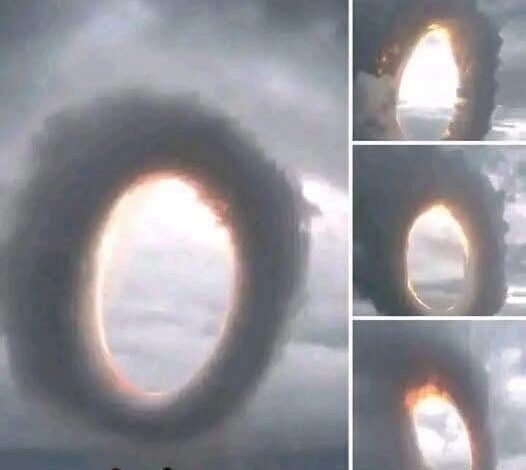
At first glance, it can look like the sky has opened.
A smooth, almost perfectly circular gap appears in a blanket of clouds, its edges sharply defined against the gray. Sunlight pours through the opening in a bright column, illuminating the ground below like a spotlight from another world. Sometimes wisps of ice trail from the center, making the formation look even stranger—less like weather and more like a doorway, a tear in the atmosphere, or evidence of something hidden above the clouds.
It is easy to understand why people stop, stare, and reach for their phones.
The sight is rare enough to feel impossible.
But the explanation is not supernatural.
What people are most likely seeing is a fallstreak hole, also known as a hole-punch cloud or cavum cloud. It is an unusual but well-documented atmospheric phenomenon created by a sudden change inside a layer of supercooled cloud droplets.
The process begins in mid-level clouds, especially altocumulus or cirrocumulus clouds. These clouds often contain countless tiny droplets of liquid water suspended in the air.
That may sound ordinary, but there is something surprising about those droplets: they can remain liquid even when the surrounding temperature is below freezing.
Water does not always turn into ice the moment the temperature drops beneath zero degrees Celsius. To freeze, the droplets usually need something to begin the process—a tiny particle, an ice crystal, or another suitable surface around which their molecules can organize.
Without that trigger, they can stay liquid at temperatures far below the normal freezing point.
This unstable condition is known as supercooling.
The droplets appear calm, but they are balanced on the edge of a transformation. A small disturbance can cause part of the cloud to freeze almost instantly.
Once that happens, the cloud begins changing in a dramatic and highly visible way.
Ice crystals form inside the supercooled layer. Because the air is no longer able to support the surrounding liquid droplets and the newly created ice in the same way, water vapor begins moving toward the ice crystals.
The ice grows.
The nearby droplets shrink and evaporate.
As more liquid water disappears, an empty space opens in the cloud.
That space expands outward, sometimes forming a clean circle and sometimes stretching into a long oval. The remaining ice crystals may fall from the center in delicate streaks, creating a feathery trail known as a fallstreak.
From below, the result can look astonishingly precise.
A solid cloud deck may suddenly contain one enormous opening, as if someone had cut through it with a giant instrument. The hole can continue widening for several minutes—or even longer—while the cloud around it appears almost untouched.
Sunlight may shine directly through the opening, making the contrast even more dramatic.
This combination of shape, light, and rarity is what fuels so many extraordinary interpretations.
People have described fallstreak holes as portals, gateways, signs, secret experiments, spacecraft disturbances, and evidence of forces that cannot be explained.
In reality, aircraft are often the force that begins the process.
When an airplane passes through a cloud containing supercooled droplets, the air around its wings and propellers changes rapidly. Pressure can drop sharply as air moves over the aircraft’s surfaces.
When pressure falls, temperature can fall with it.
For a brief moment, the air may become cold enough to push already supercooled droplets past the point where they can remain liquid.
They freeze.
That initial freezing creates the ice crystals needed to start the chain reaction.
In aircraft with propellers, the effect can be especially strong because the propeller blades repeatedly disturb and expand the air. Jet aircraft can also trigger the same process as air rushes around the wings.
The airplane does not need to leave a dramatic visible trail. In many cases, the aircraft is gone before anyone below notices that the cloud has begun to open.
Minutes later, people look up and see a huge circular gap.
Because the trigger is no longer visible, the finished formation seems to have appeared from nowhere.
That delay adds to the mystery.
A person standing beneath the cloud may see no airplane, hear no engine, and notice no obvious cause. All they see is an unnaturally smooth opening spreading across the sky.
But the shape is not evidence of intelligent design.
It is the natural result of how the freezing process spreads through a relatively even cloud layer. The initial disturbance affects a concentrated area, and the surrounding droplets begin evaporating around the growing ice crystals.
The gap expands from that point.
Wind, cloud thickness, moisture, temperature, and the aircraft’s path all influence the final appearance. Some holes remain nearly circular. Others become stretched, irregular, or elongated.
The falling ice crystals may resemble a thin veil, a tail, or a funnel suspended beneath the opening.
No two formations are exactly alike.
Fallstreak holes are not dangerous portals, nor do they indicate that the atmosphere has been physically torn apart. They are also not clouds being “removed” by mysterious technology.
They are examples of the Bergeron process, an important atmospheric mechanism in which ice crystals grow at the expense of nearby supercooled water droplets.
This same basic process plays a role in the formation of precipitation.
What makes a fallstreak hole remarkable is not that the physics is unknown, but that those familiar physical processes briefly become visible on a huge and beautiful scale.
Most changes inside clouds happen gradually or remain hidden from anyone watching below. In a fallstreak hole, the transformation creates a sharp, unmistakable pattern that can stretch across a large part of the sky.
The atmosphere, usually seen as a soft and shapeless background, suddenly reveals its structure.
A slight change in pressure creates a drop in temperature.
A few droplets freeze.
Ice crystals begin to grow.
Liquid water evaporates.
A hole opens.
Light pours through.
Each step follows established physical rules, yet the final result looks like something imagined for a science-fiction film.
That is perhaps the most fascinating part of the phenomenon.
Nature does not need to break its laws to create something that appears impossible.
The laws themselves are capable of producing scenes so strange, precise, and beautiful that people instinctively search for a more dramatic explanation.
A fallstreak hole reminds us that the atmosphere is never truly still. Even a quiet layer of clouds contains water balanced between liquid and ice, currents shifting at different speeds, invisible changes in pressure, and temperatures capable of transforming the sky within minutes.
What appears to be an ordinary gray cloud may be waiting for one small disturbance.
An aircraft passes through.
The balance breaks.
And suddenly, high above the ground, the sky seems to open.
There is no hidden portal on the other side.
No secret force has punched through the clouds.
What remains is something equally extraordinary: a perfectly natural chain reaction, unfolding in plain sight and turning a subtle interaction between water, ice, air, and motion into one of the atmosphere’s most unforgettable spectacles.