Inside the diaper bag were two tiny bottles, folded burp cloths washed so many times they had gone soft at the edges, a half-used packet of wipes, three newborn diapers, and a pink blanket delicate enough to hurt me emotionally if I stared at it too long.
The blanket was the first thing that undid me.
Not the pregnancy.
Not the confession.
Not even the sight of my eighteen-year-old son holding a baby against his chest while trying to explain how terrified he was.
It was the blanket.
Because only someone who intended to stay buys a blanket that soft.
People preparing to disappear rarely concern themselves with comfort.
I sat at the kitchen table holding that tiny folded square of fabric while my entire life seemed to split open behind my ribs all over again.
For eighteen years, survival had been my primary language.
Not happiness.
Not stability.
Not ease.
Survival.
I had Adrian when I was seventeen years old, still technically young enough to need permission slips for school field trips and old enough for people to suddenly decide every mistake I made revealed my entire moral character forever.
His father, Caleb, did not leave dramatically.
Looking back, I almost wish he had.
A screaming fight might have given me something solid to hate.
A slammed door might have sounded like closure.
But abandonment rarely arrives with cinematic honesty.
Most of the time it arrives quietly enough that denial survives for several days afterward.
One morning I woke up at his cousin’s apartment and noticed his side of the closet hanging strangely empty. At first I thought he’d gone to work early. Then I saw the missing duffel bag. The missing shoes. The missing phone charger.
His number went straight to voicemail by noon.
By evening I understood.
No note.
No explanation.
No apology.
Just absence.
And absence, I would eventually learn, echoes louder than almost any cruelty spoken out loud.
My own mother had already been dead for two years by then. Cancer took her slowly enough that I spent my final months of high school learning medication schedules instead of algebra. After she died, my father hardened into someone emotionally unreachable, a man who treated disappointment like contamination.
He let me stay in his house during pregnancy mostly because public appearances mattered to him more than tenderness did.
But six weeks after Adrian was born, he stood in the kitchen doorway watching me warm formula and said:
“You made an adult choice. Adult choices have consequences.”
Then he handed me first month’s rent for a one-bedroom apartment above a laundromat and considered his responsibility complete.
The apartment smelled permanently like detergent and steam. Industrial washers rattled the floorboards hard enough that dishes trembled in cabinets during spin cycles. At night I used rolled towels beneath the crib legs because otherwise the vibration woke Adrian every forty minutes.
That became motherhood for me:
small adjustments made quietly to survive conditions nobody else noticed.
I learned quickly.
How to calculate grocery totals mentally before reaching registers.
How to stretch formula.
How to smile through humiliation when customers at the diner asked whether Adrian’s father was “still around.”
How to sleep in fragments.
How to cry silently.
Most importantly, I learned movement.
Constant movement.
Because stopping felt dangerous.
If I stopped moving long enough to fully absorb what my life had become at seventeen, I feared grief itself might swallow me whole.
So I worked.
Diner shifts.
Clinic reception.
Weekend cleaning jobs.
I carried exhaustion like a second skeleton beneath my skin.
And Adrian grew up inside the spaces between that exhaustion.
People used to compliment him for being “easy.”
Such a quiet child.
Such a mature little boy.
He never asks for anything.
I smiled every time because correcting them required admitting something unbearable:
children become easy when they learn too early that need has a cost.
Adrian noticed everything.
Children raised by struggling parents always do.
He noticed when I skipped dinner pretending I had eaten earlier.
Noticed when overdue bills made me quieter.
Noticed when my smile became effort instead of instinct.
Once, when he was four, I came home after a twelve-hour diner shift and sat on the couch still wearing grease-stained shoes because my legs physically hurt too badly to stand again immediately.
Adrian climbed into my lap carefully and touched the dark circles beneath my eyes.
“Mommy tired?” he whispered.
“A little.”
He leaned his forehead against mine.
“I be quiet.”
That sentence destroyed me more completely than abandonment ever had.
Because it meant my child already believed his existence required compensation.
Four years old and trying to reduce himself so I could survive more comfortably.
That night, after he fell asleep, I sat on the bathroom floor and cried hard enough to make myself nauseous because I realized poverty does not merely steal comfort.
It teaches children to apologize for existing.
After that, I became almost obsessive about protecting Adrian from shame.
Not reality.
Shame.
There’s a difference.
Reality meant we could not afford certain things.
Shame meant believing that made us lesser.
So I clapped louder than anyone during school plays even when he only played “Tree Number Three.”
I saved one dollar at a time for field trips.
I took him to the library every Saturday because books were free and possibility should never become a luxury item.
I attended every parent-teacher conference smelling faintly like fryer oil and industrial cleaner from work.
And Adrian watched all of it.
That was the frightening thing about raising observant children:
love does not hide struggle from them nearly as well as parents hope.
By high school, he had become the kind of boy teachers describe carefully because they fear underestimating him publicly.
Quiet.
Brilliant.
Disciplined.
He inherited Caleb’s dark eyes but none of his slipperiness.
Where Caleb drifted through life charming people into lowered expectations, Adrian moved through it carrying responsibility like something sacred.
He fixed broken cabinet hinges without being asked.
Worked weekend grocery shifts.
Spent money cautiously.
And for the first time in my life, the future stopped looking like pure survival.
When Oregon State offered him an engineering scholarship, I cried alone in my car afterward because the acceptance letter felt like proof that all those years of exhaustion had become something tangible.
A door.
An actual door opening.
Then he changed.
Not dramatically at first.
Small things.
Phone face down instead of face up.
Late-night laundry.
New nervousness around silence.
I found a pharmacy receipt in his jeans pocket one afternoon:
prenatal vitamins,
ginger candies,
digital thermometer.
When I asked about it, he claimed it belonged to a coworker.
His voice sounded too careful.
People think lying sounds confident.
It rarely does.
Real lies often sound fragile because good people are trying desperately not to hurt someone while still hiding truth.
Still…
I wanted to believe him.
Because mothers become foolish in specific ways where their children are concerned.
Part of me sensed disaster already approaching. Another part desperately wanted one more month believing his future remained untouched by the kind of hardship that shaped mine.
But hardship has a way of recognizing itself across generations.
Three nights before graduation, he stood in the kitchen doorway twisting loose threads from his sleeve while I reheated boxed macaroni after a clinic shift.
“Mom,” he said softly, “I need you to hear all of it before you decide how disappointed you are.”
The sentence chilled me instantly.
Not because I thought he committed some terrible crime.
Because only deeply frightened people prepare themselves for disappointment before speaking.
He sat at the kitchen table where his entire childhood still seemed to exist simultaneously:
science fair projects,
scholarship essays,
math homework,
birthday cakes,
late-night conversations.
Then he told me about Hannah Brooks.
About the pregnancy.
The hidden appointments.
The baby born twelve days earlier during a thunderstorm.
And finally:
“Her name is Lily.”
My chest tightened painfully.
“Lily?”
“Lily Rose.”
Then quietly:
“Rose for Hannah. Lily because your middle name is Lillian.”
That was the moment my grief became love again.
Not instantly.
Not cleanly.
But enough.
Because naming his daughter after me meant something profound:
despite everything difficult about my life, my son still believed motherhood looked like devotion instead of ruin.
That realization shattered me.
For years I secretly feared Adrian viewed my life primarily as cautionary tale:
what happens when futures collapse early.
What survival costs.
Instead, he had apparently spent eighteen years learning something entirely different.
How to stay.
When he told me Caleb contacted him months earlier, rage entered me cold and immediate.
Of course he had.
Men who abandon children often reappear precisely when accomplishment makes reconnecting emotionally profitable.
The scholarship article reached him.
Suddenly fatherhood became convenient enough to revisit.
But what devastated me most was hearing the advice Caleb gave our son after learning about the baby.
“Sometimes leaving ruins fewer lives.”
Cowardice always sounds philosophical when people need permission to live with themselves.
What Caleb really meant was:
I left because staying required sacrifice I didn’t want to make.
And now he wanted Adrian to inherit that same emotional escape route.
But my son listened.
Looked at his newborn daughter.
And chose differently.
That mattered more than the scholarship suddenly shifting course.
More than deferred semesters.
More than altered plans.
Because generational cycles rarely break through grand speeches.
They break quietly when someone decides:
the pain stops here.
The next morning I visited Hannah.
She looked heartbreakingly young holding Lily on Denise’s worn couch near the Mexican bakery downstairs.
The first thing she said when she saw me was:
“I’m sorry.”
And immediately I understood exactly how deeply shame had already entered her bloodstream too.
Teen mothers always apologize first.
As though the child itself arrived as offense instead of human life.
I sat beside her carefully.
“That baby is not an apology,” I told her.
Then she cried with the kind of relief that only comes when someone finally stops treating your motherhood like evidence against your worth.
Holding Lily for the first time felt surreal.
She weighed almost nothing.
Warm and impossibly small.
Newborns always seem suspended between fragility and stubbornness somehow, like life itself still deciding how firmly to root them here.
Looking at her, I suddenly remembered something important:
fear and love can exist together without canceling each other out.
I was terrified for Adrian.
For Hannah.
For all the hardship waiting ahead.
But terror did not erase tenderness.
It deepened it.
Graduation night arrived humid and loud.
Families packed the auditorium carrying flowers, balloons, expensive cameras, expectations.
And tucked beside my feet beneath the folding chair sat Lily’s diaper bag holding that tiny pink blanket.
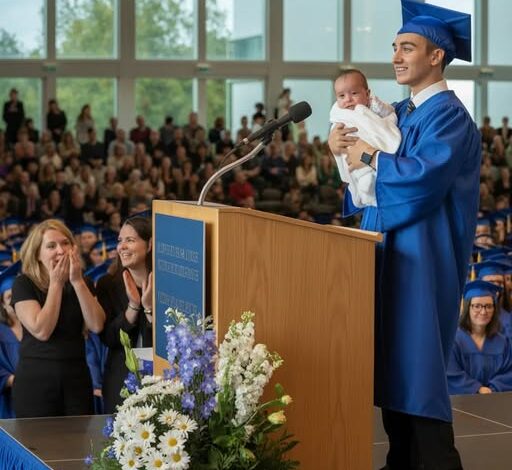
When Adrian asked me to hand him the baby before walking onstage, my hands physically shook unclipping the carrier straps.
Because suddenly I understood what he intended.
He was not hiding her.
Not from classmates.
Not from whispers.
Not from judgment.
He was carrying responsibility publicly before anyone forced him to.
Then came the laughter.
Soft at first.
Sharp afterward.
And behind me, a woman hissed:
“Just like his mother.”
For one horrifying second, I became seventeen again emotionally.
Ashamed.
Cornered.
Publicly judged.
But then my son climbed those stairs carrying Lily against his chest like she belonged there alongside every scholarship and diploma in that room.
And suddenly the meaning of those words changed completely.
Just like his mother.
Yes.
Someone who stayed.
Someone who carried difficult things without abandoning them.
Someone who kept showing up despite exhaustion, shame, and fear.
When Adrian spoke into that microphone, he did more than defend himself.
He rewrote inheritance.
Because generational legacy is not blood alone.
It is behavior repeated or rejected.
His father handed him abandonment disguised as wisdom.
He handed his daughter presence instead.
That distinction matters.
By the time applause filled the auditorium, people were crying openly.
Not because teen parenthood suddenly became easy or romantic.
But because authenticity has a strange power over crowds.
Watching an eighteen-year-old boy publicly claim responsibility without self-pity unsettled something inside everyone present. It forced them to reconsider assumptions they carried quietly about failure, dignity, and what strength actually looks like.
Afterward, when Caleb approached us near the exit trying awkwardly to insert himself back into significance, Adrian’s response carried more maturity than many grown men ever achieve.
“You don’t get to be proud of this,” he told him calmly.
That sentence mattered because it separated biology from fatherhood completely.
Fatherhood is not conception.
It is continuity.
Showing up repeatedly after difficulty arrives.
The months afterward remained hard.
That part matters too.
Real life did not transform magically after one powerful speech.
There were sleepless nights.
Financial stress.
Arguments.
Exhaustion.
But there was also something I never fully had at seventeen:
community.
Denise.
Mr. Hanley.
Eventually Hannah’s mother softening enough to admit shame made her cruel.
And through all of it, Adrian stayed.
That became the center of everything.
Not perfection.
Not polished success.
Presence.
One night months later, I found him studying calculus with Lily asleep against his chest while a bottle warmed nearby.
He looked exhausted.
“I don’t know if I can do all of it,” he admitted quietly.
I smiled sadly.
“You probably can’t all at once.”
Because adulthood eventually teaches everyone the same lesson:
strength is not doing everything flawlessly.
Strength is continuing imperfectly without disappearing.
Later, when Lily took her first wobbling steps across my apartment rug while everyone shouted encouragement around her, I looked at Adrian lifting her afterward and realized something almost unbearable in its beauty:
my son had inherited my hardship without inheriting my abandonment.
The cycle bent there.
In that living room.
In those tired young arms refusing to let go.
And years from now, Lily probably will not remember the graduation speech itself.
She will not remember whispers or applause or the way her father’s hands trembled slightly while holding her against his robe.
What she will remember instead is something quieter:
that her father stayed,
that her grandmother stayed,
that love in this family eventually stopped meaning sacrifice without support and started meaning presence without conditions.
Which is another way of saying:
the story did repeat.
But this time,
someone changed the ending.