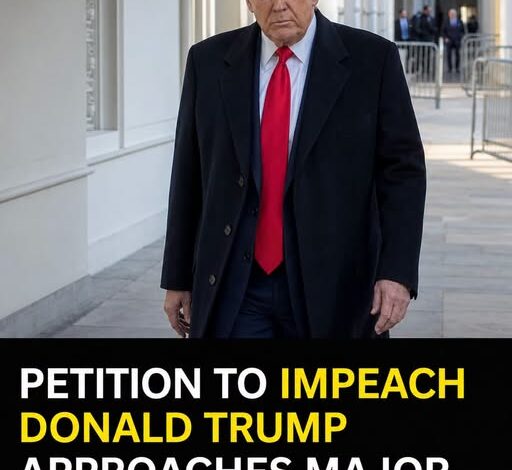
At first glance, it looks like a simple online petition—a collection of names, digital signatures, and brief statements of support. But its significance extends well beyond the legal language printed across the top of the page. Whether one views it as a meaningful call for accountability or as a symbolic political gesture, the petition has become a reflection of the emotions, disagreements, and unresolved questions that continue to surround Donald Trump’s presidency.
For many of the people who add their names, the document is not merely about a specific legal outcome. It represents a belief that the events of those years should not simply fade into history without continued public examination. Signing becomes an act of expression, a way of saying that accountability remains important even if formal political proceedings have concluded or shifted in another direction.
Others see the petition very differently.
To critics, it serves as evidence that American politics has become trapped in an endless cycle of conflict, where every election, investigation, and controversy continues long after the official process has ended. They argue that repeated campaigns centered on past political battles deepen national divisions instead of encouraging the country to focus on current challenges and future priorities.
These opposing interpretations reveal something larger than disagreement over a single political figure.
They reflect a deeper struggle over how history itself should be remembered.
Every generation eventually debates the meaning of defining political moments. The arguments are rarely limited to laws or court decisions. They also concern legacy, responsibility, public memory, and the stories future generations will inherit. The discussion surrounding Trump is no exception. His presidency continues to inspire sharply different interpretations, with supporters and critics often viewing the same events through entirely different lenses.
That is why documents like this petition attract attention even when they carry no immediate legal force.
They become symbols.
For supporters, each additional signature represents another voice insisting that important questions should remain part of the national conversation. For opponents, each signature may reinforce the belief that political disputes are being prolonged beyond their practical purpose.
Ironically, both groups are participating in the same historical process.
Each is attempting to influence how this period will ultimately be understood.
One side emphasizes accountability, democratic institutions, and the importance of preserving public scrutiny. The other emphasizes political fatigue, concerns about perpetual conflict, and the desire to move beyond years of polarization.
Neither perspective exists in isolation.
Instead, they continually shape one another through debate, commentary, elections, court proceedings, and public discussion.
The petition itself therefore functions as something more than an appeal.
It also serves as a record of public sentiment at a particular moment in time.
Long after headlines fade, historians often examine letters, petitions, speeches, newspaper editorials, and public campaigns to understand how ordinary citizens responded to controversial events. Digital petitions now occupy a similar place in the modern information landscape. They capture not only opinions but also the intensity with which those opinions are held.
Unlike traditional political movements that depended on physical meetings, printed flyers, or organized rallies, today’s campaigns can spread rapidly across digital platforms. A single shared link can travel through millions of screens within hours, allowing individuals separated by thousands of miles to participate in the same public statement.
That accessibility has transformed civic participation.
It has also transformed political disagreement.
Online spaces have become arenas where debates unfold continuously rather than only during elections, congressional hearings, or televised speeches. Public opinion is expressed not only through ballots but also through petitions, social media posts, fundraising campaigns, videos, and countless other forms of digital engagement.
As a result, political memory is increasingly shaped in real time.
Events that once settled gradually through books, documentaries, and historical analysis are now debated daily across online communities. Every new development can revive older controversies, while every shared post has the potential to introduce historical arguments to entirely new audiences.
Whether this constant discussion strengthens democratic engagement or contributes to political exhaustion remains a matter of opinion.
Reasonable people disagree.
Some believe continued public debate is essential because democracies depend on citizens remaining engaged with difficult questions. Others argue that perpetual conflict risks hardening divisions and making constructive dialogue more difficult.
The petition reflects both possibilities at once.
Its significance lies less in whether it produces direct legal consequences than in what it reveals about the political climate surrounding it. The document illustrates how strongly many Americans continue to feel about the legacy of Trump’s presidency and how differently those feelings are interpreted across the political spectrum.
That reality extends beyond any single petition.
It speaks to a broader transformation in public life, where technology has expanded opportunities for civic participation while also accelerating disagreement. Political campaigns, public advocacy, and historical interpretation increasingly unfold side by side within the same digital spaces, often reaching millions of people almost instantly.
In that environment, every signature carries symbolic meaning.
Some see it as a call for continued accountability.
Others see it as another chapter in an ongoing political conflict.
Either way, the petition becomes more than a collection of names. It evolves into a snapshot of a nation still debating one of the most consequential periods in its recent history.
Its lasting influence may not be measured by court rulings or legislative action, but by its place within the larger conversation about memory, responsibility, and democratic participation. As more people choose either to sign it or reject it, the document continues to reflect the divisions, convictions, and competing narratives that define the ongoing public debate.
In that sense, the petition functions as both a political statement and a historical artifact. It demonstrates how the internet has transformed public discourse, allowing millions of individuals to participate in conversations that once unfolded primarily in courtrooms, legislative chambers, and polling places. Today, many of those debates continue online, where history is not simply recorded after the fact but interpreted, challenged, and reshaped as events unfold—one discussion, one signature, and one click at a time.