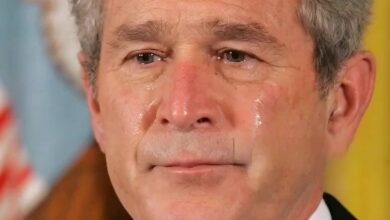
His voice cracked on the very first word.
For a man who had spent decades speaking beneath unforgiving lights—at campaign rallies, presidential debates, national addresses, and moments of crisis—the hesitation was impossible to miss.
Bill Clinton tried to continue, but for several seconds, emotion seemed to overwhelm the practiced composure that had carried him through much of his public life.
The cameras kept rolling.
No one interrupted.
And suddenly, the former president standing before the country didn’t look like a politician preparing to deliver another carefully constructed message.
He looked like a man carrying something painfully personal.
Clinton lowered his eyes briefly before continuing. When he looked up again, they appeared heavy with emotion.
He began slowly, acknowledging the uncertainty and fear that had settled over so many people. Families were searching for answers. Communities were struggling to understand what came next. Anger was spreading almost as quickly as information, while speculation threatened to drown out facts.
But then his remarks became more personal.
This wasn’t simply another national crisis he could observe from the distance afforded by former office.
It had touched someone he loved.
That admission changed the atmosphere immediately.
Clinton described the helplessness of waiting for information when there is nothing useful you can do.
The phone calls that stretch late into the night.
The moments when the phone doesn’t ring at all.
The instinct to check for another message even though nothing has changed.
The desperate search for certainty when nobody can provide it.
For anyone who had ever waited beside a hospital bed, feared for someone far away, or stared at a phone hoping for news, the emotion was painfully recognizable.
Power suddenly seemed irrelevant.
Clinton had once occupied the Oval Office.
He had commanded the attention of world leaders and spent years surrounded by advisers, security personnel, and some of the most influential people in government.
But there are moments when titles offer no protection.
There are situations that cannot be negotiated away.
There are phone calls even presidents are powerless to control.
And standing there, Clinton seemed painfully aware of that reality.
Then his message took another unexpected turn.
Rather than simply describing fear or grief, he spoke about responsibility.
He acknowledged that leaders make mistakes.
Sometimes those mistakes become obvious immediately.
Others reveal their consequences only years later, when circumstances make it impossible to avoid looking backward.
Clinton didn’t try to present leadership as a story of perfect decisions.
Instead, he spoke about regret—the decisions a person replays privately, the moments when different choices might have changed what followed, and the uncomfortable realization that good intentions do not erase consequences.
There was no triumphant attempt to rewrite history.
No insistence that everything had been handled perfectly.
His words sounded less like a defense than an admission that leadership carries responsibilities long after someone leaves office.
That honesty seemed to make the moment heavier.
Political figures are trained to project certainty.
They are expected to have answers even when answers don’t exist.
They learn to redirect uncomfortable questions, emphasize victories, minimize failures, and maintain control when cameras are present.
But grief doesn’t care about political training.
Neither does fear.
Eventually, both find their way through.
Clinton paused again.
This time, he didn’t appear embarrassed by the silence.
He allowed it to remain.
Then he urged Americans not to treat suffering as entertainment.
In an era when tragedy can become content within minutes, his warning carried particular weight.
A frightening event happens.
Videos begin circulating.
People choose sides.
Rumors spread.
Strangers become amateur investigators.
Before families have even processed what happened, millions of people may already be arguing about blame.
Clinton asked for something more difficult.
Empathy.
He urged people to remember that behind every headline are individuals whose lives do not reset when the news cycle moves on.
There are parents who still wake during the night.
Children who continue asking questions.
Families who replay final conversations.
Friends who wonder whether they missed a warning.
Communities that may carry the consequences for years.
Those experiences cannot be reduced to political ammunition.
And they cannot be repaired by outrage alone.
Clinton also turned his attention toward trust.
Americans, he suggested, should expect honesty from anyone asking for their confidence—whether that person is a politician, public official, commentator, or other influential voice.
Trust should not require pretending that leaders never make mistakes.
It should require the courage to acknowledge those mistakes when they happen.
That may have been the most uncomfortable part of his message.
Admitting failure is difficult for anyone.
For someone whose decisions have been examined by historians, journalists, opponents, and millions of citizens, it becomes even harder.
Yet Clinton appeared to argue that accountability and compassion don’t have to exist on opposite sides.
A country can demand answers while still recognizing human suffering.
People can disagree fiercely without losing empathy.
Leaders can acknowledge mistakes without surrendering their responsibility to help repair the damage.
And citizens can refuse to let every tragedy become another weapon in an endless political war.
By the time Clinton approached the end of his remarks, his voice had steadied.
The emotion hadn’t disappeared.
It had simply become something he could carry.
He wasn’t promising that everything would quickly improve.
He wasn’t offering an easy solution.
Instead, he asked people to resist the temptation to become numb.
To call someone they love.
To listen before assuming.
To question information before spreading it.
To recognize when anger is being deliberately manipulated.
And, above all, to remember that uncertainty becomes easier to survive when people refuse to face it entirely alone.
For a few seconds after he finished, there was silence.
Not the awkward silence of a speech gone wrong.
Something different.
The kind that follows when an audience realizes it has witnessed a person briefly step outside the role everyone expected him to play.
Whatever people thought of Bill Clinton politically, the moment wasn’t really about party loyalty.
It was about vulnerability.
A former president who had spent much of his life speaking with confidence had allowed people to see uncertainty instead.
A man accustomed to answering questions admitted that some questions still haunted him.
And someone who had spent decades surrounded by power acknowledged perhaps the hardest truth of all:
Power cannot protect us from every loss.
Sometimes all anyone can do is tell the truth about what hurts, admit what they wish they had done differently, and hope that others learn something before another opportunity disappears.
That was what made the moment linger after the cameras stopped rolling.
Not the politics.
Not the prepared lines.
But the sight of a man discovering, in public, that sometimes the strongest thing a person can do is stop pretending nothing hurts.