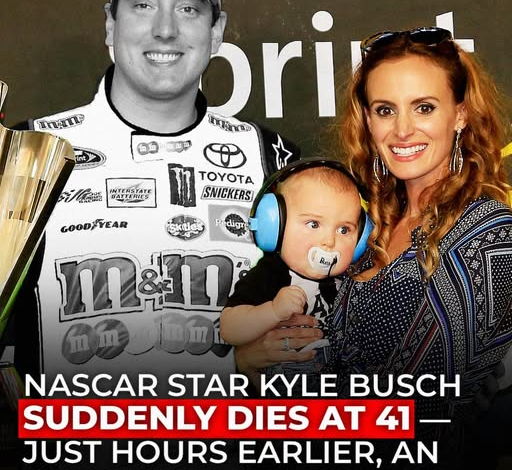
In garages, living rooms, and victory lanes frozen forever in old photographs, Kyle Busch’s absence already feels impossibly loud.
For more than two decades, NASCAR fans measured Sundays partly by his presence. Whether people loved him or loved rooting against him, Kyle carried an intensity that made every race feel sharper the moment he rolled onto the track. He was never background noise. He was confrontation, talent, frustration, brilliance, and emotion packed into one driver who refused to become ordinary simply because the sport around him sometimes demanded polish over personality.
That is why the news landed with such force.

Kyle Busch and his family | Source: Getty Images
Not only because NASCAR lost a champion, but because the racing world suddenly lost one of its defining energies.
According to NASCAR’s statement, Kyle Busch died at 41 after reports earlier that same day indicated he had been hospitalized with a severe illness. The speed of the announcement stunned fans, teams, commentators, and even longtime rivals who had spent years competing against him door-to-door at nearly 200 miles per hour.
The shock felt amplified by how alive he still seemed publicly only days earlier.
His final social media posts were not dramatic or reflective. They were deeply ordinary in the most heartbreaking way possible: birthday tributes, family photos, pride in his son Brexton, gratitude toward the life he had built beyond racing. In hindsight, those posts now read like accidental final chapters written before anyone realized the book was about to close.
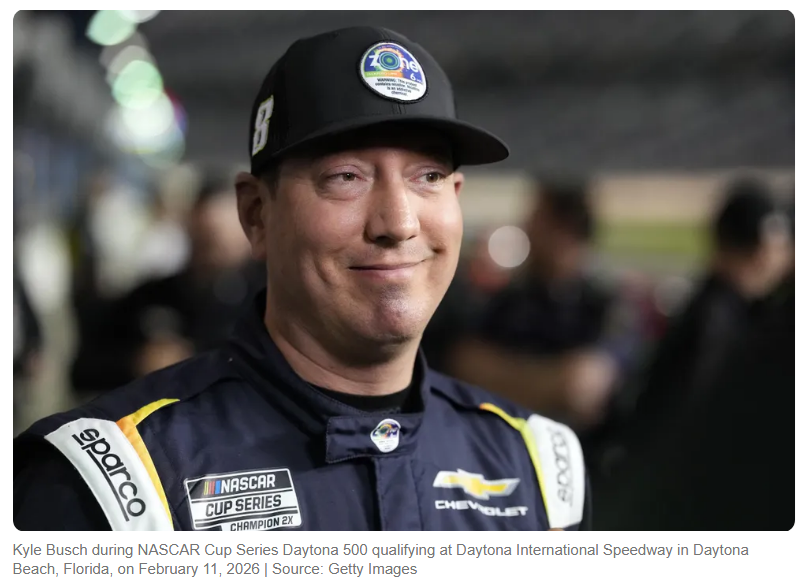
Kyle Busch during NASCAR Cup Series Daytona 500 qualifying at Daytona International Speedway in Daytona Beach, Florida, on February 11, 2026 | Source: Getty Images
That contrast hurts people most after sudden deaths.
One day someone is talking about future plans.
The next day the world speaks about them entirely in past tense.
Kyle Busch’s career itself always felt larger than statistics, though the numbers alone were staggering. Two Cup Series championships. Sixty-three victories in NASCAR’s premier division. More than one hundred wins in the Xfinity Series and dozens more in Trucks. Few drivers of his generation combined raw aggression and technical instinct so naturally. He drove like someone permanently offended by second place.
And audiences responded accordingly.
Some fans booed him for years.
Others built “Rowdy Nation” around him with near-religious loyalty.
But both groups watched.
That mattered.
Modern sports often sand athletes down into safe public versions of themselves. Kyle resisted that instinct almost completely. He argued openly. Complained openly. Celebrated openly. Failed publicly. Won loudly. He allowed fans to see emotion instead of manufacturing perfect composure, and because of that, people felt connected to him even when they disliked him.
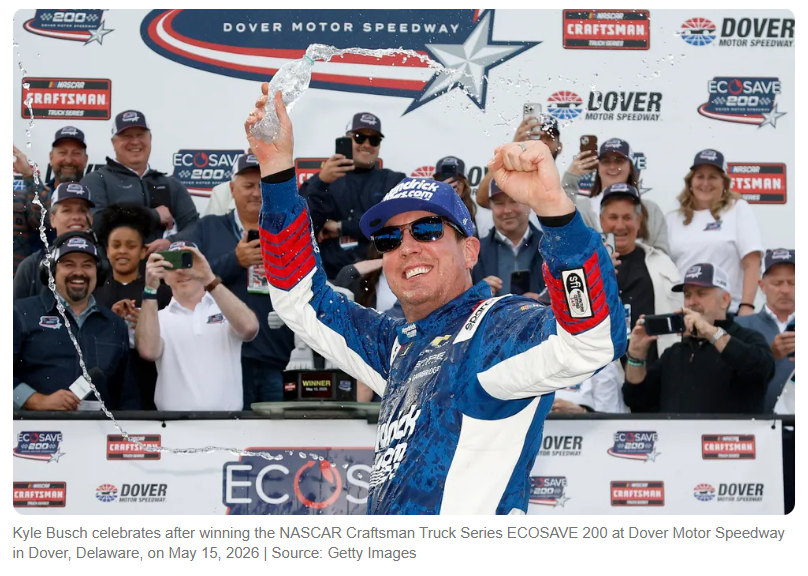
Kyle Busch celebrates after winning the NASCAR Craftsman Truck Series ECOSAVE 200 at Dover Motor Speedway in Dover, Delaware, on May 15, 2026 | Source: Getty Images
Especially then.
Sports need figures like that more than audiences sometimes admit.
Not villains exactly.
Catalysts.
People who make competition emotionally alive.
Yet behind the fire on television existed another version of Kyle Busch that those closest to him describe very differently. Samantha Busch repeatedly spoke about the private man audiences rarely saw—the husband who supported her through fertility struggles, the father whose entire demeanor softened around his children, the person she called her “rock.”
That duality fascinated people.
At the racetrack:
relentless,
combative,
intense.
At home:
present,
protective,
deeply devoted to family.
Many elite athletes contain those contradictions. The emotional machinery required to dominate professionally often exists beside remarkable tenderness privately. Competitiveness and care are not opposites. Sometimes they grow from the same place—the fierce desire to protect what matters most.
In Kyle’s case, fatherhood seemed to reshape public perception significantly over the years.
Fans watched Brexton grow up beside the sport itself, appearing in victory lane, climbing onto race cars, celebrating alongside his father after wins. Those images softened even longtime critics because they revealed something universal underneath the helmet and interviews:
a father proud of his son.
And perhaps that is why the grief surrounding his death feels unusually personal to many fans.
Not because people only mourn achievements.
They mourn continuity.
Kyle Busch represented something ongoing in NASCAR. A permanent figure audiences unconsciously expected would always remain somewhere in the garage area arguing with officials, mentoring younger drivers, chasing one more win, one more season, one more comeback.
Sudden loss interrupts that illusion violently.
Tributes from across the racing world reflected this immediately. Dale Earnhardt Jr. spoke about years of rivalry eventually turning into friendship and mutual respect. Denny Hamlin admitted publicly he struggled even to process the news. These reactions carried unusual emotional weight because racing culture often prizes toughness over vulnerability. Yet grief bypasses performance quickly.
Especially inside sports communities where competitors understand the sacrifices invisible to outsiders:
the travel,
the danger,
the pressure,
the constant physical risk normalized over decades.
NASCAR itself also seemed emotionally shaken by the loss.
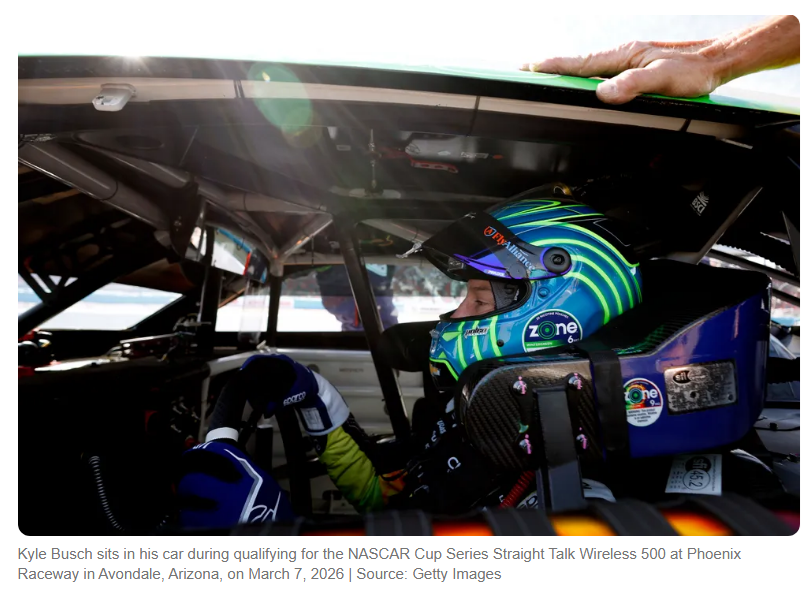
Kyle Busch sits in his car during qualifying for the NASCAR Cup Series Straight Talk Wireless 500 at Phoenix Raceway in Avondale, Arizona, on March 7, 2026 | Source: Getty Images
The organization’s statement called Kyle a “rare talent” and “a future Hall of Famer,” while also acknowledging his importance in helping younger drivers develop through team ownership and mentorship. That matters because legacies in motorsports are never measured solely by trophies. They are measured by influence.
Who changed the sport.
Who inspired future drivers.
Who altered how racing felt emotionally for audiences watching.
Kyle did all three.
At the same time, his death reopened broader conversations about fragility within motorsports generally. The NASCAR world had already been grieving other recent losses, including driver Chase Pistone, whose death earlier in the year deeply affected many within the racing community. The cumulative emotional weight of multiple tragedies in such a short span reminded fans and competitors alike how thin the line can be between spectacle and vulnerability.
Racing culture often celebrates fearlessness.
But underneath every helmet sits a human life connected to spouses, children, parents, teammates, and memories entirely separate from competition.
That truth becomes impossible to ignore after loss.
Perhaps what makes Kyle Busch’s story resonate so strongly is that his life reflected something deeply American about sports itself:
reinvention through conflict.
He was criticized constantly early in his career for attitude, aggression, immaturity, emotional volatility. Yet over time audiences watched him evolve—not into a sanitized version of himself, but into someone more layered. Still fiery. Still unapologetic. But increasingly grounded by family, leadership, and perspective earned through years inside the spotlight.
People grow publicly in sports whether they want to or not.
Fans witnessed that growth in him.
And now they are grieving not only the driver he became, but the future version they expected to continue watching.
The empty space left behind feels enormous because personalities like Kyle Busch do not emerge often. Modern media training tends to eliminate rough edges before athletes even reach superstardom. Kyle kept his. Sometimes painfully. Sometimes brilliantly.
But always authentically.
And authenticity creates emotional permanence.
Long after statistics fade, people remember feeling something when certain athletes appeared on screen.
They remember the tension before restarts.
The radio meltdowns.
The improbable recoveries.
The confidence bordering on arrogance.
The moments of vulnerability that slipped through unexpectedly after victories or heartbreak.
They remember the humanity underneath performance.
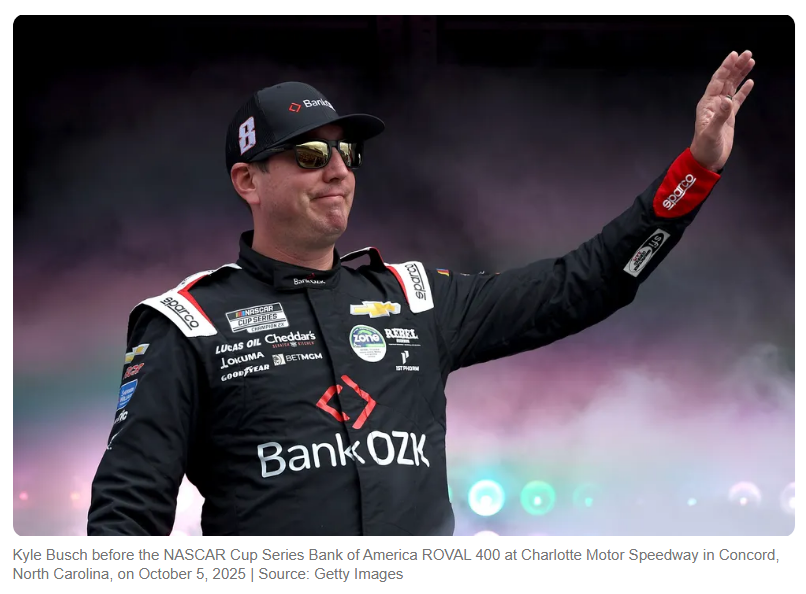
Kyle Busch before the NASCAR Cup Series Bank of America ROVAL 400 at Charlotte Motor Speedway in Concord, North Carolina, on October 5, 2025 | Source: Getty Images
That is why the garage will feel quieter now.
Why old race clips will suddenly carry different emotional weight.
Why fans who spent years booing him may discover grief catches them unexpectedly anyway.
Because even opposition creates connection over time.
In the end, Kyle Busch’s legacy will live not only in championships or record books, but in emotional memory—the sound of engines roaring while one fiercely competitive driver refused to become forgettable.
And somewhere in thousands of garages across America tonight, old race highlights will play again while fans sit quietly remembering a man who spent most of his life moving impossibly fast—
only to leave the world far too soon.