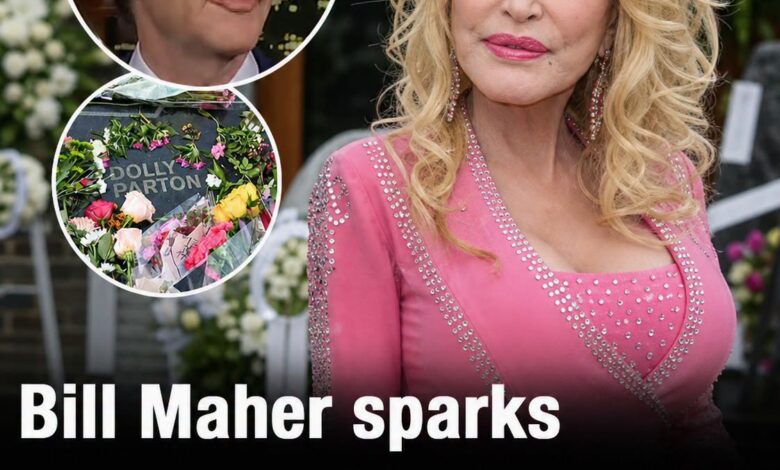
Dolly Parton had spent decades becoming something almost impossible in modern American culture:
a person nearly everyone felt allowed to love.
Her fans came from different generations, different regions, different faiths and different political worlds. Some knew every album. Others knew only “Jolene,” “9 to 5,” or “I Will Always Love You.” Millions of children knew her less as a country superstar than as the woman whose Imagination Library helped put books into their homes.
So in the days after her passing, the grief felt unusually communal.
People were not simply mourning a singer.
They were mourning a presence.
Behind the rhinestones, towering wigs and jokes about her own appearance had been a woman whose public identity was built around warmth. Dolly could make ambition seem generous rather than ruthless. She became extraordinarily wealthy and famous, yet much of her legacy revolved around what she gave away, whom she encouraged and what she built for people who might never meet her.
At the same time her family was laying her to rest, those were the stories people wanted to tell.
Not stories about charts.
Not stories about celebrity feuds.
Stories about kindness.
About the way she remembered people.
About children.
About dreams.
About a woman who had come from poverty in the Smoky Mountains and somehow never seemed embarrassed by where she started.
If anything, she turned that beginning into an invitation.
If a girl from a crowded cabin in Tennessee could dream that extravagantly, perhaps other children could dream beyond the circumstances surrounding them too.
That was the Dolly people were grieving.
Then Bill Maher made a joke.
The visual gag reportedly imagined Dolly’s nipple displayed on the Las Vegas Sphere.
In another context, involving another celebrity at another moment, the joke might have passed through the endless machinery of late-night comedy and disappeared.
Instead, it landed directly in the middle of mourning.
And people recoiled.
The backlash was quickly described in familiar language.
People were “offended.”
Fans were “outraged.”
Critics were accused of being unable to take a joke.
But those descriptions missed something.
The anger was not simply about sexual humor.
Dolly herself had spent a lifetime making jokes about her body, her breasts, her wigs, her cosmetic procedures and the exaggerated femininity she deliberately constructed.
She was not a fragile public figure who demanded solemnity whenever her name was mentioned.
She understood bawdy humor.
She used it brilliantly.
The problem was timing.
Tone.
And ownership.
There is an enormous difference between Dolly Parton making a joke about Dolly Parton’s body and someone else turning that body into a punchline while millions of people are still grieving her death.
Context changes comedy.
The same sentence can feel playful in one moment and cruel in another.
That does not mean comedians must stop making provocative jokes whenever someone famous dies. Comedy has always wandered into uncomfortable territory. Sometimes its purpose is precisely to puncture the solemnity surrounding death, power and celebrity.
But provocation alone does not make a joke meaningful.
Sometimes a joke crosses a boundary and reveals something.
Sometimes it merely crosses the boundary.
For many Dolly fans, Maher’s gag belonged to the second category.
What exactly was being challenged?
Dolly’s carefully constructed image?
She had already spent decades laughing at it herself.
America’s tendency to sanctify celebrities after death?
Perhaps—but Dolly’s affection was never based solely on pretending she was flawless.
Her fans loved that she could be glamorous without taking glamour too seriously.
They knew the hair was exaggerated.
They knew the clothes were theatrical.
They knew she had built a persona around curves, sparkle and unapologetic femininity.
The joke therefore did not feel like exposing hypocrisy.
It felt like taking one of the easiest visual features associated with a recently deceased woman and enlarging it for a laugh.
That was why some fans called it empty rather than edgy.
Edginess suggests risk in pursuit of something.
A point.
An observation.
A contradiction worth exposing.
Without that, shock can become merely noise.
And Dolly Parton’s death had already created enough noise.
Her family was dealing with something much quieter.
Absence.
There would be no new phone call.
No familiar laugh entering a room.
No private version of Dolly that the public never completely knew.
That difference between public celebrity and private grief is easy to forget when famous people die.
The audience loses an icon.
The family loses a person.
Those losses overlap, but they are not equal.
And while the public was telling stories about Dolly’s generosity, her family was carrying memories no television monologue could reach.
Perhaps that is why the joke felt especially jarring.
For once, Americans were doing something surprisingly gentle together.
They were remembering someone fondly.
In a country where almost every cultural figure eventually becomes political territory, Dolly had worked unusually hard to resist being claimed by any one side.
She had fans who disagreed about nearly everything else.
That was rare.
And valuable.
Her death briefly created a space where people could mourn without first checking whether they were mourning with the correct political tribe.
Then the joke arrived and dragged the conversation toward the oldest, easiest form of celebrity commentary:
her body.
The breasts.
The image.
The spectacle.
Everything Dolly had spent decades transcending was suddenly compressed back into one visual gag.
Fans did not need to believe Dolly was sacred to find that disappointing.
They only needed to recognize the imbalance between what she had given the culture and what the joke chose to take from her.
A songwriter.
A philanthropist.
A businesswoman.
A literacy advocate.
A woman who repeatedly encouraged children to imagine lives larger than the ones they had inherited.
Reduced, in that moment, to anatomy.
Comedy is allowed to be cruel.
It is allowed to offend.
Nobody is owed universal reverence simply because they have died.
But audiences are equally allowed to decide that a joke failed.
They can conclude that something intended as fearless looked lazy instead.
They can say, “Too soon,” without demanding censorship.
They can decide that irreverence did not reveal anything worth seeing.
That is not the death of comedy.
It is part of comedy.
The comedian gets the joke.
The audience gets its judgment.
And this time, many people judged harshly because Dolly Parton represented something increasingly scarce.
Not perfection.
Common ground.
For decades, she had somehow remained recognizable without becoming exhausting, enormously successful without appearing consumed by status, glamorous without demanding that anyone mistake glamour for seriousness.
Most importantly, she made people feel good about loving her.
That is harder than it sounds.
Celebrity often creates distance.
Dolly created familiarity.
She called people “darlin’.”
She laughed at herself before anyone else could.
She talked about poverty without shame and wealth without pretending it had appeared magically.
She made ambition sound like permission rather than competition.
So when she was gone, people protected the memory instinctively.
Maybe that explains the intensity of the reaction better than any argument about whether the joke was technically acceptable.
Fans were not defending a woman incapable of defending herself from humor.
They were defending a moment.
A brief period when grief had softened people instead of dividing them.
They wanted to talk about the books.
The songs.
The mountains.
The laughter.
The generosity.
The woman who spent a lifetime telling people that where they began did not have to determine where they ended.
Then someone offered them a giant nipple on the Las Vegas Sphere.
Of course some people laughed.
Others shrugged.
Comedy is subjective, and Dolly herself might have responded with a joke sharper than anything her defenders could invent.
But that unknowable possibility does not erase what the reaction revealed.
People wanted more for her final public memory.
Not sainthood.
Not silence.
Just proportion.
Dolly Parton had spent decades making herself larger than life while somehow making everyone around her feel larger too.
That was the trick.
The hair was enormous.
The personality was enormous.
The talent was enormous.
But the ego never seemed to be the biggest thing in the room.
So perhaps the deepest problem with the gag was not that it was offensive.
It was that it made something beloved feel unnecessarily small.
At a moment when millions were remembering Dolly for how generously she had used her life, reducing her to a body joke did not feel daring.
It felt like missing the point.
And for once, in a country that can argue about almost anything, the point was remarkably simple:
People loved her.
They were hurting.
And sometimes the boldest response to shared grief is not finding the fastest joke.
It is recognizing when something rare deserves a moment of grace.