Most of us use the microwave with all the finesse of an emergency button.
Cold leftovers go in.
The door slams.
We hit a number, press Start, and hope whatever comes out is warmer than it was without becoming rubber.
But that humming box in the corner can do far more than reheat yesterday’s dinner. Used thoughtfully—and safely—it can rescue food that seems destined for the trash, speed up tedious kitchen prep, simplify breakfast and loosen the mess coating its own walls.
The first trick is one anyone who has discovered a forgotten loaf of bread can appreciate.
Bread loses its appealing softness as it stales. Instead of immediately throwing out a hard roll or slice, try wrapping it loosely in a slightly damp paper towel and microwaving it for just a few seconds.
The combination of moisture and heat can temporarily soften the bread, making it pleasant enough to eat again.
The important word is temporarily.
This is not reversing time. Once the bread cools, it may firm up again, so revive only what you plan to eat immediately.
And don’t confuse stale with spoiled. Bread showing mold belongs in the trash, not the microwave.
Stale chips can sometimes get a second chance too.
If chips or crackers have simply absorbed moisture from the air and lost their crunch, brief microwave heating may help drive some of that moisture away. Place a small amount on a microwave-safe plate, heat cautiously in short intervals, and allow them to cool before judging the result.
The cooling matters because crispness may improve afterward.
Suddenly, the disappointing handful you were about to discard has some life again.
Food rescue is where the microwave quietly earns its keep.
A few saved rolls here and half a bag of revived snacks there may not look like much, but household food waste is often built from tiny losses.
Then there is cleaning.
One of the easiest microwave-cleaning methods requires little more than water, a microwave-safe bowl and, if you like the smell, some lemon.
Heat the water until it produces plenty of steam, then leave the door closed briefly.
That steam helps soften dried splatters and greasy residue stuck to the interior.
When you open the door, wipe everything down carefully.
The microwave has effectively helped loosen its own mess.
Just remember that heated water and steam can burn. Use a suitable container, handle it carefully, and avoid unnecessarily overheating liquids.
Sponges require even more caution.
You may have heard that microwaving a damp kitchen sponge can reduce some microorganisms. Heat can indeed kill microbes under the right conditions, but turning this into a casual “one-minute disinfection hack” oversimplifies the issue.
A sponge must be wet, contain no metal, and be suitable for microwave heating. Even then, it can become extremely hot and cause burns.
And microwaving does not transform an old, filthy sponge into something permanently sanitary.
If it smells bad, is deteriorating or has been used around risky contamination such as raw-meat juices, replacement may be the smarter option.
Wooden cutting boards deserve similar skepticism.
Rather than relying on a microwave as a universal disinfectant, clean boards appropriately for their material and follow manufacturer guidance. Large wooden boards may not be suitable for microwave heating at all, and prolonged heat can damage some materials.
The microwave is useful.
It is not a sterilization chamber.
Where it becomes genuinely clever again is food preparation.
Take garlic.
Peeling several cloves can turn into an irritating contest between fingernails and papery skin. A very brief burst of microwave heat can sometimes help loosen those skins, making the cloves easier to peel.
The key is restraint.
You’re trying to make prep easier, not cook the garlic before it reaches the pan.
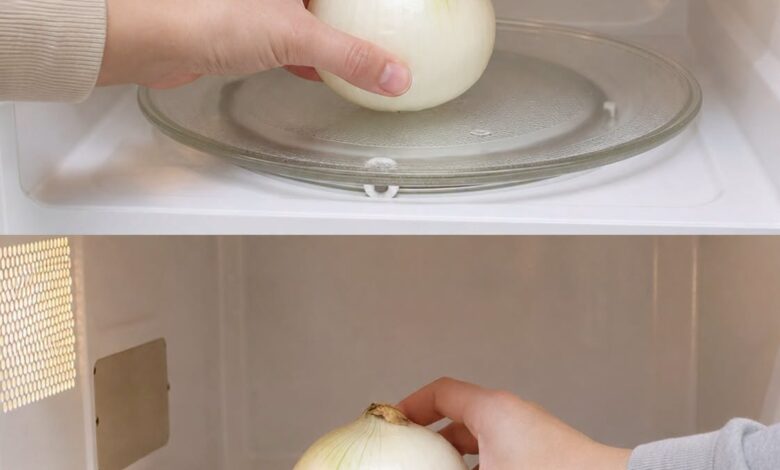
Onions come with another popular trick.
Brief heating may alter some of the compounds involved in that familiar eye-stinging reaction, but it can also begin changing the onion’s texture and flavor. If your goal is simply fewer tears, a sharp knife, ventilation and minimizing unnecessary damage to the onion can help too.
Still, the larger idea is useful:
A few seconds of controlled heat can sometimes remove minutes of frustration.
Then we arrive at breakfast.
Eggs and microwaves have a complicated reputation, largely because eggs can become rubbery when overheated—and whole eggs in their shells can be hazardous because pressure can build inside.
But scrambled eggs are a different story.
Crack eggs into a microwave-safe bowl or mug, beat them thoroughly, and cook them in short bursts, stirring between intervals.
That stirring is essential.
Microwaves do not always heat food evenly, so repeated short cooking periods give you more control than one long blast.
Stop when the eggs are cooked through but still tender.
The result can be surprisingly fluffy, and the cleanup may involve little more than a bowl, fork and mug.
That makes the technique particularly useful on mornings when pulling out a frying pan feels like an unreasonable commitment.
And that is really the secret to using a microwave well.
Stop thinking in terms of minutes.
Start thinking in intervals.
Ten seconds.
Check.
Stir.
Another ten or twenty.
Check again.
Many disappointing microwave results happen because we treat the appliance as though it has only two settings:
cold and nuclear.
Short bursts give you control.
They are especially helpful when softening, reheating or cooking foods whose texture changes quickly.
There are also basic rules no clever hack should override.
Use microwave-safe containers.
Avoid ordinary metal unless your appliance specifically permits a particular accessory.
Be careful with tightly sealed containers because pressure can build.
Stir foods when possible and allow standing time so heat can redistribute.
Be particularly cautious with liquids, which can become dangerously hot without looking dramatic.
And remember that a viral kitchen trick is not automatically a safe one simply because somebody filmed it successfully.
Some things should stay out of the microwave.
Others belong there only under specific conditions.
The goal is not to discover how many strange objects the appliance can tolerate.
It is to make ordinary kitchen work easier.
That might mean rescuing one stale roll instead of throwing it away.
It might mean loosening dried tomato sauce from the microwave walls with steam instead of scrubbing aggressively.
It might mean peeling garlic faster.
Or making scrambled eggs without creating a sink full of dishes.
None of these tricks is revolutionary by itself.
Together, however, they change the appliance’s role.
The microwave stops being the machine you use when you cannot be bothered to cook.
It becomes a tool for reducing waste, controlling heat and buying back small amounts of time.
And perhaps that is why these tricks feel so satisfying.
A kitchen does not become more efficient only through expensive gadgets.
Sometimes efficiency comes from understanding the equipment already sitting on the counter.
The same humming box that turns leftovers scorching at the edges and icy in the middle when used carelessly can become surprisingly precise when you slow down enough to work with it.
A damp towel.
A few seconds.
A stir.
A bowl of steaming water.
Tiny adjustments.
That is all.
Once you begin using the microwave intentionally rather than simply pressing Start and walking away, it becomes difficult to see it as a blunt instrument again.
It was capable of more all along.
We were just asking it to make things hot.