Thursday mornings at Jefferson High were usually forgettable.
Students hurried through crowded hallways with backpacks slung over one shoulder, teachers balanced coffee cups and stacks of papers, locker doors slammed shut in every direction, and the smell of cafeteria fries mixed with fresh floor cleaner drifted through the building. Outside, buses unloaded the last few students while cold air rushed in every time the front doors opened.
Nothing about that morning suggested it would become a day people would still remember years later.
No one expected a broken guitar to stop an entire school in its tracks.
Emma arrived at exactly 7:52 a.m., just as she always did. She walked quietly through the front entrance with a stack of books pressed against her chest and a worn acoustic guitar resting inside a faded black case. The case had seen better days. One corner was reinforced with tape after an accident on the school bus months earlier, and the zipper sometimes caught halfway if she pulled too quickly.
To anyone else, it looked like an old instrument.
To Emma, it was priceless.
She wasn’t the loudest student in school. She didn’t seek attention or compete for popularity. Teachers admired her because she was dependable, respectful, and hardworking. Other students knew her as the quiet girl who sometimes sat outside the music room during lunch, gently playing songs that seemed to soften even the noisiest hallway.
Music wasn’t just a hobby.
It was the one place where she felt completely herself.
Her music teacher, Ms. Parker, recognized that immediately.
Just before second period, Ms. Parker stopped Emma outside the classroom, holding a blue folder against her side.
“After lunch,” she said with an encouraging smile.
Emma looked down nervously at her guitar.
“Do you really think I’m ready?”
“I already know you are,” Ms. Parker replied. “Now it’s your turn to show everyone else.”
Inside that blue folder was Emma’s application for a county arts showcase—a prestigious opportunity that could open doors to scholarships, advanced music programs, and future performances. That afternoon she was scheduled to record her audition.
Neither of them realized someone else had overheard enough of the conversation to understand one thing.
The guitar mattered.
Daniel had spent months making Emma’s life miserable.
His bullying wasn’t obvious enough to attract immediate punishment. It came in small doses—a sarcastic comment while walking past her locker, a shoulder bump disguised as an accident, quiet laughter when teachers weren’t looking, or cruel jokes whispered just loudly enough for Emma to hear.
He had mastered the kind of bullying adults often missed.
His friends encouraged him without saying much. They laughed before the joke even landed, followed him through the hallways, and quietly made room whenever he decided someone deserved to become the day’s entertainment.
By lunchtime, the hallway outside the music room had become crowded with students moving between classes.
Emma carefully made her way through the noise, one hand holding her books while the other gripped her guitar case.
She almost made it.
Daniel stepped directly into her path.
“So,” he said loudly enough for nearby students to turn around, “giving another concert today?”
A few nervous laughs echoed through the hallway.
Emma kept her voice calm.
“Please let me pass.”
Daniel repeated her words in a mocking tone while his friends chuckled behind him.
She tried moving around him.
He blocked her again.
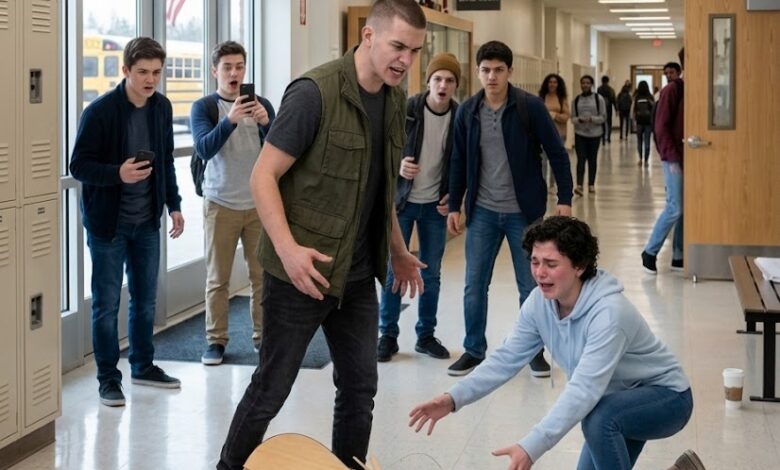
Then, before anyone fully realized what was happening, he grabbed the guitar case right out of her hand.
“Daniel,” Emma pleaded. “Please stop.”
Instead, he unzipped the case.
The sound seemed strangely loud against the growing silence.
Emma reached forward, but one of Daniel’s friends shifted just enough to prevent her from getting closer without ever touching her.
Around them, phones slowly appeared.
Students sensed something had changed.
This wasn’t harmless teasing anymore.
Daniel lifted the guitar high enough for everyone to see.
Then he smiled.
And threw it onto the tile floor.
The sound that followed wasn’t explosive.
It was worse.
A sharp crack echoed through the hallway as the neck split near the headstock. One string snapped loose with a metallic twang while the side of the wooden body burst open, exposing pale splinters beneath the polished finish.
For a moment, nobody moved.
Emma slowly dropped to her knees.
With trembling hands, she began gathering the broken pieces.
A tear rolled down her cheek.
Then another.
She never screamed.
She never yelled.
She simply tried to pick up what someone else had destroyed.
The school bell rang overhead.
Nobody walked away.
The hallway froze.
Daniel forced out a laugh that sounded far less confident than he intended.
“It’s just a stupid guitar.”
Emma stared at the broken instrument resting across her lap.
To him, it was wood and strings.
To her, it represented years of practice, comfort during difficult days, and the opportunity waiting inside Ms. Parker’s blue folder.
Then the music room door opened.
Ms. Parker stepped into the hallway.
She immediately saw Emma on the floor.
The broken guitar.
The students holding up phones.
Daniel standing over her.
Without raising her voice, she walked forward.
“Emma,” she said gently.
Emma looked up through tears.
“I’m sorry.”
Ms. Parker’s expression changed instantly.
“No,” she replied. “You have absolutely nothing to apologize for.”
Standing beside her was the assistant principal.
He looked directly at Daniel.
“Stay where you are.”
Daniel shrugged.
“It wasn’t even that serious.”
Ms. Parker calmly opened the blue folder.
Inside were several documents.
The first confirmed Emma’s scheduled audition recording that afternoon.
The second was her official recommendation for the county arts showcase.
The third listed the guitar as the instrument documented for her audition.
Finally, Ms. Parker removed one last page.
Across the top, in bold letters, were two words.
Incident Report.
The atmosphere changed immediately.
The phones students had been using no longer looked like entertainment.
They looked like evidence.
“For destroying another student’s property,” the assistant principal said, “interfering with a documented school program, and doing so in front of multiple witnesses—you’ll be coming with me.”
For the first time all day, Daniel had nothing to say.
By early afternoon, hallway security footage had been reviewed.
Student videos were collected.
Witness statements were written.
Emma’s mother arrived directly from work after receiving the school’s phone call.
When she saw the broken guitar lying across a towel inside the music room, she covered her mouth with one trembling hand.
Emma immediately whispered, “I’m sorry.”
Her mother embraced her tightly.
“No,” she said through tears. “You didn’t do this.”
Because the audition deadline couldn’t be changed, Ms. Parker unlocked a storage cabinet and carefully removed an older school guitar.
“It isn’t yours,” she admitted softly. “But today, it can carry your music.”
Emma hesitated before accepting it.
Her hands shook as she tuned the strings.
They shook a little less with every song.
That evening, Ms. Parker submitted the audition recording along with documentation explaining everything that had happened.
She wasn’t asking for sympathy.
She was documenting the truth.
One week later, an email arrived.
Emma had been accepted into the county showcase.
The news didn’t erase what had happened in the hallway.
It didn’t magically repair the guitar.
It didn’t undo the humiliation.
But it proved something Daniel had failed to understand.
Breaking someone’s instrument is far easier than breaking their future.
Months later, Emma stood onstage at the showcase holding the borrowed school guitar.
As she played, the audience fell completely silent—not because they were shocked, but because they were listening.
The applause that followed wasn’t loud for the sake of being loud.
It was warm.
Respectful.
Earned.
Eventually, Emma’s original guitar was repaired enough to hang on her bedroom wall.
The crack remained visible forever.
People sometimes asked why she kept it instead of replacing it.
She always gave the same quiet smile.
Because it wasn’t there to remind her of what had been broken.
It was there to remind her that the worst thing someone tried to do to her never became the end of her story.
Years later, many people remembered the moment Daniel smashed the guitar.
But those who had actually stood in that hallway remembered something else.
They remembered a frightened girl kneeling on cold tile.
A bully insisting it was “just a guitar.”
And one teacher opening a blue folder that forced an entire school to confront a simple truth.
It had never been just a guitar.
:::