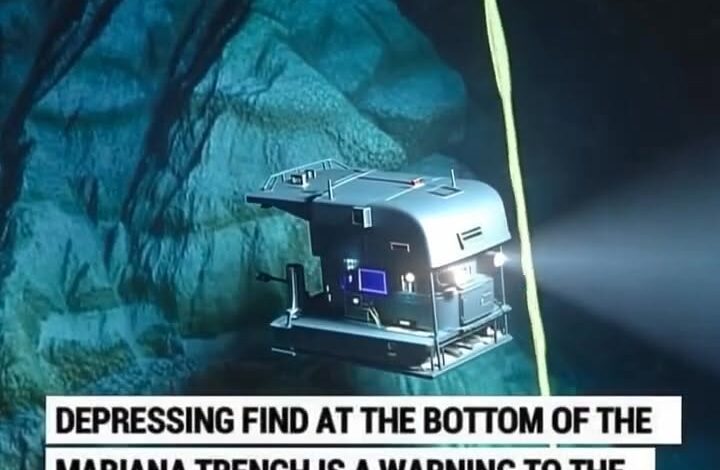
For centuries, humanity looked toward the Mariana Trench with a sense of awe.
It was the last frontier of our planet.
A place so deep, so dark, and so hostile that it seemed completely disconnected from the world above. While forests were cut down, cities expanded, and pollution spread across continents, the deepest point in Earth’s oceans appeared untouchable—a hidden realm protected by nearly seven miles of water.
Scientists believed that if any place on Earth remained beyond the reach of human influence, it would be here.
Then they found a plastic bag.
At first glance, the discovery seemed insignificant.
It wasn’t a shipwreck.
It wasn’t a new species.
It wasn’t some dramatic scientific breakthrough.
It was simply a discarded piece of plastic resting silently on the seafloor.
Yet that single object carried a message more powerful than anyone expected.
Because if a plastic bag could reach the deepest place on Earth, then nowhere was truly untouched anymore.
The discovery shattered a comforting illusion.
For years, people imagined the Mariana Trench as a world apart.
Located in the western Pacific Ocean, it plunges nearly 36,000 feet below the surface—deeper than Mount Everest is tall.
Down there, sunlight never arrives.
Temperatures hover just above freezing.
The pressure is so extreme that it would instantly crush an unprotected human.
Everything about the environment seems alien.
And yet life thrives.
Strange translucent creatures drift through the darkness.
Snailfish with delicate, gelatinous bodies navigate the crushing depths.
Giant amphipods crawl across the seabed.
Microbial communities survive without sunlight, drawing energy from chemical reactions rather than photosynthesis.
These ecosystems evolved over millions of years in isolation.
Hidden.
Stable.
Fragile.
For a long time, scientists assumed that human pollution couldn’t penetrate such depths.
Nature, it seemed, had built an impenetrable barrier.
They were wrong.
The plastic bag wasn’t alone.
As researchers continued exploring the deep ocean, they discovered an unsettling truth.
Plastic pollution had become widespread even in the most remote underwater environments.
Fragments of packaging.
Food wrappers.
Disposable containers.
Fishing debris.
Objects designed for minutes of convenience had somehow traveled thousands of miles and descended nearly seven miles into the ocean’s darkest depths.
Even more disturbing was evidence that marine life had already begun interacting with the debris.
Animals were ingesting plastic.
Becoming entangled in it.
Living alongside materials that had never existed during millions of years of evolution.
The implications were impossible to ignore.
Scientists began asking a troubling question.
How does a plastic bag end up at the bottom of the Mariana Trench?
The answer reveals just how interconnected our planet truly is.
Most plastic pollution begins in ordinary places.
A grocery store.
A restaurant.
A city street.
A neighborhood park.
Someone uses a plastic bag for a few minutes.
Someone throws away a wrapper.
Someone leaves behind a bottle.
From there, the journey begins.
Rain washes debris into storm drains.
Storm drains connect to streams.
Streams feed rivers.
Rivers flow into oceans.
Ocean currents carry waste across enormous distances.
Over time, algae, bacteria, and microscopic organisms attach themselves to floating plastic.
This process, known as biofouling, increases the plastic’s weight.
Eventually, it sinks.
Slowly descending through layers of ocean water until it reaches the seafloor.
And sometimes, that journey ends in places like the Mariana Trench.
The deep ocean has become a final resting place for humanity’s waste.
Research suggests that nearly 90 percent of the plastic recovered from these depths consists of single-use products.
Items intended to be used briefly.
Then discarded.
A few minutes of convenience can leave a footprint that lasts centuries.
That’s because plastic doesn’t truly disappear.
Unlike organic materials, most plastics don’t biodegrade naturally.
Instead, they break apart.
Sunlight, waves, and physical wear gradually reduce larger items into smaller fragments.
These fragments become microplastics.
Tiny particles often invisible to the naked eye.
But invisible doesn’t mean harmless.
Microplastics spread throughout marine ecosystems.
Plankton consume them.
Small fish consume the plankton.
Larger predators consume the fish.
The contamination moves through entire food webs.
In the deep ocean, where environmental processes occur much more slowly, plastic may remain for hundreds or even thousands of years.
Long after the people who discarded it are gone.
The consequences extend beyond physical pollution.
Plastic also acts as a chemical carrier.
Many plastics absorb harmful pollutants from surrounding water.
Others release chemicals of their own as they degrade.
These substances can accumulate inside marine organisms, potentially affecting growth, reproduction, and survival.
What makes the situation especially concerning is how little scientists still know about deep-sea ecosystems.
The ocean floor remains one of Earth’s least explored environments.
Entire species continue to be discovered.
Entire ecosystems remain poorly understood.
Damage could already be occurring without anyone realizing it.
By the time visible consequences emerge, recovery may be extraordinarily difficult.
The plastic bag resting on the seafloor became more than a piece of trash.
It became a symbol.
A reminder that human influence extends farther than we imagine.
The creatures living in the Mariana Trench will never see cities.
They will never encounter roads, factories, or landfills.
Yet they are still affected by decisions made thousands of miles away.
The ocean does not recognize borders.
Pollution introduced in one region can impact ecosystems across the globe.
That reality transforms plastic pollution from a local issue into a shared responsibility.
Governments play a role.
Industries play a role.
Communities play a role.
Individuals play a role.
Recent years have seen encouraging progress.
Many countries have restricted certain single-use plastics.
Businesses are developing biodegradable alternatives.
Cities are investing in improved recycling and waste-management systems.
Scientists continue researching innovative solutions.
But lasting change requires more than policy.
It requires participation.
Every reusable bag matters.
Every recycled bottle matters.
Every conscious purchasing decision matters.
One person’s choices may seem insignificant.
But the plastic bag in the Mariana Trench serves as proof that small actions accumulate.
The object resting at the bottom of the ocean didn’t arrive there because of one catastrophic event.
It arrived there because millions of everyday decisions collectively shaped its journey.
The same principle works in reverse.
Millions of responsible decisions can help prevent future pollution.
The Mariana Trench now functions as a mirror.
A reflection of humanity’s relationship with the planet.
Its depths reveal not only extraordinary biodiversity but also the consequences of modern consumption.
The deep ocean reminds us that there is no true “away.”
When something is thrown away, it doesn’t vanish.
It travels.
Sometimes farther than anyone imagines.
Today, the image of a plastic bag resting in Earth’s deepest trench stands as both a warning and an opportunity.
A warning that no ecosystem is immune to human activity.
An opportunity to rethink how we use resources and manage waste.
The future of the oceans depends on decisions being made right now.
In homes.
Schools.
Businesses.
Governments.
Around the world.
Because protecting the planet isn’t only about preserving places we can see.
It’s also about safeguarding the hidden worlds we may never visit but which remain essential to life on Earth.
The Mariana Trench once symbolized nature’s isolation from humanity.
Now it symbolizes something else entirely.
Connection.
Responsibility.
And the undeniable truth that our choices echo farther than we ever realize.
From the brightest beaches to the darkest ocean depths, the Earth reflects what we leave behind.
The question is whether future generations will inherit a legacy of pollution—or a legacy of stewardship.
That choice, like the plastic bag itself, begins with the actions we take every day.