What was supposed to be a simple tattoo ended up becoming an accidental psychological puzzle.
At first glance, people assume they’re looking at something straightforward. After all, tattoos featuring inspirational quotes are everywhere. Walk through any city, scroll through social media, or spend a few minutes at a beach during the summer, and you’ll encounter countless phrases permanently inked onto arms, backs, shoulders, and wrists. Some are deeply personal. Some are philosophical. Some are reminders of difficult journeys survived. Others are simply words that resonated at a particular moment in someone’s life.
This tattoo appears to belong firmly in that category.
Or at least it was supposed to.
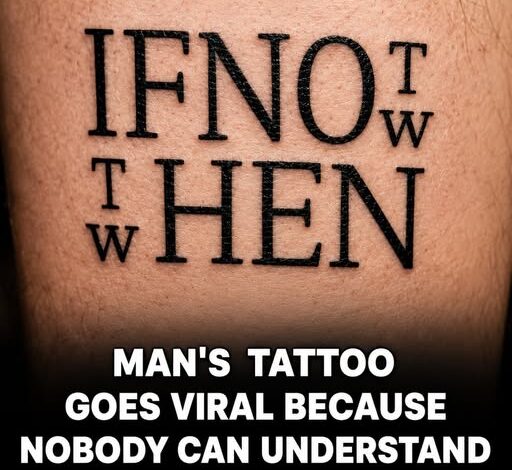
The design itself seems simple enough. A bold motivational quote stretches down a man’s arm in large block letters. The words are clearly meant to be visible. Clearly meant to make a statement. Clearly meant to communicate a message.
Yet something goes wrong almost immediately.
The moment people try to read it, their confidence disappears.
Their eyes move across the letters.
Then back again.
Then forward.
Then backward.
The brain searches desperately for meaning but struggles to find it.
What should take two seconds suddenly takes thirty.
Then a minute.
Then longer.
People squint.
Tilt their heads.
Zoom in.
Step back.
Try reading vertically.
Try reading horizontally.
Try isolating individual words.
The harder they look, the more confusing it becomes.
The tattoo transforms from a motivational quote into a visual maze.
Individual words seem familiar enough.
Letters are recognizable.
Nothing appears misspelled.
And yet the overall message remains frustratingly out of reach.
Some viewers manage to identify fragments.
A word here.
A phrase there.
Others become convinced they’re reading the design incorrectly.
Still others begin constructing entirely new sentences from the scattered pieces.
The human brain hates unresolved patterns.
When information appears incomplete, the mind instinctively tries to finish the puzzle.
That instinct becomes almost impossible to resist.
People begin guessing.
Inventing.
Rearranging.
Searching for hidden logic.
What follows is a fascinating display of perception at work.
One person sees a completely different phrase than another.
Someone else becomes convinced the tattoo contains a secret message.
Others suspect a foreign language.
A few believe the design must be intentionally artistic and therefore impossible to decipher conventionally.
Theories multiply.
Certainty disappears.
And all because a handful of words have been stacked, stretched, compressed, and arranged in a way that disrupts normal reading patterns.
What should function as language begins behaving like abstract art.
The internet, naturally, becomes obsessed.
Images circulate rapidly.
Comment sections explode.
Thousands of people attempt to solve the mystery.
Some approach it methodically.
Others rely on intuition.
Many fail spectacularly.
And therein lies the appeal.
The tattoo is not difficult because the words themselves are complicated.
The difficulty comes from presentation.
Human beings read through patterns.
We expect language to follow certain visual rules.
Words flow left to right.
Lines maintain spacing.
Sentences occupy predictable structures.
When those expectations are disrupted, comprehension slows dramatically.
Even familiar phrases become surprisingly difficult to recognize.
Psychologists often describe perception as a collaboration between the eyes and the brain.
The eyes gather information.
The brain organizes it.
Most of the time, this process happens so efficiently that we never notice it.
Reading feels effortless.
Instant.
Automatic.
The tattoo exposes how fragile that process actually is.
By disrupting visual expectations, it forces the brain to work far harder than usual.
And the results are fascinating.
People who can instantly recognize complex logos, read tiny text, and identify faces in crowded rooms suddenly find themselves defeated by a simple sentence.
Eventually, after countless guesses and endless speculation, a consensus emerges.
Someone solves it.
Then others confirm it.
The phrase hidden within the visual chaos is:
“If not now, then when.”
The revelation is almost anticlimactic.
Not because the phrase lacks meaning.
But because it is so familiar.
So recognizable.
So widely used.
For decades, variations of the quote have appeared in speeches, self-help books, classrooms, motivational posters, and social media posts.
Its message is direct.
Action matters.
Opportunities disappear.
Waiting indefinitely often becomes another form of surrender.
If something deserves pursuit, why delay?
If change is necessary, why postpone it?
If a dream matters, why keep moving it into the future?
The phrase encourages urgency.
Not panic.
Purpose.
It challenges hesitation.
It questions procrastination.
It reminds people that someday often becomes never.
Under normal circumstances, the quote is instantly understandable.
Here, however, it feels strangely inaccessible.
Even after learning the answer, many viewers continue struggling to see it.
The brain knows the phrase.
Yet the eyes still resist.
People stare at the tattoo again.
And again.
And again.
Sometimes the words finally snap into place.
Other times they remain frustratingly elusive.
The disconnect creates a strange emotional effect.
Knowing should eliminate confusion.
Instead, confusion lingers.
The solution feels simultaneously obvious and impossible.
This paradox is what makes the tattoo so memorable.
And perhaps unintentionally profound.
Because the tattoo begins reflecting something larger than typography.
Something larger than design.
Something larger than language itself.
It becomes a metaphor.
The message encourages decisive action.
Yet the execution prevents immediate understanding.
The intention is clarity.
The result is confusion.
The purpose is motivation.
The experience is hesitation.
The quote urges people not to delay.
Yet readers spend several minutes trying to decode it.
There is something almost poetic about that contradiction.
The tattoo becomes an accidental illustration of the very challenges it attempts to address.
Communication is never as simple as we imagine.
We often assume that having a message is enough.
But messages must travel.
They must move from one mind to another.
And during that journey, countless things can go wrong.
Words can be misunderstood.
Intentions can be misread.
Meaning can become distorted.
The sender believes they are being clear.
The receiver experiences confusion.
Entire relationships sometimes struggle under the weight of this reality.
Businesses fail because of it.
Friendships suffer because of it.
Families argue because of it.
History itself is filled with examples of people meaning one thing and being understood as another.
The tattoo captures that phenomenon in visual form.
The owner likely intended inspiration.
Instead, he created a riddle.
Not because the message was flawed.
Because the delivery obscured it.
And perhaps that is what resonates most deeply with viewers.
Everyone has experienced some version of this disconnect.
Everyone has tried to communicate something important only to discover it was misunderstood.
Everyone has watched meaning become tangled somewhere between intention and reality.
The tattoo simply makes that process visible.
What begins as a humorous internet mystery gradually transforms into something more reflective.
A reminder that communication requires more than good intentions.
A reminder that clarity matters.
A reminder that even meaningful ideas can become inaccessible when presentation overwhelms substance.
Most importantly, it becomes a reminder of how perception works.
People assume seeing is simple.
Reading is simple.
Understanding is simple.
Yet the tattoo reveals how dependent comprehension is on context, structure, and expectation.
A few altered design choices are enough to turn a familiar phrase into an unsolvable puzzle.
That realization is both amusing and humbling.
Because if a simple quote can become nearly unreadable, what else might we be misunderstanding every day?
How many assumptions guide our perception?
How often do we believe something is obvious when it only seems obvious from our perspective?
How much meaning gets lost between what is intended and what is received?
The tattoo does not answer those questions.
But it raises them.
And perhaps that is why people remain fascinated by it long after solving the puzzle.
Not because the quote is extraordinary.
Not because the design is beautiful.
But because the gap between the two reveals something unexpectedly human.
A motivational message meant to inspire action becomes trapped inside confusion.
A sentence encouraging clarity becomes an exercise in uncertainty.
A permanent reminder to seize the moment becomes a permanent reminder of how easily meaning can disappear.
And in that strange contradiction lies the true power of the image.
Not the words themselves.
But the lesson hidden beneath them.
That intention alone is never enough.
That communication is fragile.
And that between what we mean and what others understand, there is often a distance far greater than we realize.
Sometimes that distance lasts a few seconds.
Sometimes it lasts a lifetime.
And sometimes, it gets tattooed permanently onto someone’s arm.