I Paid for a Stranger’s Groceries at Checkout—Then a Police Officer Showed Up at My Job Days Later

The entire thing cost me less than ten dollars.
At the time, I didn’t think twice about it.
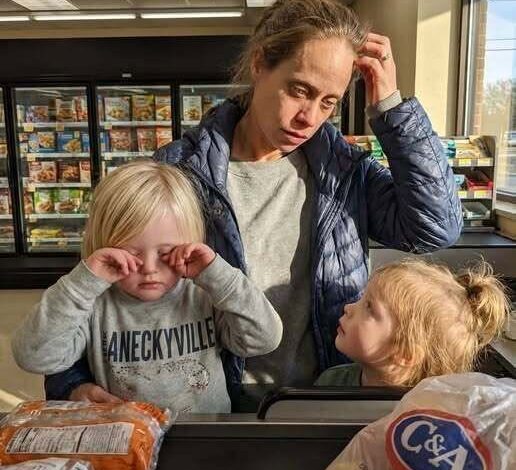
I was halfway through a long shift at the grocery store, scanning items one after another, when a woman stepped into my checkout line with two young children. She looked like countless customers I had seen before—quiet, polite, and clearly exhausted.
But there was something about her expression that stayed with me.
As I scanned the final items and the total appeared on the screen, I watched her face change.
It wasn’t dramatic.
Most people probably wouldn’t have noticed.
But I did.
Her eyes flicked toward the number. She hesitated. Then she looked down at her cart and began making calculations only she could see.
Finally, she spoke.
“Could you take off the cereal?” she asked softly.
Then, after a pause, she pointed toward a bag of apples.
“And those too, please.”
Her voice was calm, but I could hear the disappointment beneath it.
The children stood quietly beside her.
One of them glanced at the cereal box.
The other stared at the apples.
Neither complained.
Neither begged.
That somehow made it worse.
The woman wasn’t asking for sympathy. She wasn’t trying to create a scene or persuade anyone to help.
She simply accepted that there wasn’t enough money.
And she was preparing to leave those items behind.
Something about that moment hit me harder than I expected.
Maybe it was because I recognized the look on her face.
I had seen it before.
Years earlier, my own mother had worn the same expression while standing at checkout counters, quietly deciding what we could live without.
I remembered the embarrassment.
The stress.
The endless calculations.
I remembered how heavy a few dollars could feel when you didn’t have them.
Before I could overthink it, I smiled.
“Don’t worry about it,” I said.
She looked confused.
“I’ve got it.”
For a second she simply stared at me.
Then her eyes filled with tears she clearly didn’t want anyone to see.
“Oh no,” she said immediately. “You don’t have to do that.”
“It’s okay,” I replied.
“It’s really not much.”
The total for the apples and cereal came to less than ten dollars.
I paid for them myself.
The woman thanked me several times.
Her children smiled.
A minute later they were gone.
The next customer stepped forward.
And life moved on.
Or so I thought.
Three days later, I was working the same register when I noticed a police officer entering the store.
At first, I paid little attention.
Police officers stopped in all the time.
But then he looked directly at me.
And started walking my way.
My stomach immediately tightened.
When you work retail long enough, unexpected conversations rarely feel comforting.
The officer stopped at my register.
“Are you Sarah?” he asked.
My heart dropped.
“Yes.”
“Could I speak with you for a few minutes?”
Suddenly my mind was racing.
Had someone filed a complaint?
Had I broken a policy?
Was there a problem with a transaction?
Had I done something wrong without realizing it?
My hands felt unsteady as I asked a coworker to cover my lane.
The officer waited patiently.
Then he led me outside.
Every step made me more nervous.
But instead of walking toward a patrol car, he guided me down the block to a small café.
I was completely confused.
When we entered, he pointed toward a table by the window.
That was when I saw them.
The woman.
The two children.
All sitting together.
I stopped walking.
For a moment, I genuinely thought I had entered the wrong place.
Then the officer smiled.
“That’s my family.”
Everything clicked.
The woman’s eyes lit up when she saw me.
The children immediately waved.
And suddenly the mystery made sense.
The officer invited me to sit down.
Then he explained.
For months, he had been assigned to a demanding operation that kept him away from home for extended periods.
His wife had been carrying everything herself.
The bills.
The children.
The groceries.
The endless balancing act that so many families quietly face.
Money had become tight.
Much tighter than most people realized.
That day in the grocery store had been particularly difficult.
The cereal and apples weren’t luxury items.
They were simply two more things she couldn’t quite afford.
As he spoke, I began to understand something I hadn’t realized.
To me, the moment had lasted less than thirty seconds.
To them, it had stayed with them for days.
Then the younger child stood up and walked over holding a folded piece of paper.
“I made this for you,” he said.
I smiled and carefully opened it.
The drawing showed a grocery store.
A checkout lane.
And behind the register stood a smiling cashier wearing a bright red superhero cape.
Across the top, written in large uneven letters, were the words:
SUPERHERO CASHIER.
That was it.
That was the moment I completely lost my composure.
The tears came instantly.
I tried to laugh them away.
Failed.
And ended up crying in the middle of a café.
The officer laughed softly.
His wife reached across the table.
“You know what mattered most?” she asked.
I shook my head.
“You helped without making me feel ashamed.”
The room suddenly felt very quiet.
She wasn’t talking about the cereal.
Or the apples.
Or the money.
She was talking about dignity.
About being treated like a person rather than a problem.
The officer nodded.
“You didn’t make an announcement. You didn’t draw attention to it. You just helped.”
I left the café carrying a feeling I struggled to describe.
It wasn’t pride.
It wasn’t satisfaction.
It was something gentler.
A reminder that the smallest moments often matter the most.
A week later, my manager asked me to come to her office.
The familiar anxiety returned immediately.
Whenever a manager says, “Can we talk?” it’s difficult not to imagine the worst.
But this time she was smiling.
She handed me a letter.
The officer had written to corporate headquarters.
In it, he described what had happened and praised the way I had treated his family.
Months later, that letter contributed to a promotion.
People often assume that’s the best part of the story.
It isn’t.
The promotion was nice.
The recognition was appreciated.
But neither was what stayed with me.
What stayed with me was that drawing.
The superhero cashier.
Because the truth is, I wasn’t trying to be anyone’s hero.
I simply recognized something familiar in a tired mother’s face.
I knew what it felt like to worry about money.
I knew what it felt like to stand one unexpected bill away from panic.
And I knew how much a small act of kindness can mean when life already feels heavy.
That experience taught me something I’ve never forgotten.
We often underestimate the impact of tiny decisions.
A few dollars.
A kind word.
A moment of patience.
A simple choice to care.
Most of the time, we assume they disappear as quickly as they happen.
But sometimes they don’t.
Sometimes they become the story someone tells years later.
Sometimes they arrive at exactly the moment another person needs them most.
And sometimes they create connections between strangers that neither side ever expected.
Kindness isn’t an investment.
It isn’t a transaction.
It isn’t something we do because we expect a reward.
But every now and then, life offers a reminder that goodness travels farther than we can see.
One ordinary checkout lane.
One tired mother.
One box of cereal.
One bag of apples.
And a ripple that kept moving long after the moment itself had passed.