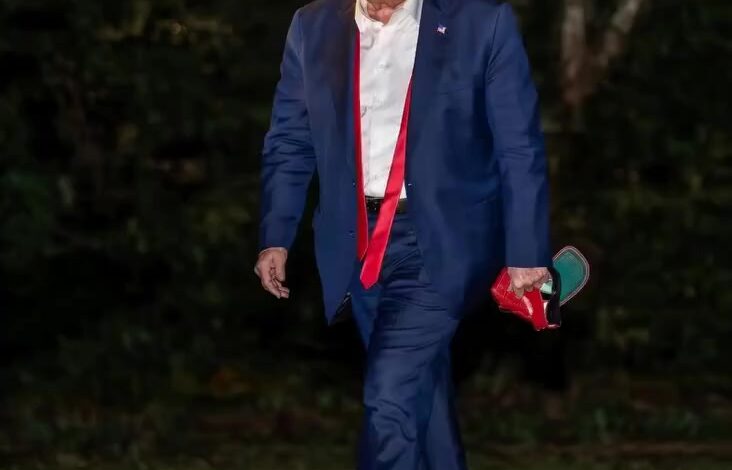
He stopped being viewed as an actual person the moment the footage hit the internet. That late-night walk, captured in grainy fragments and stripped of any real context, instantly became a blank canvas for millions of competing theories. To some, it signaled secrecy. To others, weakness, strategy, fear, manipulation, or hidden power. Every blurry screenshot was enlarged, analyzed, reposted, and transformed into “evidence” supporting whatever version of reality people already wanted to believe. The object in his hand barely mattered anymore. What mattered was the story people could attach to it.
Within hours, social media had turned an ordinary human moment into a national obsession. Comment sections filled with amateur investigators drawing arrows across screenshots, slowing videos frame by frame, insisting that tiny details proved enormous conclusions. News panels debated possibilities with the seriousness of breaking state secrets, while influencers monetized speculation by packaging uncertainty into certainty loud enough to go viral.
But beneath the frenzy sat something far more revealing than the walk itself.
The real spectacle was us.
Our discomfort with ambiguity has become almost unbearable. Silence now feels suspicious. A moment without explanation demands immediate interpretation. We no longer tolerate unanswered questions; we rush to complete them ourselves, even when the truth remains unknowable. In that atmosphere, every gesture from a public figure becomes overloaded with meaning. A glance becomes strategy. A stumble becomes decline. A quiet walk becomes conspiracy.
What unfolded after those images surfaced exposed how deeply modern culture confuses access with understanding. People believe that because they can replay footage endlessly, zoom into pixels, and consume nonstop commentary, they are somehow entitled to certainty. But repetition is not clarity. Visibility is not truth.
The man in the baseball cap became less important than the emotional machinery activated around him. He turned into a mirror reflecting public anxiety back at itself. People projected their fears, loyalties, resentments, and hopes onto footage so incomplete it could support almost any interpretation at all.
Some viewers saw corruption because they already expected corruption.
Others saw vulnerability because they longed for signs of humanity.
Some dismissed the entire thing as absurd, while others treated it like a coded message hidden in plain sight.
The details changed depending on the audience, but the hunger underneath remained the same:
the desperate need to force meaning onto uncertainty.
And maybe that is what lingers longest after moments like this fade from the headlines. Not the mystery itself, but the speed with which we transformed confusion into certainty simply because uncertainty felt intolerable. The blurry frames revealed almost nothing concrete about the man being filmed, yet they revealed an enormous amount about the culture watching him.
A restless culture.
An exhausted culture.
A culture addicted to interpretation.
In the end, the truth behind that walk remained unresolved. No definitive revelation arrived. No dramatic answer emerged to satisfy the speculation machine.
But perhaps that was never really the point.
Because long before anyone discovered what he was carrying or where he was going, the public had already exposed something far more significant: how quickly we turn incomplete information into emotional reality, and how eagerly we reshape strangers into symbols capable of carrying the weight of our own fears and obsessions.
The mystery remained unsolved.
But the reaction to it explained us perfectly.