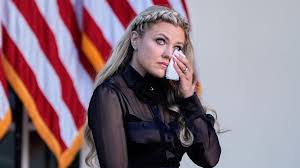
Lip reader reveals Karoline Leavitt’s blunt 3-word remark to Trump aide Natalie Harp in ‘tense’ exchange

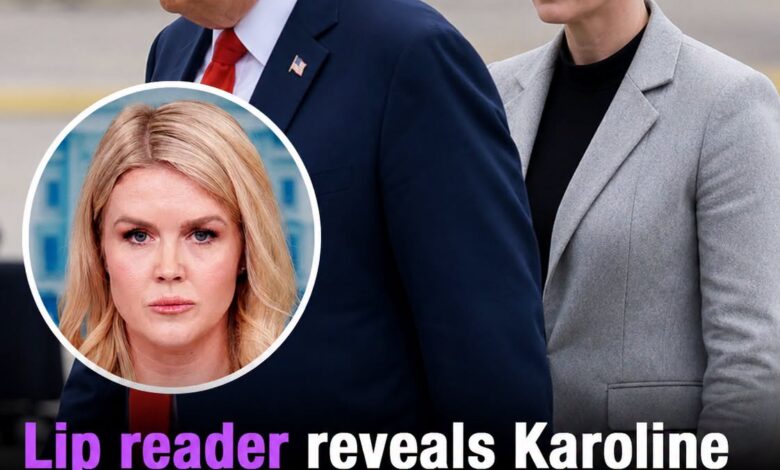
At first, the Marine One footage looked like almost nothing.
A few seconds of body language.
A glance.
A phone check.
A woman folding her arms.
Another leaning in to speak.
The kind of clip that normally disappears into the endless stream of political video within hours.
Instead, people began replaying it.
Slowing it down.
Zooming in.
Watching faces rather than listening for sound.
And suddenly, the clip seemed to carry an entirely different weight.
At the center of the speculation was Karoline Leavitt.
Her expression appeared tense.
Her shoulders seemed rigid.
At several points, she looked down at her phone, then back toward those around her, as if waiting for something she already knew was coming.
A lip reader later offered an interpretation of part of the exchange, suggesting Leavitt may have asked Susie Wiles aide Natalie Harp, “Are you sure?”
The reported reply was even more intriguing.
Something, according to that interpretation, was about to be announced.
Something Trump’s team “didn’t like.”
It is important to say immediately that lip-reading from distant, silent political footage is inherently uncertain.
Angles are imperfect.
Words can look similar on the lips.
Context can be missing.
Without clear audio or confirmation from the people involved, interpretations should not be treated as transcripts.
But once that reading entered the public conversation, viewers began looking at the clip differently.
Leavitt’s sighs no longer looked like ordinary exhaustion.
Her crossed arms seemed defensive.
Her repeated phone-checking felt anticipatory.
What had first appeared to be routine stress suddenly became, in the eyes of many observers, the image of someone waiting for bad news.
That is how political imagery works now.
A few seconds can become a narrative before anyone involved says a word.
And in an administration where loyalty has always carried enormous symbolic importance, the narrative practically writes itself.
Was Leavitt being pushed out?
Was she expecting some announcement about her position?
Had she been told that a decision had already been made?
Or was she simply tired, distracted, or dealing with something completely unrelated?
The honest answer is that body language alone cannot settle any of those questions.
But the clip became much more combustible when people connected it to another figure standing nearby.
Natalie Harp.
Harp has long attracted attention not simply because of her proximity to Donald Trump, but because of the unusually personal tone of messages associated with her relationship to him.
Letters attributed to Harp have reportedly used strikingly devotional language, including descriptions of Trump as “all that matters” and expressions of her own “unworthiness.”
Those phrases are extraordinary in almost any professional political setting.
They do not sound like ordinary staff correspondence.
They sound personal.
Intense.
Almost reverential.
And once those words were placed beside the Marine One footage, viewers began constructing a larger picture.
Leavitt looked uneasy.
Harp looked composed.
Harp had written in language suggesting profound personal loyalty to Trump.
And suddenly the scene stopped looking like a mundane staff interaction.
It looked, to some, like a glimpse into a hierarchy where access and survival depend on something more emotional than job performance.
That interpretation may ultimately prove exaggerated.
But the reason it resonates is not difficult to understand.
Trump has always placed unusual emphasis on loyalty.
He speaks about it openly.
Former aides discuss it.
Supporters often describe personal allegiance to him as a virtue, while critics argue that the expectation can blur the line between loyalty to a leader and loyalty to an institution.
That distinction matters enormously in government.
In a traditional political structure, staff relationships are supposed to revolve around responsibilities.
Who manages communications?
Who advises on policy?
Who schedules appearances?
Who handles legal questions?
Who controls access?
Personal trust matters, of course.
Every White House depends on it.
But once devotion to the individual becomes more important than disagreement, expertise, or institutional restraint, the internal culture can begin to change.
People stop asking:
“What is the best decision?”
They start asking:
“What does the leader want?”
Then perhaps:
“Who is closest to him?”
And finally:
“Who is safe?”
That is why the Leavitt-Harp speculation has generated attention far beyond the personalities involved.
It raises a broader question about political power.
What kind of loyalty keeps someone inside the circle?
Professional loyalty?
Personal loyalty?
Public loyalty?
Private devotion?
And what happens when those forms begin competing with one another?
Leavitt has built a public image around combativeness and certainty.
At the podium, she rarely appears hesitant.
She answers aggressively.
Pushes back on reporters.
Defends the administration with confidence.
That persona matters because political communications depend heavily on projection.
A press secretary is expected to appear in control even when events behind the scenes are chaotic.
So seeing someone known for certainty appear visibly unsettled naturally attracts attention.
The contrast becomes the story.
But there is also a danger in reading too much into that contrast.
People have bad days.
They receive difficult messages.
They worry about family.
They get tired.
A tense expression is not evidence of dismissal.
Crossed arms are not a resignation letter.
Political viewers, however, are rarely content with uncertainty.
We want hidden meaning.
Especially when the camera appears to catch someone during an unguarded moment.
That hunger has created an entire ecosystem around body-language analysis.
A politician looks away.
What does it mean?
Someone touches their face.
Are they lying?
Two officials fail to shake hands.
Are they feuding?
Sometimes those observations provide useful clues.
More often, they become raw material for whatever story viewers already expect.
That is why the lip-reading claim must be handled carefully.
Even if the words were interpreted correctly, the meaning still depends on context.
“Are you sure?” could refer to almost anything.
An event.
A timing change.
A travel plan.
A personnel decision.
A statement.
A news story.
And saying something is about to be announced does not automatically mean someone is being fired.
Politics is filled with announcements.
The uncertainty is precisely what made the footage so powerful.
It provided enough detail to suggest a story, but not enough to confirm one.
And ambiguity is irresistible online.
Then the Harp letters added emotional fuel.
Language like “all that matters” feels jarring because it does not fit the tone most people expect from professional staff.
Government officials and political aides are expected to support leaders.
They are not usually expected to sound worshipful.
That does not automatically establish improper influence.
People express gratitude, admiration, and personal loyalty in many ways.
But unusually intense language can raise legitimate questions when the person writing it also occupies a position of access.
Access is power.
Especially around a president.
The person who gets the final conversation before a decision can matter.
The person who controls information flow can matter.
The person whose opinion is trusted personally can sometimes matter more than someone holding a grander title.
Every administration has informal power structures.
Some advisers become influential because the president trusts them.
Some lose influence despite impressive résumés.
Some survive because they understand the leader’s instincts better than anyone else.
None of that is unique to Trump.
What makes Trump’s orbit different is how openly loyalty itself becomes part of the political language.
People are described as loyal.
Disloyal.
Strong.
Weak.
Good.
Bad.
With him.
Against him.
That framing creates an environment where personnel changes can be interpreted almost like court politics.
Who has favor?
Who lost it?
Who is rising?
Who is about to disappear?
The Marine One footage fit perfectly into that mythology.
Maybe too perfectly.
A tense press secretary.
A deeply loyal aide.
A mysterious announcement.
A silent exchange beside the president’s aircraft.
It had every ingredient necessary for a viral political mystery.
But if the public wants to understand what actually happened, the standard must be higher than atmosphere.
Did Leavitt announce a departure?
Did the White House confirm a personnel change?
Did reliable reporting establish that she had been pressured?
Did anyone involved explain the conversation?
Without those facts, the strongest conclusion remains limited.
The video raises questions.
It does not answer them.
That may sound unsatisfying.
But political media often becomes most dangerous when questions are presented as conclusions.
“There appears to be tension” becomes “she was being fired.”
“A lip reader interpreted this phrase” becomes “she admitted she knew.”
“An aide wrote emotional letters” becomes “she controls the president.”
Those jumps are where speculation becomes misinformation.
Still, the underlying discussion about loyalty is legitimate.
Because governments should never depend entirely on personal devotion.
A president needs people willing to say no.
People willing to bring bad news.
People willing to disagree privately.
People willing to defend institutions even when doing so creates friction with the person who appointed them.
The strongest adviser is not necessarily the one who loves the leader most.
Sometimes it is the one willing to risk losing access by saying something the leader does not want to hear.
That principle is not partisan.
It applies to every president.
Every governor.
Every executive.
Every organization where one person holds significant authority.
Power becomes more dangerous when everyone surrounding it begins competing to demonstrate devotion.
That is why Harp’s reported language attracts scrutiny.
Not because affection or gratitude is inherently suspicious.
But because power and reverence can be an uncomfortable combination.
If an adviser sees a leader as “all that matters,” what happens when the interests of the leader conflict with the interests of the institution?
That is the question critics naturally ask.
Supporters may see something different.
They may view Harp’s language as evidence of extraordinary personal gratitude and loyalty, especially given her own history and relationship with Trump.
They may argue that private expressions of admiration tell us little about whether she performs her job professionally.
That perspective deserves acknowledgment too.
Private language can sound more emotional than public conduct.
People write things to mentors, employers, or figures who changed their lives that they would never say in a formal memo.
Context matters.
But context is exactly what the public does not fully have.
Which brings us back to that few seconds of video.
Leavitt looks uneasy.
Harp appears beside her.
Words are inferred.
Phones are checked.
The president’s helicopter waits nearby.
And millions of viewers attempt to reconstruct a power struggle from silence.
Maybe someday someone involved will explain exactly what was happening.
Maybe a memoir will reveal it years from now.
Maybe it was genuinely the moment before a major personnel decision.
Or maybe it was one stressful exchange among hundreds that week.
Until then, the footage remains what so much political content has become:
A fragment.
Powerful enough to influence perception.
Incomplete enough to demand caution.
What it does reveal with greater certainty is the public’s fascination with the internal dynamics of Trump’s circle.
People are not merely interested in policy.
They are interested in proximity.
Who has his ear?
Who is trusted?
Who is tolerated?
Who is replaceable?
Who survives?
That is partly celebrity culture.
Partly politics.
And partly the unavoidable reality that personal relationships can influence presidential decision-making.
The danger comes when fascination with those relationships replaces examination of what officials actually do.
Leavitt should ultimately be judged by her conduct and performance.
Harp should be judged by her responsibilities and influence.
Any personnel decision should be evaluated through confirmed facts.
And Trump’s leadership should be assessed through actions, decisions, and outcomes—not only through silent video interpretation.
Still, images have power.
The Marine One clip may endure precisely because it captured something that felt unscripted.
No podium.
No prepared statement.
No television lighting.
Just people waiting beside an aircraft, apparently carrying information the public could not hear.
That is enough to make viewers feel they have glimpsed backstage.
Whether they actually have is another question.
If Leavitt eventually left under pressure, the footage would likely be replayed as foreshadowing.
If nothing happened, it would become another example of how easily ordinary tension can be turned into political drama.
Either outcome teaches the same lesson.
Watch carefully.
But separate observation from proof.
Ask questions.
But do not turn those questions into facts because the story feels convincing.
And when assessing power inside any administration, pay attention not only to who appears nervous or confident in one clip, but to the culture surrounding the leader.
Is disagreement tolerated?
Is expertise valued?
Can advisers challenge decisions?
Or does survival depend primarily on proving loyalty to one person?
Those questions matter far more than a single whispered exchange.
Because personnel come and go.
Press secretaries change.
Aides rise and fall.
The deeper issue is what kind of system remains behind them.
And if the Marine One footage has become a symbol of anything, it may be that.
Not proof that Karoline Leavitt was being pushed toward the door.
Not proof that Natalie Harp controlled what happened next.
But a reminder that inside every seat of power, there is an invisible hierarchy outsiders rarely see clearly.
Titles tell us who officially holds authority.
The more difficult question is who the leader actually listens to.
And sometimes all the public gets is a silent clip, a handful of letters, and the uneasy feeling that the real conversation is happening just outside the frame.