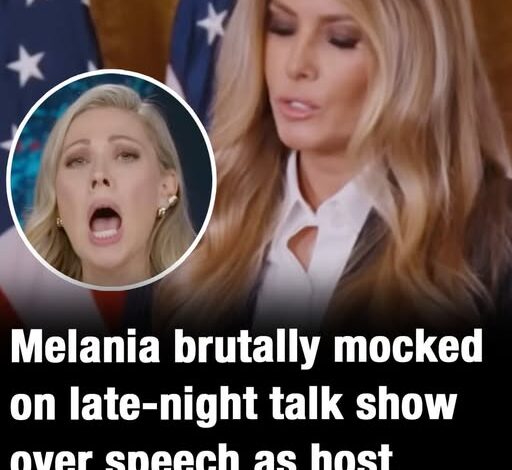
What began as a speech about the future of artificial intelligence quickly became something else entirely.
Within hours, the headlines weren’t focused on emerging technology, the role of AI in education, or the profound questions surrounding humanity’s relationship with machines.
Instead, attention shifted to Melania Trump herself.
Her delivery.
Her accent.
Her mannerisms.
And eventually, a late-night comedy sketch that transformed a serious discussion about technological change into the latest political punchline.
In today’s media environment, that shift felt almost inevitable.
Yet the reaction revealed something larger than a disagreement over a speech.
It exposed the growing tendency to turn conversations about the future into debates about personalities.
And in doing so, it raised an uncomfortable question:
Are we becoming so distracted by who delivers a message that we no longer engage with what the message actually says?
A Speech About Tomorrow
When Melania Trump took the stage to discuss artificial intelligence and its impact on students, she entered a conversation that is becoming increasingly urgent.
Artificial intelligence is no longer a distant concept confined to science fiction novels and futuristic films.
It is already shaping daily life.
It influences healthcare decisions.
It assists in scientific research.
It powers financial systems.
It affects military planning.
It determines what information people see online.
And with every passing year, its influence continues to grow.
Against that backdrop, Melania’s remarks attempted to paint a picture of a rapidly changing world.
She spoke about technological innovation.
She referenced advances in medicine.
She touched on the growing role of automation.
And she described a future in which machines may perform tasks that once seemed impossible.
The language was ambitious.
At times, even cinematic.
To supporters, it sounded aspirational.
To critics, it sounded overly dramatic.
But regardless of perspective, the speech was intended to address a topic that affects virtually everyone.
Unfortunately, that wasn’t what most people ended up discussing.
The Comedy Response
Soon after the speech gained attention, late-night television found its target.
On “The Daily Show,” comedian Desi Lydic delivered a parody that quickly spread across social media.
The impression focused heavily on Melania’s speaking style, delivery, and public persona.
The joke was simple but effective.
Rather than presenting Melania as someone discussing artificial intelligence, the sketch suggested she herself seemed artificial.
A human chatbot.
A digital avatar.
Someone reciting prompts rather than expressing personal conviction.
The audience laughed.
The clips circulated.
The impressions generated millions of views.
For many viewers, it was classic political satire.
Sharp.
Timely.
And well within the traditions of late-night comedy.
But for others, the performance crossed a different line.
Critics argued that the sketch focused less on the substance of the speech and more on characteristics unrelated to the ideas being discussed.
Some questioned whether the humor targeted Melania’s arguments or simply her accent and public image.
Others defended the routine as fair game in a culture where political figures are constantly scrutinized through comedy.
The debate itself became almost as prominent as the speech.
The Bigger Issue Hiding Beneath the Laughter
Lost amid the jokes was the reality that artificial intelligence is rapidly becoming one of the defining issues of the modern era.
The technology is already transforming industries.
Doctors increasingly rely on AI-assisted diagnostics.
Researchers use machine learning to identify patterns invisible to human analysis.
Military organizations explore autonomous systems and drone technologies.
Educational institutions grapple with AI-generated content and evolving classroom challenges.
These are not hypothetical questions.
They are happening now.
Yet discussions about AI often struggle to remain focused on those realities.
Instead, public attention frequently shifts toward personalities, political affiliations, or viral moments.
The reaction to Melania’s speech highlighted that tendency perfectly.
A discussion that could have centered on technological ethics, workforce disruption, privacy concerns, or the future of education instead became a conversation about delivery style and internet memes.
The result was familiar.
The messenger overshadowed the message.
A Reflection of Modern Media
Part of this phenomenon reflects the way modern media operates.
Complex topics rarely compete successfully against personality-driven narratives.
A nuanced discussion about artificial intelligence requires attention, context, and patience.
A comedy sketch requires only a few seconds.
One demands reflection.
The other rewards immediate reaction.
As a result, public discourse increasingly gravitates toward moments that are easy to share, easy to clip, and easy to debate.
This does not necessarily make the humor wrong.
Political satire has long served an important cultural function.
It challenges authority.
It questions public figures.
It exposes contradictions.
But it can also redirect attention.
Sometimes so effectively that the original subject disappears entirely.
The Question We Should Be Asking
Whether one admired Melania Trump’s speech or found it unconvincing ultimately misses the larger point.
The future she described—awkwardly, dramatically, or otherwise—is arriving regardless of political affiliation.
Artificial intelligence will continue reshaping society.
It will influence how students learn.
How businesses operate.
How governments function.
How wars are fought.
How medical decisions are made.
Those developments deserve serious examination.
The challenge is ensuring that conversations about those issues do not become trapped inside endless cycles of personality conflict.
Because the real question is not whether Melania Trump sounded robotic.
Nor is it whether a comedian’s impression was fair.
The real question is who gets to define the future being discussed.
Who decides how artificial intelligence is developed.
Who benefits from it.
Who regulates it.
And who bears the consequences when it goes wrong.
Those questions are far more significant than any viral clip.
Beyond the Headlines
As the jokes fade and the news cycle moves on, the underlying issues remain.
Artificial intelligence continues advancing.
Students continue preparing for careers that may not yet exist.
Governments continue debating regulation.
Technology companies continue building increasingly powerful systems.
The future keeps moving forward.
Regardless of who delivers the speech.
Regardless of who mocks it.
And regardless of who wins the next round of online debate.
In the end, the controversy surrounding Melania Trump’s remarks may be remembered less for what was said than for what it revealed.
A society fascinated by personalities.
A media landscape driven by spectacle.
And a public conversation that sometimes struggles to focus on the very issues that will shape the decades ahead.
The laughter may have been loud.
The satire may have been effective.
But the technology at the center of the discussion remains real.
And long after the punchlines are forgotten, the future being debated will still be waiting.