My Arrogant New Neighbors Made My Pristine Lawn Their Parking Lot – I May Be Old, but My Revenge Was Ruthless

For years, Edna believed kindness was enough.
She greeted neighbors with a smile, kept her yard immaculate, and never looked for conflict. After her husband, Harold, passed away, she continued caring for the little house they had built their life around, treating every flowerbed, every tree, and every stretch of grass as if he were still beside her.
To anyone passing by, it was simply a well-kept lawn.
To Edna, it was forty years of memories made visible.
Harold had loved working in the yard. Every Saturday morning, coffee mug in hand, he would inspect the grass like it was his greatest masterpiece. Together they planted shrubs, celebrated birthdays beneath the maple tree, watched grandchildren chase butterflies across the lawn, and spent countless evenings sitting on the porch as the sun slipped below the rooftops.
Keeping the yard beautiful wasn’t about appearances.
It was her way of keeping part of Harold close.
After his death, the neighborhood changed.
New families moved in, old friends relocated, and familiar faces slowly disappeared. Among the newcomers was a man whose confidence quickly turned into entitlement.
At first, the problems seemed minor.
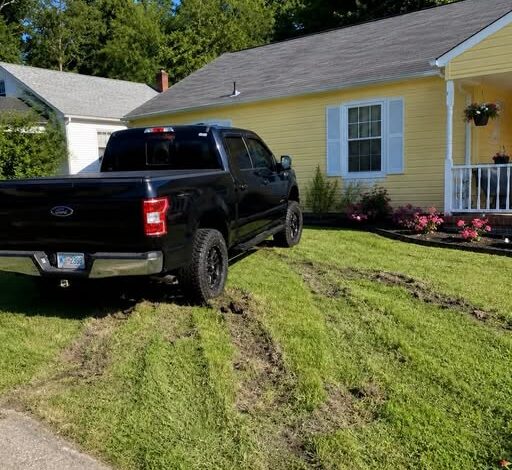
He parked partially on her property.
His visitors cut across her lawn instead of using the sidewalk.
Equipment and trash occasionally found their way onto the edge of her yard.
Edna politely asked him to be more careful.
He apologized.
Nothing changed.
In fact, things became worse.
The more patient she remained, the bolder he became.
It slowly dawned on her that he wasn’t ignoring her requests because he hadn’t heard them.
He simply didn’t believe she would ever stand up to him.
To him, she wasn’t a homeowner protecting decades of memories.
She was an elderly widow living alone.
An easy target.
Then came the morning that changed everything.
Edna stepped outside to water her flowers and immediately noticed something was wrong.
Her lawn looked damaged.
Not from weather.
Not from animals.
Scattered across the grass were dozens of sharp tacks.
Tiny.
Nearly invisible.
Perfectly positioned where someone walking, mowing, or driving across the yard would almost certainly encounter them.
Her heart sank.
A lawn mower could have been destroyed.
Children could have stepped on them.
A pet could have been seriously injured.
Even her own car tires weren’t safe.
As she carefully collected each tack, wearing gardening gloves and dropping them into a bucket one by one, sadness slowly gave way to determination.
This wasn’t carelessness.
Someone had done it deliberately.
Instead of confronting anyone in anger, Edna documented everything.
She photographed the tacks before removing them.
She noted where they had been scattered.
She gathered every piece of evidence she could.
Then she contacted the police.
When the officers arrived, she expected skepticism.
She worried they might dismiss the situation as a neighborhood disagreement.
Instead, they listened.
Carefully.
Respectfully.
They examined the photographs, inspected the property, and took her concerns seriously.
As the investigation continued, evidence began pointing in an unexpected direction.
The accusations that had quietly hovered over Edna suddenly shifted.
The focus turned toward the neighbor whose behavior had grown increasingly aggressive over the previous months.
What had started as an attempt to intimidate an elderly widow became a problem he could no longer explain away.
The evidence spoke for itself.
By the time everything was resolved, the consequences landed squarely where they belonged.
He faced financial penalties for his actions.
His reputation within the neighborhood suffered.
And in an ironic twist, his own vehicle ended up with four flat tires after driving where those scattered tacks had been left.
The person who intended to create trouble found himself dealing with the very damage he had helped create.
For Edna, though, the outcome wasn’t about revenge.
It wasn’t even about winning.
It was about being seen.
For the first time since Harold’s death, she felt someone acknowledge what she had quietly carried all those years—that her home mattered, her safety mattered, and her voice deserved to be heard.
The officers hadn’t treated her like a helpless widow.
They treated her like a homeowner protecting her property and her rights.
That simple act of respect restored something she hadn’t realized she was beginning to lose.
Confidence.
Over the following weeks, she repaired the damaged patches of grass.
She reseeded worn areas.
She watered patiently each morning, watching tiny green shoots emerge where bare soil had once remained.
Neighbors stopped to chat more often.
Some offered help.
Others simply told her how beautiful the yard looked.
For the first time in months, she smiled without forcing it.
Standing on the porch one evening, Edna looked across the lawn glowing softly in the setting sun.
The breeze moved gently through the trees Harold had planted decades earlier.
Everything felt peaceful again.
She realized the battle had never truly been about grass.
It had been about memory.
About refusing to let someone else’s arrogance erase the life she and Harold had built together.
People sometimes mistake kindness for weakness.
They assume quiet people won’t defend themselves.
They mistake patience for surrender.
Edna had learned otherwise.
Strength doesn’t always arrive with raised voices or dramatic confrontations.
Sometimes it appears in careful documentation.
Sometimes it looks like calmly telling the truth.
Sometimes it’s simply refusing to abandon what you love because someone else believes they can take it.
As the lawn continued to recover, she noticed something else healing alongside it.
Her grief no longer felt quite as heavy.
The yard Harold had loved remained exactly where it belonged.
So did she.
She hadn’t merely protected a piece of property.
She had protected the memories rooted beneath every blade of grass, the dignity that no bully had the right to steal, and the quiet life she and Harold had spent decades creating together.
And in doing so, she discovered that even after profound loss, there are still things worth standing up for—and sometimes, standing your ground is the most powerful way to honor the people you loved most.