My Husband Fired Our Nanny and Compelled My Mom with a Broken Arm to Watch Our 4 Kids – So I Taught Him a Lesson

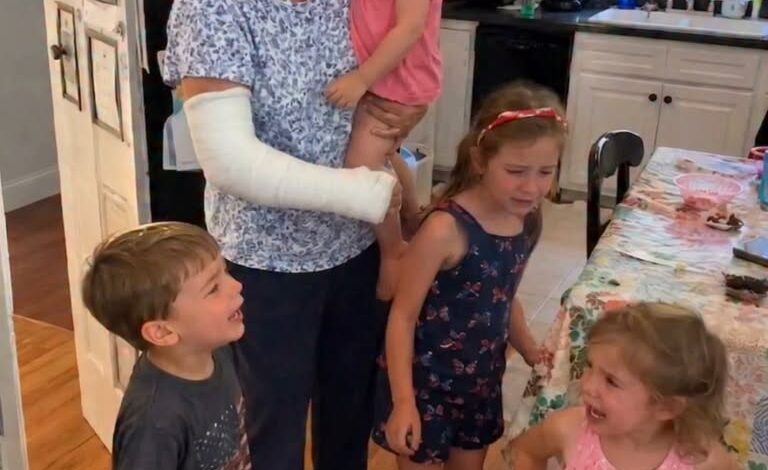
When I brought my mother home after surgery, I thought the hardest part would be helping her recover.
I couldn’t have imagined that the real challenge would be protecting her from my own husband.
Mom was sixty-eight and fiercely independent. She had lived alone for years after my father passed away, insisting she could handle everything herself. But after slipping on an icy sidewalk and badly breaking her arm, independence wasn’t an option anymore.
The surgery went well, but the orthopedic surgeon couldn’t have been clearer.
“No lifting. No cooking. No cleaning. No repetitive movement with that arm for at least eight weeks.”
Mom smiled politely.
“I’ll behave.”
I knew she wouldn’t.
Even in pain, she hated feeling like a burden.
As we walked toward my car, she glanced at the heavy cast wrapped nearly to her shoulder.
“I hope Carl doesn’t mind having me around.”
“He won’t,” I assured her. “I already asked.”
When I’d brought it up earlier that week, Carl hadn’t hesitated.
“She’s family,” he’d said. “Of course she can stay.”
I believed him.
Our house was busy enough already.
We both worked full-time.
We had four children whose schedules overlapped in every possible way.
Thankfully, our nanny, Nina, kept our evenings from collapsing into complete chaos. She handled daycare pickup for our youngest, met the older kids after school, helped with homework, and somehow managed to keep everyone fed until we got home.
The first evening Mom apologized every time she needed help opening a bottle or cutting her food.
“You don’t have to apologize,” I kept telling her.
“I’m just not used to this.”
“You’ll get there.”
The following afternoon, my phone rang while I was sitting in a meeting.
“Hello?”
“Hi, this is Ellie’s daycare.”
Something about the teacher’s voice immediately made my stomach tighten.
“We’re closing in ten minutes. Is someone still coming?”
I froze.
“Nina always picks her up.”
“Nobody has arrived.”
I didn’t even remember grabbing my keys.
I flew out of the office, barely making it before the doors locked.
Ellie sat quietly in a tiny plastic chair hugging her backpack.
When she saw me, her face lit up.
“Mama… did everyone forget me?”
The guilt hit me like a punch.
By the time I reached home, fear had turned into anger.
Carl stood comfortably in the kitchen opening a beer.
“Why didn’t Nina pick up Ellie?”
He looked almost pleased with himself.
“I fired her.”
For several seconds I simply stared.
“You… what?”
He shrugged.
“Your mom’s living here now.”
I frowned.
“So?”
“So why are we paying someone thousands of dollars when we’ve got free help sitting in the guest room?”
The words echoed through the kitchen.
Mom had walked in quietly behind me without either of us noticing.
She immediately stepped forward.
“Oh sweetheart,” she said gently. “It’s alright. I can help with the children.”
“No,” I answered instantly.
Carl rolled his eyes.
“See? Even she understands.”
I looked directly at him.
“She has one working arm.”
“So?”
“So?”
I couldn’t believe I was repeating his own words back to him.
“The doctor specifically said she shouldn’t be lifting anything.”
“Watching kids isn’t exactly construction work.”
“Our youngest is four.”
He waved dismissively.
“Grandmothers babysit all the time.”
“Did you even think about daycare pickup?”
“I told your mother where it was.”
I blinked.
“You expected her to drive there?”
“Why not?”
“My mother arrived yesterday.”
He frowned as though I were the unreasonable one.
The next day I finally reached Nina during lunch.
“I’ve been trying to understand what happened.”
Her voice immediately softened.
“I almost called you yesterday.”
“Why didn’t you?”
“Carl said you’d both agreed. He told me your mother was replacing me.”
I felt sick.
“We never discussed that.”
“I figured something wasn’t right.”
Neither of us spoke for a moment.
Then I quietly said, “Would you be willing to come back if I can fix this?”
“Absolutely.”
That evening I walked into the kitchen and stopped cold.
Mom stood over the stove awkwardly stirring soup with one hand while trying to steady the pot against her body.
A basket overflowing with laundry sat beside her.
Two children argued over markers.
Another cried because someone had taken the blue cup.
Carl remained stretched across the couch working on his laptop.
Mom saw me.
“I just wanted to help.”
She smiled nervously.
“I was getting bored.”
No.
She wasn’t bored.
She was trying not to disappoint the man who had made her feel guilty for existing inside his house.
That realization settled everything.
After the children were asleep, I quietly booked an extended-stay hotel.
Then I packed.
Suitcases.
Medicine.
Pajamas.
School clothes.
Chargers.
Toys.
Snacks.
Everything.
Finally, I left one handwritten note on the kitchen counter.
You asked whether my mother was living here for free.
She isn’t.
I’m taking her somewhere she can recover in peace, and you’ll be paying for it until this house becomes safe for her again.
I had just finished zipping the last suitcase when Carl walked into the hallway staring at his phone.
“What is this?”
“The truth.”
“You charged our emergency card?”
“Yes.”
His eyes moved toward the pile of luggage.
“Why are there so many bags?”
“Because Mom isn’t the only one leaving.”
His face changed instantly.
“You’re taking the kids?”
“For now.”
“You can’t just do that.”
I laughed once.
“You fired our nanny without asking me.”
My mother appeared wearing her robe.
“What’s happening?”
I walked straight to her.
“Nothing you need to solve.”
The next morning we checked into the hotel.
For the first time since surgery, Mom simply sat by the window wrapped in a blanket while drinking coffee.
Nobody asked her to fold towels.
Nobody handed her a grocery list.
Nobody expected childcare.
She finally rested.
Carl spent the next two days filling my phone with messages.
Come home.
You’re overreacting.
We can discuss this.
You’re embarrassing me.
I ignored every one.
Instead, I rehired Nina.
I called Mom’s doctor and asked him to repeat every recovery instruction on speakerphone.
Then I contacted a home-care agency.
The prices shocked me.
Professional help cost far less than Carl had always insisted.
He had never researched it.
He had simply chosen the option that cost him nothing.
A few days later he arrived at the hotel furious.
“You’ve humiliated me.”
“No,” I replied calmly.
“I stopped you.”
“You took my children.”
“Our children.”
“They belong at home.”
“So does my mother.”
Before he could respond, a tiny voice interrupted.
“Daddy?”
Our oldest daughter stood nearby holding a chocolate-chip cookie from the hotel lobby.
She looked between us.
“Why was Grandma crying while folding towels?”
Carl froze.
“I told her I’d help,” she continued quietly. “But she said she didn’t want you getting upset.”
Silence swallowed the lobby.
His shoulders slowly dropped.
For the first time, he wasn’t defending himself.
He was listening.
“I… didn’t realize.”
I looked at him steadily.
“The children did.”
His eyes filled with regret.
The next morning he apologized to Mom.
Not halfway.
Not with excuses.
A genuine apology.
Then I handed him a written plan.
Nina returned on Monday.
He handled daycare pickup twice every week.
A home aide visited three afternoons each week.
Mom would cook only if she genuinely wanted to—not because anyone expected it.
No childcare.
No cleaning.
No household decisions without both of us agreeing first.
Carl read every line carefully.
“And if I refuse?”
“Then we don’t come home.”
He looked at me for a long moment.
Then he signed.
We returned home that weekend.
Life didn’t magically become perfect.
Trust rarely heals overnight.
But promises became actions.
Nina came back.
The home aide arrived exactly as scheduled.
Carl never again treated kindness like free labor.
One afternoon I watched him carrying a heavy laundry basket toward the washing machine while Mom sat comfortably outside watching the grandchildren draw chalk pictures across the patio.
I opened the back door.
“Careful,” I called with a small smile.
“That basket’s heavier than it looks.”
He stopped walking and looked at me.
“I know.”
This time, there was no defensiveness in his voice.
Only understanding.
And sometimes, that’s where real change begins.