The voice on the other end of the call knew my family.
Not casually.
Not in the vague way someone recognizes a surname.
They knew enough that the moment they heard the names—my father-in-law, Brian, Scott, Christine—the silence changed.
And in that instant, Jake’s beating stopped feeling like one terrible event with a clean beginning and end.
I still did not know what they knew.
I only understood that the night had become something larger.
A few hours earlier, my biggest concern had been whether my eight-year-old son would make soccer practice on time.
Now he was lying in a hospital bed with a serious concussion, his face swollen and bruised, while I tried to understand how three grown men from his own family could hold him down for his grandfather.
The hospital lights were what stayed with me most.
Not the carts rolling through the hall.
Not the hurried footsteps.
Not the low voices behind curtains.
The lights.
Fluorescent tubes buzzing overhead while everything I thought I knew about my family came apart beneath them.
My phone vibrated again.
Christine.
Her ninth call.
I looked at the screen and let it stop.
My wife was not beside me.
She had not followed the ambulance.
She had not arrived demanding to know which doctor had seen our son.
She was still at her father’s house.
The same house Jake had somehow escaped after being hurt.
That fact kept circling back no matter how hard I tried to focus on the doctors.
A neighbor had found Jake alone on the sidewalk.
One sneaker missing.
Blood near his ear.
Barely able to stand.
The missing shoe bothered me more than it should have.
Maybe because it was such an ordinary thing.
Kids lose shoes while running through sprinklers.
During soccer.
When climbing into the back seat too fast.
Jake had lost his while trying to get away from people he should never have needed to fear.
The doctor told me the concussion was serious.
They wanted more imaging.
They were watching for swelling.
I listened carefully.
Asked questions.
Nodded when appropriate.
But there is a distance between hearing medical language and accepting that the words belong to your child.
That morning, Jake had been a kid with cleats and a practice schedule.
That night, he was a patient.
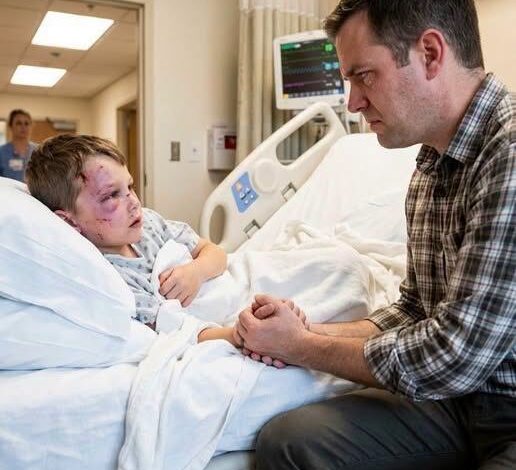
When the doctor finally told me he was awake and asking for me, I stood outside his room for several seconds before entering.
I had to make a decision first.
I could carry my anger through that door.
Or I could leave it in the hallway long enough to be his father.
So I pushed it down.
Not because it had disappeared.
Because Jake had already spent enough time around angry adults.
His face looked worse up close.
One side was swollen.
Purple bruising spread across his cheek.
Small cuts marked his skin.
Dried blood sat near his hairline.
Then he saw me.
“Dad…”
That one word almost dropped me.
I sat beside him and took his hand carefully.
“I’m here, buddy.”
His fingers closed around mine.
Hard.
“I tried to run.”
I wanted to tell him he never should have needed to.
Instead, I asked him what happened.
His grandfather had gotten angry.
“He said you think you’re better than everybody.”
I kept my voice level.
“And then?”
Jake swallowed.
“Uncle Brian grabbed my arms.”
The room seemed to narrow.
“And Uncle Scott held my legs.”
I stared at him.
Those men had always been difficult.
Loud.
Aggressive.
The kind of relatives everyone excused because “that’s just how they are.”
Not anymore.
After those words, they were something else.
Grown men who had used their strength to restrain an eight-year-old child.
Then Jake whispered the part that made everything inside me go cold.
“Grandpa slammed my head on the driveway.”
For a moment, the only thing I could feel clearly was his hand inside mine.
I held onto it.
I needed something physical to keep me in that room.
Jake was not telling me because he wanted revenge.
He was telling me because he needed me to understand what had happened when I wasn’t there.
Then he repeated what his grandfather had said.
“Your daddy isn’t here to protect you.”
That sentence cut deeper than the description of the violence.
The injury was terrible.
But those words made something else clear.
The humiliation had been intentional.
Jake had not only been hurt.
He had been made to believe the person he trusted most had abandoned him.
I leaned down and kissed the uninjured side of his forehead.
“I’ll always come for you.”
His eyes moved away.
Then he said:
“Mom didn’t stop them.”
I had no answer.
There are moments when language becomes useless.
I did not know what Christine would eventually claim happened.
I did not know what explanation she believed could survive this.
All I had were facts.
Jake’s injuries.
His account.
His mother’s absence from the hospital.
And nine missed calls.
Facts were suddenly the only things I trusted.
I stepped into the hallway but kept looking through the glass.
Jake was watching the door.
Watching me.
Making sure I was still there.
That hurt almost as much as anything else.
Before that night, I thought fatherhood was mostly the big things.
Working.
Providing.
Showing up to games.
Fixing what broke.
Keeping promises.
In that hospital, it became much simpler.
Stay where your son can see you.
My phone was still in my hand.
Christine’s name stared back at me.
So did her father’s.
I called neither.
Arguing with people who already knew a child had been hurt would not make Jake safer.
Rage would not answer what I needed answered.
So instead, I opened an encrypted app I had not touched in years.
The contact inside had no name.
It did not need one.
That number belonged to a part of my life I had deliberately buried.
A life Christine barely understood.
She knew me as the man who came home every night.
The father who worried about homework, soccer schedules, grocery lists, and whether the furnace sounded strange.
Her family had mistaken ordinary for weak.
They assumed there was nothing beneath the suburban life except what they could see.
What they did not understand was that the past I had left behind had not taught me how to lose control.
It had taught me the opposite.
It taught me what happens when anger replaces thought.
How quickly bad information becomes action.
How dangerous assumptions become when someone wants them to be true.
How to separate what a person says from what can actually be established.
And most importantly, how to avoid threats when the truth itself can do far more damage.
That was why I made the call.
The connection opened almost immediately.
A familiar voice answered.
“I wondered if I’d ever hear from you again.”
I looked through the glass at Jake.
He had pulled the blanket closer.
“I need help.”
The pause was brief.
“Who are we dealing with?”
I gave the names.
My father-in-law.
Brian.
Scott.
Christine.
I expected questions about what they had done.
Instead, the first question surprised me.
“Does your son still trust you?”
I looked at Jake.
He was still watching the door.
“Yes.”
“Then start there.”
It was not what the angry part of me wanted.
The angry part wanted action.
Immediate consequences.
Someone to feel what Jake had felt.
But the father in me understood.
If I turned the night into my anger, then the people who hurt Jake would still be controlling what happened next.
Jake needed safety before explanations.
He needed to know the next adult entering the room would not drag him into another confrontation.
He needed predictability.
And he needed to know that when he told me the truth, I believed him.
That was when I remembered why my old life mattered.
Not because I had some dramatic alter ego hidden beneath my suburban clothes.
Not because I knew how to hurt people.
Because I knew how to resist the easiest mistake available to me.
Revenge was easy to understand.
Truth was harder.
Truth meant listening while every sentence made me want to leave that hospital and confront someone.
Truth meant remembering exactly what the doctor said about Jake’s concussion instead of turning the hospital into scenery for my fury.
Truth meant remembering the neighbor who found him alone.
The missing shoe.
The blood.
The fact that Christine had not come.
The names Jake gave me.
Truth meant not filling in whatever I didn’t yet know simply because the blanks hurt.
And most of all, truth meant Jake’s safety could not depend on whether the adults who hurt him felt remorse tomorrow.
When I went back into the room, he grabbed my sleeve.
“Dad?”
“Yeah?”
“Are they going to come back?”
That question put every other problem lower on the list.
Not Christine’s calls.
Not her father.
Not Brian.
Not Scott.
My son was in a hospital bed wondering whether the people who had already hurt him were allowed to return.
I sat beside him.
“No.”
He stared at me.
“They’re not coming near you tonight.”
I did not tell him to be brave.
I did not explain that grown-up relationships were complicated.
I did not ask him to defend his mother.
He had already done enough.
I stayed until his breathing slowed.
Until his grip loosened.
Until he stopped checking the doorway every few seconds.
The call to my old contact was no longer a desperate reaction by then.
It had become a decision.
What kind of father was I going to be after the worst thing Jake had ever experienced?
The people who hurt him probably believed anger was all I had left.
Maybe because anger was the only kind of power they understood.
But anger could not tell me why Christine remained at her father’s house while our son was taken away.
It could not tell me whether this had been one sudden eruption or part of something older.
It could not explain why my old contact reacted to those names the way they did.
Only careful answers could do that.
So I listened.
The voice on the phone began telling me that the people surrounding my family were not entirely unknown.
Not clean names.
Not blank files.
There had been prior concerns.
Patterns.
Things that had never touched my life closely enough for me to see them.
Until now.
I did not have the complete picture.
No neat dossier.
No magical explanation.
What I had was worse in a different way.
Questions I had not known to ask until my son ended up in a hospital.
I looked at Jake again.
Hours earlier, his grandfather had told him his father was not coming.
Now I was sitting close enough for him to reach me without leaving the bed.
That was where I began.
Not with revenge.
Not with a threat.
Not by proving Christine’s family had underestimated me.
I began with staying.
With listening.
With documenting every word Jake had said.
With making sure his injuries were recorded accurately.
With making sure no one could later turn his fear into a family misunderstanding.
The next morning, the first person from child protective services arrived.
Then a detective.
I stayed beside Jake through both interviews.
I did not coach him.
I did not answer for him unless he asked me to.
When he became tired, I stopped the conversation.
When he needed water, I got it.
When he looked at me before answering something difficult, I nodded.
You’re okay.
Tell the truth.
That was all.
Christine finally came to the hospital shortly after noon.
She looked like she had not slept.
The second she saw me, she started crying.
“Please let me explain.”
I looked at Jake.
His entire body tightened.
That was enough.
“Not here.”
“He’s my son.”
“And he’s scared of you right now.”
Her face collapsed.
“I didn’t touch him.”
The detective standing nearby heard that.
So did I.
Nobody had asked whether she touched him.
That was the first thing she chose to defend.
I remembered what my old contact had taught me years ago.
Listen closely to what people volunteer.
Sometimes the answer begins before the question.
Christine reached toward the room.
Jake turned his face away.
I stepped between them.
“You can talk to the investigators.”
“Please.”
“Not to him.”
She stared at me as if I had become someone she did not recognize.
Maybe I had.
Or maybe this was simply the first time she had met the version of me that stopped confusing love with access.
By evening, a temporary protective order was already being discussed.
Brian and Scott had been interviewed separately.
Their stories did not match.
Her father’s did not match either.
Each man tried to describe the incident as discipline.
A child being “out of control.”
A family matter.
But bruises are not family terminology.
Neither is a concussion.
Neither is restraining a child while another adult slams his head into pavement.
The facts remained stubborn.
That night, Jake slept while I sat beside him.
My phone vibrated again.
This time it was the old contact.
I stepped into the hall.
“You were right to call.”
“What did you find?”
A pause.
“Enough to tell you this isn’t the first time that family has relied on silence.”
My stomach tightened.
“Children?”
“Not exactly. But intimidation. Assault complaints that went nowhere. Pressure on relatives. People changing stories.”
I closed my eyes.
The shape of the night changed again.
Not because I suddenly knew everything.
Because I understood what secrecy had protected.
People like that rarely begin with the worst thing.
They test boundaries.
They learn who stays quiet.
Who excuses.
Who says, “That’s just how he is.”
Who values family reputation over the person getting hurt.
And then, eventually, the line moves too far.
Jake had been the line.
The old contact continued.
“Don’t chase them.”
“I’m not.”
“Good.”
“What do I do?”
“Keep doing what you’re doing. Medical records. Witnesses. Timelines. Let the system see the pattern.”
The advice felt almost disappointingly ordinary.
That was why I trusted it.
Real protection is often boring.
Forms.
Statements.
Photographs.
Court orders.
Names written correctly.
Dates preserved.
A neighbor willing to tell the truth.
Nothing cinematic.
Everything useful.
Three days later, Jake came home with me.
Not to the old house.
I did not trust the location anymore.
We stayed temporarily somewhere secure while the case moved forward.
His soccer bag came with us.
So did his Lego box.
That mattered to him.
The first night, he placed the missing sneaker’s surviving partner beside the bed and stared at it for a while.
“They never found the other one,” he said.
“No.”
He nodded.
Then:
“I don’t want to go back there.”
“You don’t have to.”
He looked at me carefully.
“Ever?”
I knew better than to promise things courts might eventually influence.
So I answered the part I controlled.
“I will never make you go somewhere you’re afraid to be without listening to why.”
That seemed to satisfy him.
The investigation continued.
Slowly.
Painfully.
Christine gave her statement.
Her version shifted.
First she said she had been inside.
Then that she had come outside after Jake fell.
Then she admitted she had seen Brian holding him.
She insisted she froze.
Maybe she did.
Maybe fear explained part of it.
But explanations did not erase the fact that our son had been hurt while she stood within reach.
That truth broke something between us.
Not instantly.
Not dramatically.
Just permanently.
I had spent years believing family meant people who would become safer when things went wrong.
Now I knew some families become most dangerous when everyone agrees not to tell the truth.
The old life I had abandoned never fully returned.
I did not go back to who I had been.
I did not need to.
Its useful parts came back instead.
Patience.
Observation.
Discipline.
Knowing that rage feels powerful but evidence lasts longer.
Knowing that frightened people often deserve calm more than vengeance.
Knowing that you do not protect a child by becoming the most frightening adult in the room.
Weeks later, Jake asked me something while we were eating breakfast.
“Dad?”
“Yeah?”
“Was Grandpa right?”
“About what?”
“That you weren’t there.”
I put down my coffee.
For a second, I hated myself for not understanding sooner.
“He was right about one thing.”
Jake’s face tightened.
“I wasn’t there when it started.”
I moved closer.
“But he was wrong about the part that mattered.”
“What part?”
“That you were alone.”
Jake looked down.
“You got out. A neighbor helped you. The doctors helped you. The police listened. And I came.”
He nodded slowly.
Then I said the thing I needed him to remember.
“Being brave doesn’t mean nobody ever hurts you. It means when something bad happens, you tell the truth and let safe people help.”
He thought about that.
Then returned to his cereal.
Children sometimes accept enormous truths with almost no ceremony.
The legal process would continue long after that breakfast.
There would be hearings.
Evaluations.
Statements.
Consequences.
Christine and I would have decisions to make that had no painless version.
But the center of the story had become clear.
It was not about my past.
Not about proving dangerous men had underestimated me.
Not about punishing them.
It was about Jake.
Everything else came second.
The night he was hurt, my old contact asked whether my son still trusted me.
At first, I thought the question was too small.
Now I understood it was the largest one anyone could have asked.
Because systems can investigate.
Courts can order.
Doctors can treat.
But a child who has watched trusted adults become dangerous needs one thing before all the rest.
Someone safe who stays.
So I stayed.
Through the scans.
Through the statements.
Through the nightmares.
Through the mornings when he asked whether the doors were locked.
Through the first soccer practice he was cleared to watch but not join.
Through the day he finally laughed again without stopping himself halfway through.
I never told him the full story of the life I had left behind.
He did not need it.
Someday, perhaps.
What he needed now was the man he already knew.
Dad.
The one sitting in the hospital chair.
The one who believed him.
The one who did not turn his pain into a revenge fantasy.
The one who found out what was true and built safety around it.
That became the only identity I cared about keeping.
And eventually, the missing sneaker stopped haunting me.
Not because I forgot it.
Because I began remembering something else.
Jake had lost that shoe while running away.
But he had run.
He had kept moving.
He had found the sidewalk.
The neighbor.
Help.
The shoe was not evidence that he had been abandoned.
It was evidence that he had escaped.
That was the story I chose to carry forward.
Not the driveway.
Not his grandfather’s words.
Not the people who failed him.
The boy who kept moving until someone safe saw him.
And the promise that when he looked up again, I would still be there.