My Neighbor Smashed My Lawn Sprinklers With a Golf Club Because The Water Was Getting on His Brand New Car I Didnt Call the Authorities, but I Came up with Something Better to Teach Him a Lesson!

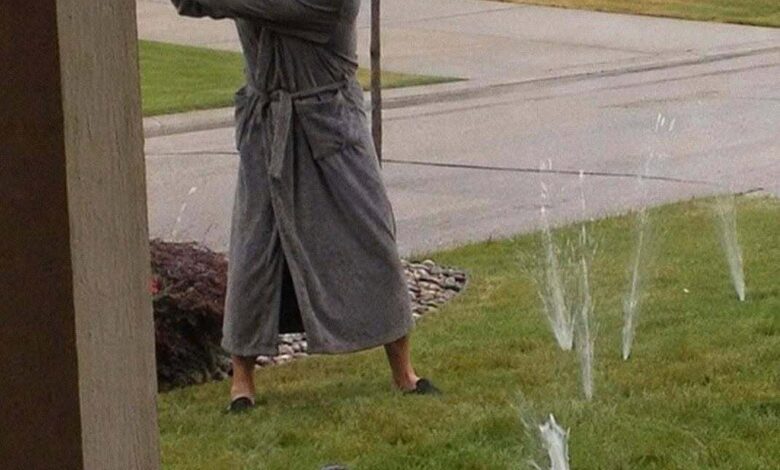
The sound that woke me wasn’t loud enough to be an emergency.
At least, that’s what I thought.
It was barely morning when a sharp crack came from outside my bedroom window.
Then another.
Crack.
Crack.
I pushed aside the curtain and froze.
My neighbor Paul was standing in my yard with a golf club.
And he was smashing my sprinkler system.
For several seconds, I simply watched, too stunned to understand what I was seeing. Then he raised the club again and brought it down on another sprinkler head I’d spent months saving to install.
I rushed outside.
“Paul! What are you doing?”
He turned toward me with the club still in his hand.
“Your sprinklers got water on my car.”
I stared at him.
His new car was parked in his driveway, gleaming in the morning light.
“Water?”
“Yes. Water.”
“So you’re destroying my property?”
His expression barely changed.
“If you can’t control your sprinklers, you shouldn’t have them.”
That sentence told me everything.
To Paul, a few drops of water touching his car justified hundreds of dollars in damage to something that belonged to me.
I was a single mother. That sprinkler system hadn’t been some casual luxury. I’d saved for months because keeping the yard alive while juggling work and children had become one more chore I couldn’t manage every day.
Paul knew none of that.
Or perhaps he knew and simply didn’t care.
This wasn’t our first problem.
Months earlier, flowerpots had disappeared from my yard. When I eventually confronted him, Paul admitted taking them because he thought they were ugly.
Another time, my son’s bicycle had been left where Paul considered inconvenient.
His solution?
He threw it into my flower bed.
Then came the complaints about my children’s treehouse.
The HOA notices.
The little comments near the mailbox.
The constant sense that Paul believed the neighborhood was his private kingdom and the rest of us were tenants who needed his approval.
Every time, I had tried to keep the peace.
Don’t escalate.
We’re neighbors.
We have to live beside each other.
Let it go.
Watching another sprinkler head explode beneath his golf club, I finally understood what all my restraint had accomplished.
Nothing.
My silence hadn’t taught Paul to respect me.
It had taught him there would be no consequences.
But I wasn’t going to give him the confrontation he expected.
I went inside.
And I saved the footage.
My security camera had captured everything.
Paul entering my property.
Paul raising the club.
Paul destroying the sprinkler heads one after another.
Paul standing there afterward as though he had every right in the world to do it.
For once, I had more than my word against his.
I had proof.
I assumed that would be the end of the story.
Then I spoke to Sarah.
“You need to see something,” she told me.
She pulled up footage from her own camera.
There was Paul.
He was carrying her patio chairs away from her property.
“What is he doing?”
“Keep watching.”
The video showed him hauling them toward the curb and dumping them there.
Sarah had apparently confronted him before. He claimed the chairs were an eyesore.
The explanation sounded painfully familiar.
Then Mrs. Henderson joined us.
She brought paperwork.
Three HOA warnings.
All triggered by complaints from Paul.
“He told me he’d keep reporting us until we moved,” she said.
That changed everything.
We started asking around.
One neighbor had a story.
Then another.
Property moved without permission.
Belongings taken.
Threats.
Complaints.
Warnings.
Intimidation disguised as concern for neighborhood standards.
Paul hadn’t been feuding with me.
He had been doing this everywhere.
By that evening, eleven homeowners had signed a joint statement.
I spent the next two nights turning years of frustration into something far more useful than anger.
Videos.
Photographs.
Dates.
Times.
HOA notices.
Written accounts.
Descriptions of threats.
I organized everything into one folder.
That folder mattered because Paul had always relied on isolation.
One angry homeowner could be called difficult.
Two could be dismissed as neighbors taking sides.
But eleven?
Eleven households with documentation created a pattern.
For the first time, we weren’t standing in our separate yards wondering whether fighting back would make things worse.
We were standing together.
Then Sarah sent me a screenshot.
My stomach dropped.
Paul had joined the HOA board.
Of course he had.
While we were gathering evidence for the organization that was supposed to hold him accountable, Paul had managed to place himself inside it.
The next morning, I went to the HOA office.
Paul was already there.
He saw the folder in my hands and smiled.
“You’re too late.”
I stopped.
He stepped closer.
Then he told me exactly what he planned to do.
The treehouse.
He would keep issuing violations over it.
Daily fines if necessary.
He’d make things so expensive that eventually I wouldn’t be able to afford staying in the neighborhood.
My children and I would be forced out.
This time, I didn’t argue.
I walked inside and added his threat to the complaint.
Mark, the HOA president, reviewed the material.
His expression changed as he worked through it.
“This is extensive,” he finally said.
“What happens now?”
“For the moment, don’t confront him.”
That wasn’t the reassuring answer I wanted.
When I got home, something was attached to my front door.
A property-compliance notice.
Another treehouse inspection.
Paul hadn’t wasted any time.
My son saw it.
“Are they going to take the treehouse?”
“No.”
I answered immediately.
Too quickly.
Because the truth was that I no longer knew.
Later, near the mailboxes, Paul made sure I saw how amused he was by our petition.
He believed the board seat had saved him.
Eleven signatures didn’t frighten him.
Evidence didn’t frighten him.
As far as he was concerned, he was now one of the people making the rules.
A few hours later, however, something appeared on his porch.
A large document box.
Attached to it was a formal notice.
Disciplinary Review.
Inside was the complaint.
Eleven names.
Videos.
Photographs.
Statements.
Dates.
Everything.
Paul laughed when he saw it.
Then Mark explained the part Paul apparently hadn’t considered.
Joining the board didn’t protect him from the rules.
It placed him under additional ones.
Board members were expected to meet a higher standard of conduct.
And Paul had signed the code himself.
At the hearing, Sarah showed the footage of him removing her patio chairs.
Another neighbor described having her property thrown into her flowers.
Mrs. Henderson produced the warnings and described Paul’s threat to keep reporting her family until they moved.
Then it was my turn.
I played the sprinkler video.
There was no interpretation required.
Paul walked onto my property.
Raised a golf club.
Destroyed something that wasn’t his.
Again.
And again.
And again.
Then came the treehouse notice.
That might have been the most damaging evidence of all.
Paul had threatened to use his new position to punish me.
Shortly afterward, the compliance action appeared.
What he had intended as intimidation now looked like retaliation.
He had joined the board because he thought authority would make him untouchable.
Instead, he had given everyone another standard by which to judge his behavior.
Four days later, Paul was removed from the board.
He was ordered to pay restitution for my damaged sprinkler system.
And the retaliatory compliance action could no longer be used as a weapon to push my family out.
A week later, I stood in my yard watching a repairman replace the last sprinkler head Paul had smashed.
Sarah came over.
Neither of us said much.
We just watched.
The system switched on.
For a second, nothing happened.
Then water rose from the lawn in clean, controlled arcs.
One stream reached the edge of my property exactly as it was supposed to.
I couldn’t help smiling.
It would have been easy to make that moment about revenge.
It wasn’t.
I hadn’t smashed Paul’s car.
I hadn’t screamed louder than he did.
I hadn’t threatened him back.
What stopped him was much less dramatic.
A camera.
A folder.
Eleven signatures.
People willing to tell the truth together.
For years, Paul had counted on each of us thinking we were alone.
He depended on embarrassment.
Fear.
Exhaustion.
The desire to avoid neighborhood drama.
He knew that if every person swallowed one incident, nobody would ever see the pattern.
The moment we compared stories, his greatest advantage disappeared.
I looked across the yards at the homes around mine.
For years, I’d thought protecting my family meant keeping things quiet.
Don’t cause trouble.
Don’t make enemies.
Don’t turn a disagreement into a war.
But peace and silence aren’t the same thing.
Sometimes silence only gives the loudest person more room.
I hadn’t protected my home by enduring Paul’s behavior.
I protected it when I stopped treating his conduct as something I had to handle alone.
I documented.
I listened.
I found other people willing to speak.
And together, we built something stronger than his intimidation.
A record he couldn’t argue away.
The sprinklers continued turning across the lawn.
My son ran outside and watched the water glitter in the afternoon light.
The treehouse still stood behind him.
So did our home.
Sarah smiled beside me.
Paul had believed power meant making everyone else afraid to challenge him.
He had been wrong.
Real power had been sitting quietly in eleven houses all along.
It appeared the moment eleven neighbors stopped being afraid separately and decided to stand together.