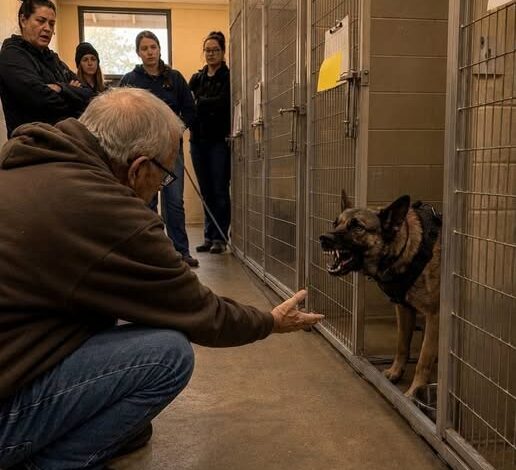
The Belgian Malinois stood eight feet from Samuel Gage and looked like a dog who had forgotten what safety was supposed to feel like.
His ribs showed beneath a coat gone dull and matted. Fresh rope burns circled his neck. Every muscle in his body was locked tight.
Behind the quarantine window, shelter workers barely moved.
A security officer stood nearby with one hand close to his rifle.
Samuel crouched.
He did not stare directly at the dog.
He did not reach too quickly.
He did not use the soft, coaxing voice people often use with frightened animals.
He simply said one word.
“Kestrel.”
The dog changed.
Only slightly at first.
His raised hackles lowered a fraction.
His head tilted.
One paw moved forward.
Then another.
Samuel extended one hand, palm low, but made no attempt to touch him.
Kestrel closed the distance.
He pressed his nose against Samuel’s knuckles.
For one long second, neither moved.
Then the dog leaned his forehead into Samuel’s palm.
It was such a small gesture that someone unfamiliar with working dogs might have missed its weight entirely.
Samuel did not.
His shoulders dropped.
Kestrel leaned harder.
Eight years disappeared.
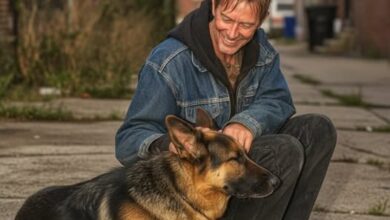
When Samuel finally unclipped the chain, the dog stepped against his leg and stayed there.
Nobody behind the glass spoke.
They had expected aggression.
What they were watching instead looked almost like recognition made physical.
Samuel had been coming to the county shelter every Tuesday for three years.
Most people knew him only as the quiet man who delivered animal feed.
He drove an old pickup.
Unloaded bags.
Signed paperwork.
Usually left without lingering.
He did not tell stories about his past.
He did not wear it on his sleeve.
The scar across his face told enough.
Eight years earlier, Samuel had been Kestrel’s first military handler.
They had trained together.
Worked together.
Deployed together.
Then Fallujah changed everything.
Samuel was badly wounded in 2016.
He lost one eye and most of the sight in the other.
The injuries ended his military career.
Kestrel’s did not.
That was the part Samuel had never been able to make peace with.
Military working dogs do not belong to one person in the sentimental way civilians often imagine.
They belong to a system.
Handlers rotate.
Assignments change.
Dogs continue working.
After Samuel’s medical discharge, Kestrel was reassigned.
Then reassigned again.
Three handlers in total.
The last died in service.
After that, Samuel lost track of the dog completely.
He asked questions for a while.
Made calls.
Followed whatever trail he could.
Eventually, the trail disappeared.
He told himself Kestrel had probably been retired somewhere decent.
Perhaps adopted by another handler.
Perhaps living out his final years on acreage with someone who understood what kind of dog he was.
That was easier to believe.
Then Brenda, the shelter director, scanned the microchip.
At first, she expected an ordinary registry.
Name.
Owner.
Phone number.
Maybe an outdated address.
Instead, the chip connected to a Department of Defense database.
The animal in quarantine was not simply a stray Belgian Malinois.
He was a retired military working dog.
Formally retired fourteen months earlier.
There was supposed to have been an adoption.
Somewhere between retirement paperwork, transfer records, and whatever happened afterward, the process had failed.
No civilian owner was properly registered.
No tags had been found.
No one had reported him missing in a way that reached the shelter.
He had finally been discovered wandering near an industrial park.
Underweight.
Dehydrated.
Rope burns around his neck.
Terrified enough that staff initially believed he might never be safe outside quarantine.
Then Samuel happened to arrive with the Tuesday feed delivery.
Brenda mentioned the chip.
Mentioned the military registry.
Mentioned the dog’s call sign.
Kestrel.
Samuel stopped moving.
He asked to see him.
That brought them to the quarantine room.
The dog everyone else approached with caution had walked straight into Samuel’s hand.
For Samuel, the next question seemed obvious.
“I want to take him home.”
The shelter staff wanted the same thing.
The federal system did not operate on emotion.
Kestrel’s military status meant the adoption could not be treated like an ordinary county transfer.
There had to be verification.
Veterinary assessments.
Ownership documents.
Military-release records.
Liability forms.
A waiting period.
The shelter had never processed anything like it.
Brenda started calling.
One office transferred her to another.
A regional number sent her to a liaison.
The liaison requested paperwork nobody at the shelter had ever seen before.
Samuel waited.
He was good at that.
Waiting had been part of military life.
So had bureaucracy.
Still, every delay felt different now because Kestrel was finally within reach.
Then Colonel Patricia Reeves heard Samuel’s name.
The case changed speed.
She remembered him.
More importantly, she remembered Kestrel.
Orders came down to expedite the review.
The process still took six days.
For Kestrel, those six days became a kind of transition.
Veterinarians treated his dehydration.
His malnutrition.
The rope injuries around his neck.
He tolerated them because Samuel was there.
Every morning, Samuel arrived before most of the shelter had settled into the day.
He sat on the kennel floor.
No treats.
No toys.
No excited praise.
He understood what Kestrel needed better than anyone.
The dog was not searching for entertainment.
He was searching for something recognizable.
A voice.
A rhythm.
A presence.
Something from the old world strong enough to survive everything that had happened since.
Samuel gave him that.
Sometimes he spoke old commands.
Quietly.
Kestrel responded almost automatically.
Down.
Stay.
Heel.
Watch.
The words still lived somewhere deep inside him.
Other times Samuel said nothing at all.
He simply sat.
Eventually, Kestrel would lower himself beside him.
Then closer.
By the third morning, he slept against Samuel’s leg.
The shelter staff noticed the difference.
The dog who had lunged at sudden movement stopped tracking every person as a threat.
He still startled.
Still remained alert.
Still carried the posture of an animal trained to notice what everyone else missed.
But with Samuel beside him, the defensive edge softened.
His breathing changed.
He slept more deeply.
He began eating consistently.
One technician said it felt as if Kestrel had finally received permission to stop working.
Samuel understood that too.
Military dogs are trained to remain ready.
To search.
Alert.
Protect.
Hold position.
Follow commands even in chaos.
Kestrel had spent years being useful.
Now someone needed to teach him he was allowed simply to exist.
On the sixth day, authorization arrived.
The Department of Defense approved the transfer.
The county completed its portion.
Samuel signed the medical forms.
The liability documents.
The ownership papers.
Every line required for a retired military working dog.
There were so many signatures that Brenda joked Kestrel had generated more paperwork than some human adoptions.
Samuel smiled.
“Sounds about right.”
The veterinary report documented significant stress and deprivation.
There were no permanent medical findings that would prevent Kestrel from living safely with Samuel.
The final condition was the property inspection.
Samuel lived on a farm outside town.
Secure acreage.
A barn.
Fenced land.
Plenty of distance from traffic and crowds.
The kind of quiet environment recommended for an animal who had spent too long living inside uncertainty.
The farm passed.
That afternoon, Kestrel left the shelter.
There was no dramatic ceremony.
No crowd.
Samuel opened the passenger door of his pickup.
Kestrel climbed in.
Then, instead of sitting upright and watching everything, the dog rested his head against Samuel’s leg.
Samuel placed one hand on his neck.
Carefully.
Avoiding the healing rope burns.
The drive home was quiet.
At the farm, Kestrel stepped out and immediately began inspecting.
Yard.
Barn.
Tree line.
Fence.
Doorways.
Old habits remained.
He moved with the methodical precision of a working dog checking a new perimeter.
Samuel let him.
He did not call him back.
Did not rush him.
When Kestrel seemed satisfied, he climbed the porch steps.
Turned once.
Then stretched out in a patch of afternoon sun.
Samuel stood nearby.
For the first time in years, Kestrel was somewhere nobody expected anything from him.
No search.
No patrol.
No reassignment.
No next handler.
Just home.
During the final welfare visit, shelter veterinarian Anya stood on the porch watching him sleep.
She had been curious about the name from the beginning.
“Kestrel,” she said. “Why that?”
Samuel looked toward the dog.
“A kestrel is a small falcon.”
Anya nodded.
“I know the bird.”
“They can hold almost perfectly still while everything around them moves.”
He paused.
“Then strike exactly when they need to.”
He looked at Kestrel again.
“That dog could hold position under fire without losing focus. Didn’t matter what was happening around him.”
Anya smiled.
“So the name was about the dog.”
Samuel gave a small shrug.
“Mostly.”
She looked at him.
One damaged eye.
The other doing the work for both.
A man who had spent years carrying a loss nobody at the shelter had known existed.
A man who had walked into quarantine and spoken one word instead of making a scene.
A man who had waited six days without demanding special treatment even though every hour mattered to him.
Anya looked from Samuel to Kestrel.
“I think it fits both of you.”
Samuel did not answer.
He didn’t need to.
Back at the shelter, Anya printed a photograph.
It had been taken the day Kestrel left.
Samuel stood beside the pickup.
Kestrel leaned against his leg.
Nothing about the image was dramatic.
That was why she liked it.
She pinned it near her desk.
Then she completed the adoption record.
The official file reduced everything to dates.
Transfer.
Medical assessment.
Ownership verification.
Release.
Adoption.
Those things mattered.
Systems need records.
But the paperwork could not capture the actual story.
It could not explain what it meant for a dog to hear a voice after eight years and recognize safety.
It could not explain what it meant for a wounded handler to touch the head of the animal he thought he had lost forever.
It could not measure the distance between three handlers, one death in service, a failed retirement transfer, an industrial park, a county shelter, and a farm porch.
And it could not translate the meaning inside a single word.
Kestrel.
To everyone else, it was a name.
To the dog, it was memory.
Command.
Recognition.
Home.
Samuel had once taught him that when the world became chaotic, his voice was something worth following.
Eight years later, after reassignment, loss, hunger, fear, and abandonment, that lesson remained.
The dog had remembered.
Maybe Samuel had too.
Because when he crouched in that quarantine room, he had not asked Kestrel to prove anything.
He had not asked him to be brave.
He had not demanded trust.
He had simply made himself recognizable.
I am here.
The rest came naturally.
In the weeks that followed, Kestrel settled into farm life.
He still inspected the property each morning.
Still raised his head whenever an unfamiliar vehicle slowed near the road.
Still chose positions where he could watch entrances.
Training does not disappear simply because paperwork says retired.
But other habits emerged.
Sleeping in sunlight.
Following Samuel from room to room.
Lying beside him while he worked.
Standing at the kitchen doorway in the evening with no mission except knowing where his person was.
Samuel did not try to make him into an ordinary pet.
Kestrel had never been ordinary.
He respected what the dog had been while giving him permission to become something else.
Safe.
That mattered more.
Sometimes visitors asked whether Kestrel remembered the war.
Samuel never answered for him.
Nobody knew what dogs remembered in the way humans understood memory.
But he knew what Kestrel recognized.
Commands.
Tone.
Touch.
Routine.
And him.
That was enough.
There were scars on both of them.
Samuel’s were easier to see.
Kestrel’s were partly hidden beneath fur.
Neither needed the other to pretend those scars were gone.
They only needed somewhere those scars were not the whole story.
The farm became that place.
Years earlier, Samuel had believed losing Kestrel was one more thing war had taken.
Then one Tuesday morning, buried inside an ordinary feed delivery, life returned something.
Not untouched.
Not unchanged.
But alive.
And waiting.
That may have been the greatest miracle in the story.
Not that Kestrel survived.
Working dogs are bred and trained to survive difficult things.
Not that Samuel recognized him.
He had known that dog too well not to.
The miracle was that after everything, recognition still mattered.
One word could still reach through fear.
One voice could still mean safety.
One person could still become home.
At the shelter, the photograph remained near Anya’s desk.
New employees would eventually ask about it.
She would tell them.
The abandoned Malinois.
The military registry.
The handler nobody knew had once served beside him.
The quarantine room.
The single word.
The six-day federal review.
The farm.
But eventually, she stopped describing it as an adoption story.
That word felt too small.
Adoption suggested one life taking responsibility for another.
This had been something different.
Two lives had been separated.
Both had gone through things the other could not witness.
Then, eight years later, circumstance brought them into the same room.
Samuel said his name.
Kestrel stepped forward.
And whatever distance remained between those lost years disappeared beneath the touch of a dog’s forehead against an old handler’s palm.
There are reunions that need speeches.
This one needed only one word.
Kestrel.
And everything inside it still meant what it always had.
I am here.
You are safe.
You are not alone.