The morning began like countless others before it.
Sunlight filtered gently through the trees, casting golden streaks across my garden. Dewdrops clung to leaves like tiny jewels, sparkling whenever the light touched them. Birds filled the air with cheerful songs, while bees drifted lazily between blossoms, collecting nectar in the cool morning air.
It was my favorite part of the day.
Before emails.
Before responsibilities.
Before the noise of the world had a chance to intrude.
Gardening had always been my escape. There was something deeply comforting about tending plants, pulling weeds, and watching life unfold at its own pace. The garden demanded patience, and in return, it offered peace.
That morning felt no different.
At least, not at first.
I was kneeling beside one of my rose bushes, carefully trimming away a few faded blooms, when something unusual caught my eye.
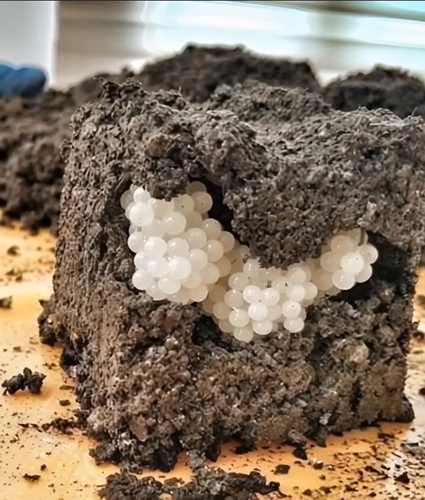
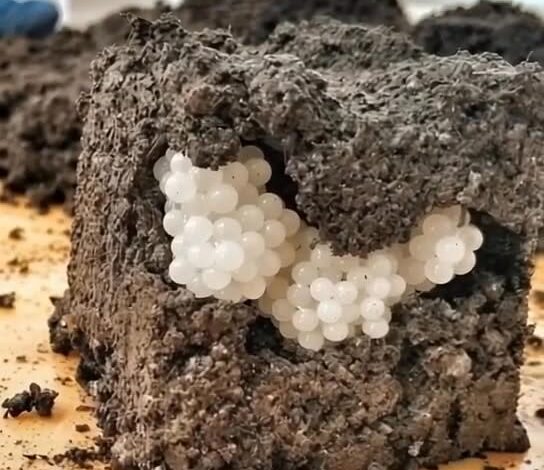
Near the base of the plant, partially hidden beneath damp soil and scattered mulch, sat a small cluster of white spheres.
I paused.
At first glance, they looked harmless.
Tiny.
Perfectly round.
Almost beautiful.
My first thought was that they might be bits of fertilizer or decorative stones mixed into the soil somehow. Their pale color stood out sharply against the rich dark earth, making them impossible to ignore once I noticed them.
Curiosity pulled me closer.
The cluster appeared strangely organized.
The tiny white objects were packed together tightly, almost as if someone had carefully placed them there by hand.
I leaned forward.
What I saw immediately deepened the mystery.
Each sphere was smooth and slightly translucent.
The morning sunlight passed through them, giving them a delicate glow that reminded me of pearls.
For several moments, I simply stared.
The garden around me continued its quiet symphony.
Birds sang.
Leaves rustled.
Bees hummed.
Yet my attention remained fixed on those strange little orbs.
Something about them felt important.
I slipped on my gardening gloves and reached down.
Carefully, I touched one.
To my surprise, it wasn’t hard.
The sphere yielded under gentle pressure.
Soft.
Gelatinous.
Cool to the touch.
A small chill ran down my spine.
These weren’t stones.
They weren’t seeds either.
Whatever they were, they were alive.
Or at least, they had once been part of something living.
My curiosity quickly transformed into fascination.
I gently lifted a few of the spheres into my palm and examined them more closely.
They looked delicate enough to burst if squeezed.
Fragile.
Mysterious.
Beautiful in an oddly unsettling way.
The longer I looked, the more questions I had.
I carried several of them inside the house for a closer inspection.
Under the brighter light of my kitchen, details that had been invisible outdoors suddenly emerged.
I held one near the window.
My breath caught.
Inside the translucent shell, I could make out a tiny dark speck.
Then another.
Tiny shapes suspended within the gelatinous spheres.
Not fully formed.
Not recognizable.
But undeniably there.
A realization slowly settled over me.
These weren’t merely strange objects.
They were eggs.
Dozens of them.
The discovery filled me with equal parts wonder and concern.
Life existed inside those tiny spheres.
Something was waiting to emerge.
The question was simple.
What exactly?
I spent the next hour researching.
Photographs.
Gardening forums.
Wildlife guides.
Biology websites.
Eventually, the answer became clear.
The mysterious white pearls in my garden were snail eggs.
Suddenly, everything made sense.
Snails often lay eggs in moist, protected soil where conditions remain cool and damp. Flower beds, garden borders, and shaded areas provide ideal environments for their development.
The eggs remain hidden underground until conditions are right.
Then, within a matter of weeks, dozens of young snails emerge.
At first, I felt a sense of awe.
There was something remarkable about discovering life in such an early stage.
Nature constantly works behind the scenes.
While we focus on flowers and vegetables, countless invisible processes unfold beneath the surface.
Seeds germinate.
Roots expand.
Insects develop.
Eggs hatch.
Entire worlds exist below our feet.
Yet as fascinating as the discovery was, another reality soon entered my mind.
Snails and gardeners rarely coexist peacefully.
I had spent years building my garden.
Nurturing plants.
Protecting seedlings.
Cultivating flowers.
A large snail population could undo much of that work surprisingly quickly.
Tender leaves.
Young shoots.
Vegetables.
Flowers.
All of them could become food.
I’ve heard countless stories from fellow gardeners who woke up to discover entire sections of their gardens devastated overnight.
The damage often begins quietly.
A few holes in leaves.
A missing seedling.
Then suddenly, the problem becomes impossible to ignore.
As I continued researching, I learned that while most garden snails are harmless, some species can carry parasites that pose risks to pets and, in rare circumstances, humans.
Proper handling and caution were strongly recommended.
The discovery had shifted from curiosity to responsibility.
I knew I couldn’t simply leave the eggs where they were.
Not if I wanted to protect the balance of the garden.
Returning outside, I located the cluster once more.
For a moment, I hesitated.
The eggs seemed so delicate.
So harmless.
Yet I understood what they represented.
Not evil.
Not danger.
Simply nature following its course.
But gardening requires choices.
Maintaining a healthy environment often means intervening before small problems become larger ones.
Following guidance from horticultural experts, I carefully poured boiling water over the area.
The process was quick.
Humane.
Effective.
Then I gently turned over the surrounding soil, inspecting beneath leaves, stones, and patches of mulch.
The search became almost meditative.
Each handful of soil revealed a hidden world.
Tiny insects scurried away from the light.
Earthworms moved through rich organic matter.
Roots stretched through the darkness like underground highways.
The more I looked, the more I realized how much life existed beneath the surface.
Most of it unseen.
Most of it unnoticed.
That realization stayed with me long after the eggs were gone.
Because the experience wasn’t really about snails.
It was about awareness.
The eggs had been there all along.
Hidden in plain sight.
Had I ignored them, they would eventually have transformed into something much larger.
The same principle applies far beyond gardening.
Life often sends subtle signals before problems become obvious.
Small warning signs.
Minor irregularities.
Tiny details that seem insignificant until they suddenly aren’t.
The people who thrive aren’t necessarily those who react fastest.
They’re often the ones who notice earliest.
That morning changed the way I garden.
Now I pay closer attention.
I examine leaves more carefully.
Watch for silvery snail trails after rain.
Study the soil instead of merely walking across it.
I notice things I once overlooked.
But more importantly, it changed how I view nature itself.
Those tiny white spheres taught me that beauty and consequence often exist side by side.
Something can appear delicate and harmless while still carrying the potential to transform an entire environment.
Nature isn’t good or bad.
It simply is.
Its systems operate continuously, whether we notice them or not.
Our responsibility isn’t to dominate those systems.
It’s to understand them.
To observe.
To learn.
And when necessary, to act thoughtfully.
Even today, when I step into the garden at sunrise, I sometimes find myself looking toward the spot where I discovered those tiny pearls hidden beneath the soil.
The flowers still bloom.
The bees still hum.
The birds still sing.
Everything appears peaceful.
Yet now I understand that beneath every garden lies a hidden world full of activity, surprises, and lessons waiting to be discovered.
And sometimes, the smallest discoveries teach the biggest truths.
All it takes is the willingness to kneel down, look closer, and pay attention to what most people never see.