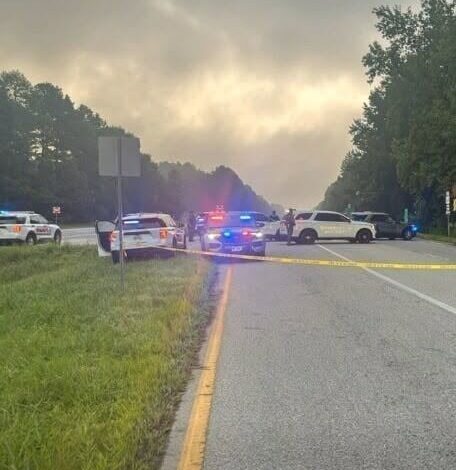
By the time dusk settled fully over the neighborhood, the streets no longer felt familiar.
What had once been an ordinary cluster of homes, sidewalks, parked cars, and porch lights now carried the atmosphere of something suspended between emergency and uncertainty. The neighborhood remained physically present — children’s bicycles still leaned against fences, dinner dishes still sat in sinks, televisions still glowed behind curtains — yet emotionally it felt transformed into a sealed world operating under entirely different rules.
Residents described the sensation almost like living beside an invisible border.
You could see the flashing lights.
Hear radios crackling.
Watch officers moving deliberately through intersections.
But understanding remained out of reach.
That emotional gap between visibility and knowledge often becomes one of the most psychologically difficult parts of large police operations or unfolding emergencies. Human beings instinctively seek narrative during crisis:
What happened?
Who is hurt?
Is the danger over?
Are we safe?
When answers remain unavailable, imagination fills the silence instead.
And silence itself changes during moments like these.
Normally, neighborhoods carry familiar ambient sounds:
dogs barking,
distant traffic,
someone mowing a lawn,
neighbors speaking casually outside.
But during active emergencies, silence acquires weight. Every pause between sirens feels charged with possibility, as though something unseen is still unfolding just beyond public view.
Parents pulling children away from windows captures this emotional reality powerfully.
Children naturally move toward spectacle and curiosity. Flashing lights and emergency vehicles draw attention almost magnetically. Adults, however, recognize danger differently. They understand how quickly uncertain situations can escalate and how little information civilians usually possess during active operations.
So instinct takes over:
close blinds,
lock doors,
keep everyone inside,
stay reachable by phone.
The neighborhood begins operating collectively through caution.
At the same time, modern crises unfold through another layer previous generations experienced differently:
constant digital communication.
People text relatives frantically.
Neighborhood group chats explode with speculation.
Social media fills with half-confirmed updates and blurry videos.
Residents refresh local news feeds repeatedly hoping for clarity.
Technology creates connection, but it also intensifies emotional volatility during uncertain events. Information moves faster than verification. Rumors spread quickly because uncertainty itself becomes emotionally unbearable.
One person reports hearing shots.
Another claims suspects remain nearby.
Someone else insists the danger has ended.
Meanwhile, outside, convoys of marked and unmarked vehicles continue rolling slowly through streets illuminated red and blue.
That contrast between public uncertainty and official movement creates a strange psychological tension. Civilians wait passively while emergency personnel move with purpose, suggesting decisions are being made somewhere beyond ordinary visibility.
And perhaps that is where the quiet trust described in the scene begins emerging.
Because beneath fear often exists another emotion people rarely articulate during crises:
dependence.
Communities rely heavily on unseen systems during emergencies:
dispatchers coordinating resources,
officers securing perimeters,
medics stabilizing victims,
technicians gathering evidence,
command staff making rapid decisions under pressure.
Most residents never witness the full complexity of those operations directly. They only see fragments:
ambulance lights disappearing around corners,
officers speaking urgently into radios,
roads suddenly blocked without explanation.
But inside those fragments lies enormous procedural coordination designed around one overwhelming priority:
preventing further harm.
The phrase “practiced urgency” captures emergency response culture especially well.
Professionals operating in crisis environments cannot afford panic outwardly even when stakes are extremely high. Their calm movements often mask intense pressure underneath:
uncertain threats,
limited information,
potential casualties,
public scrutiny,
split-second decisions carrying lasting consequences.
To civilians watching from windows or behind barricades, that composure can become emotionally reassuring. Even without answers, people look for signs that someone understands the situation more clearly than they do.
And during emergencies, trust frequently becomes less ideological than practical.
People may disagree about politics,
law enforcement,
government,
or institutions generally.
But when danger enters physical space directly, communities often return instinctively to simpler emotional needs:
protection,
coordination,
medical care,
containment,
order restored safely.
That does not erase fear or skepticism entirely.
But it complicates them.
The neighborhood waiting “between rumor and fact” reflects another truth about modern emergencies: information now arrives unevenly and emotionally filtered. Some residents may already know victims personally while others remain completely in the dark. Journalists seek confirmation. Families seek reassurance. Officials balance transparency against operational security.
Meanwhile ordinary people simply wait.
Waiting itself becomes exhausting.
Every passing minute stretches emotional tension further:
Should we leave?
Should we stay?
Is it safe to sleep?
Should we check on neighbors?
Are loved ones accounted for?
Crisis compresses communities emotionally. People who barely spoke before may suddenly exchange messages, share updates, or offer shelter. Fear often strips away ordinary social distance temporarily because survival instinct emphasizes collective vulnerability.
And perhaps that is why the final hope feels so profoundly human:
that when the lights finally dim and roads reopen, the lasting memory will be relief rather than tragedy.
Not heroics.
Not headlines.
Simply relief.
Relief that children are safe.
Relief that loved ones answer phones.
Relief that the worst possibilities imagined during long hours of uncertainty did not fully materialize.
Communities never emerge entirely unchanged from nights like these. Even after barricades disappear and routines resume, something subtle lingers:
the memory of vulnerability,
the awareness of how quickly ordinary life can rupture,
the realization that safety often depends on fragile systems working correctly under pressure.
Yet people continue afterward anyway.
Children eventually return outside.
Neighbors resume conversations.
Traffic flows normally again.
And slowly the neighborhood reclaims its ordinary identity from the shadow of the emergency that briefly transformed it into something tense,
sealed,
and frighteningly uncertain.
But for those who watched flashing lights flicker across their windows at dusk that night, the memory remains:
the strange heaviness of waiting together in partial darkness,
trusting unseen hands to carry everyone safely through until morning.