Some people spend their whole lives wondering what unconditional love is supposed to feel like.
They search for it in marriages that slowly harden into routine, in friendships that fade under pressure, in parents who tried but could never fully say the right things at the right time. They spend years hoping to find someone who stays—not only when life is easy, but when everything falls apart.
I never had to search for that kind of love.
It was already waiting for me before I was old enough to understand what love even meant.
It looked like rough hands smelling faintly of motor oil and coffee.
Like a navy-blue work jacket hanging by the front door.
Like a man in his late sixties running into a burning house because somewhere inside, a baby was still crying.
That man was my grandfather.
And on prom night, when he rolled into that crowded gym in his wheelchair while hundreds of eyes turned toward us, I realized something I should have understood long before then:
he had not only saved my life once.
He had spent every single year afterward saving it again in quieter ways.
I don’t remember the fire itself.
People always seem surprised by that, as though surviving something tragic should automatically come with cinematic memory. But I was too young. The night exists in pieces borrowed from other people:
neighbors describing orange flames swallowing the roof,
paramedics talking about smoke thick enough to blind,
reporters photographing ash-covered sidewalks while dawn crept over the neighborhood.
And at the center of every version of the story stands my grandfather.
Sixty-seven years old.
Already retired.
Already carrying bad knees and the slow stiffness age leaves behind in a body.
Yet the moment someone screamed there was still a baby inside, he ran toward the fire anyway.
Not because he thought carefully about heroism.
Not because he believed he would survive.
Because love sometimes moves faster than fear.
Witnesses later said the flames had already climbed most of the staircase by the time he got inside. Smoke poured through shattered windows. Firefighters hadn’t even arrived yet. People begged him not to go.
He ignored all of them.
When he finally came back out, he was carrying me against his chest wrapped inside a soot-covered blanket. He collapsed on the lawn coughing violently while neighbors poured water over his burned arms and waited for ambulances.
The paramedics wanted him hospitalized longer for smoke inhalation.
He stayed one night.
Then signed himself out against medical advice because, as he later explained with typical stubbornness:
“Somebody had to take care of you.”
That somebody became him.
Entirely.
From that day forward, my grandfather stopped being only a grandfather.
He became everything.
People sometimes pitied me growing up because I didn’t have parents, but honestly, I never experienced my childhood as lacking. I had one person who loved me with enough steadiness to make the absence less frightening.
To me, our little house was normal.
The smell of his coffee brewing before sunrise.
Country music playing too loudly on Saturday mornings.
His reading glasses sliding down his nose while helping me with homework he barely understood but insisted on trying anyway.
Love built itself there through repetition.
Every single morning before school, he packed my lunch.
And every single morning, tucked between sandwiches and apple slices, there was a handwritten note.
Sometimes they were silly:
Don’t trade your cookies again.
Sometimes encouraging:
You’re braver than you think.
Sometimes embarrassingly sentimental:
Best granddaughter in the world.
I rolled my eyes constantly by middle school.
“Grandpa, people are going to see these.”
“So?” he’d reply. “Maybe they’ll get jealous.”
Eventually I begged him to stop because being twelve years old means believing embarrassment is a form of death.
He pretended to agree.
Then started hiding shorter notes inside napkins instead.
That was him.
Quietly stubborn in all the ways that mattered.
When I was younger, he taught himself how to braid hair because I came home crying one afternoon after another girl laughed at my uneven ponytail. That night, I found him sitting at the kitchen table watching tutorial videos online with intense concentration while practicing on an old doll he’d bought from a thrift store.
For weeks afterward, my braids looked terrible.
Crooked.
Too tight.
Falling apart by lunchtime.
But he kept trying.
Eventually, his hands learned.
That memory destroys me now because it captures who he was perfectly:
a man from a generation not raised to discuss emotions openly, yet willing to sit through hours of hair-braiding tutorials because love demanded adaptation.
He came to everything.
School plays where I forgot lines.
Band concerts where half the notes squeaked.
Parent-teacher conferences where teachers smiled gently at the old man trying so hard to fill impossible shoes.
And every time I walked onto a stage or field or platform, I could find him instantly in the crowd because he applauded louder than anyone else.
Not polite applause.
Proud applause.
The kind that says:
I need the world to understand how extraordinary you are.
Of course we fought too.
Real love includes friction.
He burned dinners regularly because he got distracted telling stories halfway through cooking. I ignored chores. We argued about curfews once I became a teenager convinced freedom was being unfairly withheld from me specifically.
Sometimes I slammed doors dramatically.
Sometimes he muttered under his breath about “attitude.”
But no matter how angry either of us became, the distance never lasted long.
We always found our way back.
Usually through dancing.
That was our thing.
Whenever I felt nervous about school dances or social events, he’d push the kitchen chairs aside and hold out one hand formally like some old movie gentleman.
“Come on,” he’d say. “Everybody should know how to dance.”
Then we’d spin slowly across the linoleum floor while old records played through crackling speakers.
I used to laugh so hard during those dances I could barely breathe because he took them absurdly seriously:
dramatic dips,
ridiculous twirls,
over-the-top ballroom posture.
And every single time, he ended the evening exactly the same way.
“When prom comes,” he’d announce proudly, “I’m going to be your date. Most handsome one there too.”
I always laughed.
But I believed him.
Then life changed again.
I was fifteen when I found him collapsed on the kitchen floor.
One side of his body wouldn’t move.
His speech sounded broken and uneven.
The coffee mug beside him had shattered across tile.
Even before the ambulance arrived, terror settled into me so completely it felt physical.
At the hospital, doctors used words like:
severe stroke,
limited mobility,
uncertain recovery.
The man who once carried me from fire suddenly could not stand without help.
Watching someone strong become vulnerable rearranges your understanding of the world permanently.
Especially when that person has always seemed indestructible.
Recovery was brutal.
Physical therapy exhausted him.
Speech exercises frustrated him.
Simple tasks became humiliatingly difficult.
And beneath all of it lived something even harder:
his fear of becoming a burden.
I caught him crying once late at night because he couldn’t button his own shirt properly anymore.
He didn’t know I saw.
After that, I started helping more quietly so it wouldn’t feel like pity.
We adapted.
Ramps replaced stairs.
Medicine schedules replaced spontaneity.
Wheelchairs became ordinary furniture in our house.
And despite everything, he still showed up for me.
At my scholarship interview, I spotted him in the front row wearing his best jacket and giving me a tiny thumbs-up with his stronger hand.
Afterward he told me:
“You’re not somebody life breaks. You’re somebody it makes stronger.”
I carried those words everywhere after that.
So when prom season arrived senior year, the decision felt obvious to me long before anyone else understood it.
Friends obsessed over dresses and dates and elaborate proposals.
Meanwhile, I already knew exactly who I wanted beside me.
One evening during dinner, I looked across the table and said casually:
“You know you’re still taking me to prom, right?”
He laughed immediately.
Then realized I wasn’t joking.
The laughter faded.
His eyes dropped toward the wheelchair.
“I don’t want people staring at you,” he said quietly.
The sadness in his voice nearly broke me.
Because suddenly I understood:
the man who had spent my whole life making me feel protected now feared embarrassing me simply by existing visibly beside me.
I moved beside his chair and knelt down.
“You ran into a burning house for me,” I whispered. “You think I care what anybody thinks?”
His eyes filled instantly.
Still, he hesitated.
“I can’t dance like I used to.”
“Yes, you can.”
“No,” he said softly. “Not really.”
I took his hand.
“You taught me that dancing isn’t about standing,” I told him. “It’s about showing up.”
That made him cry.
Which immediately made me cry.
Eventually he cleared his throat dramatically and said:
“Well, if I’m going, I’m wearing the navy suit.”
Prom night arrived wrapped in blue lights and nervous excitement. Girls adjusted makeup in bathroom mirrors while boys pretended not to care how nervous they were.
And then there was us.
Me in a blue dress I spent months altering by hand because money was tight.
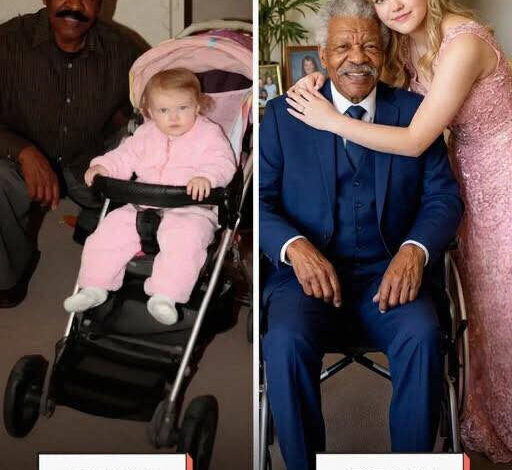
Him in that navy suit, freshly pressed, silver hair combed carefully back.
When we entered the gym together, conversations softened almost immediately.
People stared.
Not cruelly at first.
Just surprised.
Teenagers are rarely prepared for vulnerability interrupting celebration.
Still, for one beautiful hour, everything felt perfect.
We took photos.
Laughed.
Shared cake far too sweet for either of us.
Then someone whispered something.
Quiet.
Cruel.
Meant to stay private.
But humiliation has a way of carrying across rooms.
A few people laughed awkwardly.
I felt anger rise instantly.
Before I could respond, however, my grandfather began wheeling himself slowly toward the DJ booth.
The music faded.
The entire room turned toward him.
And suddenly I panicked because I thought maybe he was hurt.
Instead, he reached for the microphone.
The gym fell completely silent.
Then he looked directly toward the girl who had made the comment and smiled gently.
“Would you dance with an old man?” he asked.
The room froze.
The girl looked horrified initially, caught between embarrassment and uncertainty. But after several seconds, she walked slowly toward him while everyone watched.
Then the music started again.
And something extraordinary happened.
My grandfather began moving across the dance floor with astonishing grace.
Not standing.
Not pretending disability didn’t exist.
Dancing exactly as he was.
He spun the wheelchair rhythmically.
Guided movements smoothly with practiced confidence.
Turned the moment from pity into celebration so naturally the entire room transformed around him.
People started cheering.
Then clapping.
Then crying.
Even the girl dancing with him began smiling through tears because suddenly she understood what everyone else was seeing:
not weakness,
not tragedy,
but dignity.
Pure dignity.
When the song ended, applause exploded across the gym louder than anything I’d ever heard.
My grandfather lifted the microphone again.
“My granddaughter,” he said carefully, voice rough from emotion, “is the reason I survived my stroke.”
The room quieted instantly.
“When everything felt impossible, she never gave up on me. Even when I wanted to give up on myself.”
I covered my mouth crying openly by then.
Then he smiled toward me.
“And tonight,” he added proudly, “I finally kept my promise.”
The crowd laughed softly through tears.
“I told her I’d be the most handsome date at prom.”
Someone in the back shouted:
“You are!”
The entire room erupted again.
Then he held out one hand toward me.
“You ready?” he asked.
The girl guided him gently back across the floor and stepped aside.
And suddenly we were there again:
not in a crowded gym,
not under prom lights,
but somehow back in our kitchen years earlier.
Dancing.
Just us.
The music slowed while he guided the wheelchair carefully in rhythm and I moved beside him holding both his hands.
Nothing else existed for those few minutes.
Not grief.
Not strokes.
Not wheelchairs.
Not lost parents.
Only love surviving long enough to become visible to everyone else too.
Later that night, outside beneath quiet stars, he squeezed my hand softly.
“Told you,” he whispered.
I laughed through tears.
“You did.”
“The most handsome date there.”
“The best one too,” I said.
And while pushing his wheelchair toward the car, I realized something that overwhelmed me completely:
my grandfather had spent his entire life carrying me.
Out of fire.
Through grief.
Into adulthood.
Toward every version of myself I was brave enough to become.
Some people search forever for love that stays no matter what.
I never had to search.
I was held by it from the very beginning.