The Most Hilarious Collection of Outrageous Misunderstandings and Twisted Fairy Tale Endings Ever Recorded

Comedy has always been one of humanity’s oldest survival skills.
Long before therapy language, motivational books, or wellness culture, people survived embarrassment, aging, loneliness, and daily absurdity by turning them into stories someone else could laugh at too.
That is exactly what ties all these jokes together.
On the surface, they are ridiculous little misunderstandings:
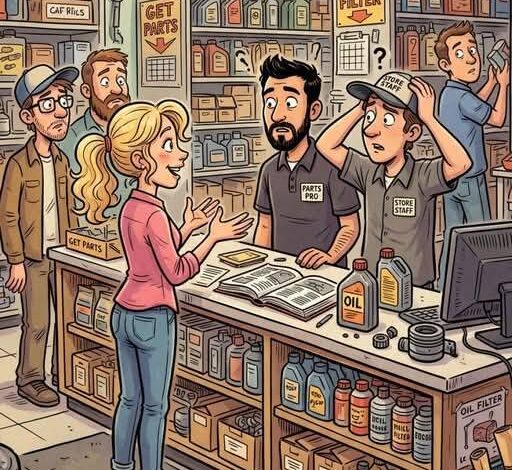
an oil cap mistaken for a “seven ten cap,”
a doctor’s abbreviation becoming a humiliating disaster,
a snail driving a sports car,
an elderly Cinderella regretting one very permanent veterinary decision.
But underneath the punchlines sits something surprisingly human:
the fear of losing control over life as it becomes stranger, messier, and harder to navigate.
Take the woman searching for the “710 cap.”
The joke works because confusion itself becomes recognizable. The mechanics stare blankly, trying to decode what impossible part she’s requesting, until someone finally flips the cap upside down and realizes she means “OIL.” Suddenly the misunderstanding transforms from absurd to strangely believable.
And maybe that is why the joke lands so well emotionally.
Because aging often feels exactly like that:
knowing something is wrong,
struggling to communicate it clearly,
watching younger people exchange confused looks while you insist the problem absolutely makes sense in your own head.
The joke lets people laugh at cognitive slips that otherwise feel frightening.
Humor softens vulnerability.
That same emotional pattern runs through all the “old car” comparisons too:
fading paint,
dim headlights,
engines sputtering,
bad exhaust systems,
leaky radiators,
and spare tires nobody wants to admit they’re carrying.
On paper, they are simple mechanical metaphors.
In reality, they are coded conversations about mortality.
People joke about aching knees and failing memory because direct fear sounds too heavy at dinner tables. Comparing the body to a worn-out car creates emotional distance. Suddenly deterioration feels less terrifying and more communal:
everyone’s transmission slips eventually,
everyone’s shocks wear out,
everyone starts making strange noises getting out of chairs after a certain age.
Comedy becomes permission to admit weakness without surrendering dignity completely.
Then the humor swerves into total absurdity again with the snail and the Datsun 240-Z.
Objectively, it is an incredibly stupid joke.
A snail paints a “240-Z” into “240-S” so people can yell:
“Look at that S-car go!”
And yet that ridiculousness matters.
Because absurd jokes remind people that not everything painful or embarrassing requires deep meaning. Sometimes laughter itself is enough. Wordplay, puns, and goofy misunderstandings create tiny moments where the brain stops catastrophizing and simply enjoys nonsense for a second.
The Cinderella joke works differently because it combines nostalgia, loneliness, sexuality, and regret into one wildly inappropriate punchline.
At first, it sounds almost sentimental:
Cinderella old and alone,
the fairy godmother returning,
youth restored,
wealth returned,
her beloved cat transformed into a handsome human companion.
Then suddenly the entire emotional tone flips when he whispers:
“You probably regret neutering me now.”
The humor comes from collision:
childhood innocence smashed directly into adult implication.
And importantly, aging humor often operates exactly that way. Older adults frequently use shock humor and innuendo because it pushes back against society’s tendency to treat them as nonsexual, invisible, or emotionally finished.
The joke says:
old age may bring loneliness,
but desire,
awkwardness,
and regret remain stubbornly human.
Then there are the misunderstanding jokes built entirely on language itself.
The blonde sister hearing “comfortable” as “come for bull.”
The patient misunderstanding medical abbreviations so badly that ear medicine ends up somewhere catastrophically wrong.
These jokes survive because human beings constantly overestimate communication. We assume words transfer perfectly from one mind to another when in reality conversation is full of partial hearing, assumptions, and accidental reinterpretation.
Life itself often feels like one long chain of misunderstood instructions.
Doctors explain things too quickly.
Families mishear each other.
People pretend they understood directions they absolutely did not understand.
Then chaos follows.
Comedy simply exaggerates what already happens daily.
And maybe that is the deeper emotional thread connecting every one of these stories:
human beings are profoundly imperfect interpreters of reality.
We misread labels.
Mishear advice.
Misunderstand intentions.
Embarrass ourselves publicly.
Forget words halfway through sentences.
Laugh at the wrong moments.
Turn ordinary situations into disasters.
And somehow, instead of destroying us, those failures often become the stories people remember most fondly afterward.
Because perfection is not actually very funny.
Flawed humanity is.
That may explain why aging humor remains so enduring across generations. As people grow older, control slowly becomes less reliable:
memory slips,
the body changes,
hearing weakens,
energy fades,
technology becomes confusing,
simple tasks grow complicated.
Humor provides psychological resistance against the humiliation of that process.
If you can laugh about your “check engine light” knees or your “bad suspension” hips, then aging becomes slightly less frightening and slightly more survivable.
Laughter creates solidarity too.
Someone hears the joke and thinks:
That’s me.
I do that now too.
I thought I was the only one.
Even the crude jokes serve a purpose.
Embarrassment isolates people.
Humor reconnects them.
And perhaps that is why these old joke structures endure decade after decade despite being corny, inappropriate, or absurd.
They are not really about snails or oil caps or confused blondes.
They are about the ongoing human attempt to stay emotionally afloat while life keeps reminding us:
your body is temporary,
your mind is imperfect,
communication fails constantly,
and dignity is often hanging by a thread.
So people laugh.
Not because everything is fine.
Because laughter makes the indignities feel survivable.
It transforms confusion into connection.
Embarrassment into storytelling.
Fear into something smaller and lighter for a few minutes.
And honestly, there may be something comforting in that.
As long as people can still misread signs,
mishear instructions,
tell terrible puns,
and laugh hard enough to wipe tears from their eyes afterward,
some stubborn piece of human resilience is still working just fine.