In an age when electric razors can map facial contours, rechargeable trimmers fit inside a pocket, and disposable blades promise a flawless shave in minutes, it’s easy to forget how inventive earlier generations were in their pursuit of convenience.
Long before modern grooming technology reached today’s level of sophistication, inventors were experimenting with bold new ideas designed to transform one of the most routine tasks in daily life: shaving.
Among the many innovations that emerged during the twentieth century, few are as fascinating—or as unusual—as the Rally Dry Shaver.
Today, it survives largely as a collector’s item and historical curiosity, but during its time, the Rally represented something much bigger than a simple grooming tool.
It embodied an era that believed technology could improve almost anything.
Even shaving.
The story begins in the years following World War II, when much of the Western world experienced rapid economic growth and technological expansion.
Homes were filling with new appliances.
Televisions became increasingly common.
Refrigerators grew more efficient.
Washing machines promised to reduce household labor.
Consumers embraced products that saved time and simplified daily routines.
Manufacturers quickly realized that personal grooming represented another opportunity for innovation.
For generations, shaving had remained largely unchanged.
Most men relied on safety razors or straight razors, combined with shaving brushes, soaps, and warm water.
The process required patience.
Preparation mattered.
Technique mattered.
For many men, shaving was almost ceremonial.
The scent of shaving soap, the feel of warm lather, and the careful movement of a blade across the skin formed a daily ritual repeated thousands of times throughout a lifetime.
There was comfort in that routine.
Yet there was also inconvenience.
The process took time.
Travel complicated matters.
Mistakes could result in cuts and irritation.
As society accelerated, many consumers began looking for faster alternatives.
Manufacturers responded enthusiastically.
Electric shavers began appearing on the market, promising speed and convenience.
However, early electric models were far from perfect.
Many required bulky cords.
Some produced inconsistent results.
Others struggled to compete with the closeness of traditional shaving.
It was within this environment that the Rally Dry Shaver emerged.
Unlike electric competitors, the Rally offered a completely different approach.
Its creators envisioned a portable grooming solution that required no electricity, no batteries, no water, and no shaving cream.
The concept sounded revolutionary.
A man could theoretically shave anywhere.
At home.
At work.
While traveling.
Even outdoors.
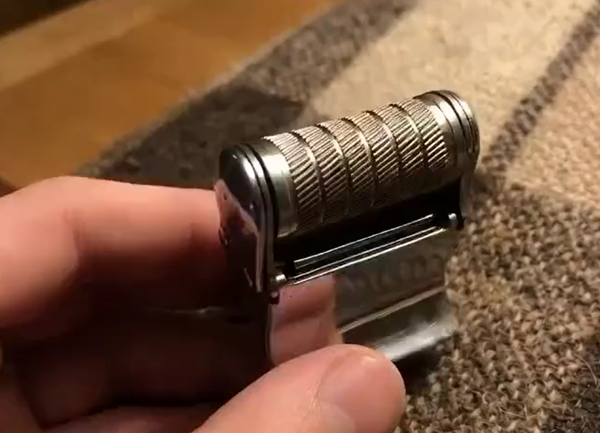
The Rally’s defining feature was its distinctive mechanical design.
Hidden inside its compact body was a rolling cylindrical cutting mechanism equipped with precisely engineered teeth.
As the user rolled the device across the skin, those teeth worked in a scissor-like motion designed to shear facial hair without requiring traditional blades or electric power.
At first glance, the concept appeared brilliantly simple.
Yet simplicity often hides complexity.
The engineering behind the Rally demanded remarkable precision.
Each component needed to align perfectly.
Even minor imperfections could affect performance.
Too much pressure during use might irritate the skin.
Too little pressure could leave hairs untouched.
Success depended on technique as much as design.
That characteristic made the Rally unlike almost every other shaving device available at the time.
Rather than automating the process entirely, it required active participation from the user.
The experience remained tactile and mechanical.
Some users appreciated that engagement.
Others found it frustrating.
The device occupied an unusual position between traditional wet shaving and emerging electric technology.
It was neither fully modern nor entirely traditional.
Instead, it attempted to combine aspects of both worlds.
This balancing act reflected broader cultural values of the postwar era.
People wanted convenience.
But they also wanted control.
New technologies were welcomed, yet consumers often remained attached to familiar routines.
The Rally appealed to individuals who appreciated hands-on interaction while still seeking greater efficiency.
Its marketing emphasized exactly those qualities.
Advertisements portrayed the shaver as modern, portable, and practical.
Busy professionals could use it during travel.
Commuters could carry it easily.
Men on the move could maintain their appearance without needing sinks, mirrors, or shaving supplies.
The message aligned perfectly with mid-century optimism.
Technology would save time.
Technology would improve life.
Technology would create freedom.
Visually, the Rally fit seamlessly into that vision.
Its compact design reflected the streamlined aesthetics popular during the 1950s and 1960s.
Industrial designers across multiple industries embraced sleek shapes and clean lines.
Automobiles, kitchen appliances, radios, and personal gadgets all reflected society’s fascination with progress.
The Rally appeared futuristic without looking intimidating.
It suggested sophistication while remaining approachable.
For a brief period, it captured public curiosity.
Yet curiosity does not always translate into lasting success.
Despite its ingenuity, the Rally faced significant challenges.
Many users struggled with the learning curve.
Unlike traditional razors, which most men already understood, the Rally required experimentation.
Technique influenced results considerably.
Comfort varied from person to person.
Some users praised its convenience.
Others complained about skin irritation or inconsistent performance.
At the same time, electric shaver technology continued improving rapidly.
Manufacturers invested heavily in research and development.
New models became more powerful, more comfortable, and increasingly reliable.
As electric alternatives improved, the Rally’s advantages began to shrink.
Consumers seeking convenience often preferred automated solutions.
Meanwhile, those who valued shaving quality frequently remained loyal to traditional wet shaving methods.
The Rally found itself caught between two powerful competitors.
Too unconventional for traditionalists.
Too manual for those embracing electric technology.
Its market position became increasingly difficult to sustain.
By the 1960s, it had largely faded from mainstream attention.
Yet failure to dominate the market does not diminish its significance.
In many ways, products like the Rally are among the most fascinating artifacts of technological history.
They reveal how inventors think.
They show what societies value.
And they demonstrate the willingness of innovators to challenge established habits.
The Rally represented a genuine attempt to rethink an everyday experience.
That willingness to experiment remains essential to progress.
Today, surviving Rally Dry Shavers have become highly sought after by collectors and enthusiasts of vintage design.
For many, the appeal extends beyond shaving.
The device serves as a tangible reminder of a unique period in history.
A time when engineers believed virtually every aspect of daily life could be reinvented through clever design and mechanical creativity.
Collectors often admire the craftsmanship involved.
The precision of the cutting mechanism.
The elegance of the engineering.
The ambition behind the concept.
Even its shortcomings contribute to its historical value.
They reveal the challenges inventors faced while attempting to balance innovation, usability, and consumer expectations.
The Rally also offers lessons for modern product designers.
Successful innovation requires more than originality.
A product must fit naturally into people’s lives.
It must solve problems without creating new frustrations.
The Rally succeeded brilliantly as an idea.
Its practical execution proved more complicated.
That distinction remains relevant across industries today.
Interestingly, many of the goals that inspired the Rally remain central to grooming technology decades later.
Modern cordless shavers, travel trimmers, and portable grooming kits pursue the same objectives.
Convenience.
Portability.
Efficiency.
The difference lies primarily in technological advancement.
Contemporary products benefit from better materials, improved manufacturing processes, rechargeable batteries, and decades of user-feedback research.
In that sense, the Rally was ahead of its time.
Its vision ultimately proved correct.
Consumers did want portable grooming solutions.
The market simply needed additional technological development before that vision could be fully realized.
Looking back, the Rally Dry Shaver stands as more than a forgotten gadget.
It represents optimism.
Creativity.
And the enduring human desire to improve everyday experiences.
Its creators saw an opportunity where others saw routine.
They challenged assumptions.
They experimented boldly.
And although the product never achieved widespread commercial success, it earned something perhaps equally valuable: a lasting place in the story of innovation.
Today, when collectors display a Rally Dry Shaver on a shelf or historians discuss mid-century design, they are preserving more than a grooming device.
They are preserving a mindset.
A belief that no task is too ordinary for reinvention.
A belief that progress often begins with unconventional ideas.
And a belief that innovation requires courage, even when success is uncertain.
The Rally may no longer occupy bathroom counters around the world, but its legacy endures.
Not because it changed shaving forever.
But because it reminds us that the path of innovation is built by people willing to ask a simple question:
“What if there’s a better way?”
And sometimes, even when the answer isn’t perfect, the attempt itself becomes part of history.