For a few agonizing seconds, Conner Kemmsies had almost everything he needed.
The money was already his.
The Bonus Round was underway.
The board was beginning to surrender its letters.
And somewhere inside a nearly completed sentence was another $40,000 waiting to be won.
Then the clock started winning instead.
It happened during a Valentine’s Day episode of Wheel of Fortune, where Kemmsies, a commercial pilot, had already put together an impressive game. By the time he reached the final round, he had accumulated $19,080 in cash and prizes.
Whatever happened next, he was leaving as a winner.
But nobody reaches the Bonus Round thinking about being satisfied with what they’ve already earned.
There is another envelope.
Another puzzle.
Another opportunity.
And only a handful of seconds separating a contestant from the kind of money that can turn a successful game into an unforgettable one.
The category was announced:
Phrase.
That single word quietly became the source of an argument much bigger than anyone expected.
Kemmsies selected his additional letters and waited for the board to reveal what they had given him.
Slowly, pieces of the answer appeared.
He could see the beginning.
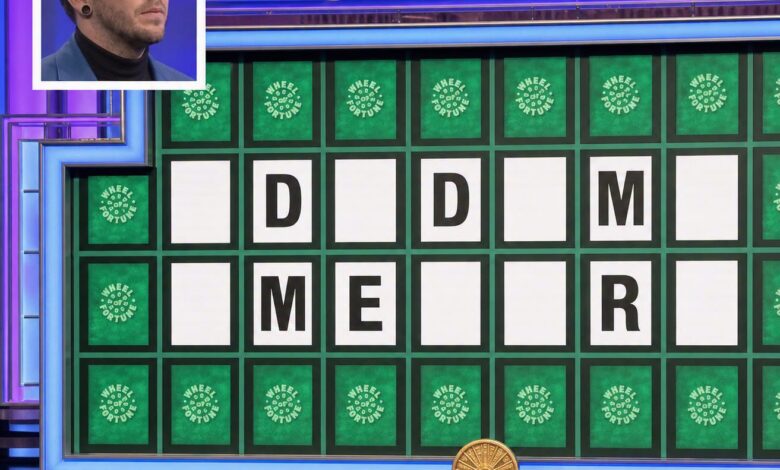
I DID MY…
Three ordinary words.
Three words that seemed as though they should lead naturally somewhere.
But where?
“I did my best.”
“I did my part.”
“I did my…”
The possibilities multiplied precisely when he needed them to narrow.
Anyone watching comfortably from a couch could stare at the screen and experiment.
A contestant doesn’t have that luxury.
The Bonus Round is brutally short.
There is no time to calmly diagram the sentence.
No opportunity to ask for clarification.
No second board.
The music is running.
The host is waiting.
The studio is watching.
And every wasted second becomes louder than the one before it.
Kemmsies stared at the puzzle.
He searched.
Nothing.
The missing word simply would not come.
That is one of the cruelest features of game-show puzzles.
The answer can be completely obvious the instant after time expires.
Before that instant, it can feel impossible.
The buzzer sounded.
The opportunity disappeared.
Then the complete answer appeared:
I DID MY HOMEWORK.
There it was.
Homework.
A word familiar to practically everyone.
No obscure vocabulary.
No strange proper name.
No specialized knowledge.
Just a phrase most people have probably said—or wished they could truthfully say—at some point in their lives.
And Kemmsies hadn’t found it.
Then came the second blow.
The envelope revealed what the unsolved puzzle had cost him.
$40,000.
That number transformed a frustrating miss into a painful one.
For viewers, forty thousand dollars is enough to inspire secondhand agony.
You can almost hear people shouting at their televisions:
“HOMEWORK!”
But Kemmsies did something that immediately made the moment easier to watch.
He laughed.
Instead of collapsing into visible frustration, he joked about the answer, noting that he didn’t really do homework anymore.
It was the perfect way to release the tension.
After all, he was a commercial pilot.
Homework was not exactly the center of his daily life.
And more importantly, he had not walked away empty-handed.
Far from it.
He still had $19,080 in winnings.
The $40,000 was money he could have won, not money that had been taken out of his pocket.
That distinction can be difficult to remember when a prize envelope is opened directly in front of you.
Kemmsies appeared capable of remembering it.
The internet was less forgiving.
Almost immediately, the debate shifted away from whether he should have solved the puzzle.
People began questioning whether Wheel of Fortune should have presented the answer under the category “Phrase” at all.
“I did my homework.”
Is that really a phrase?
Or is it simply a sentence?
For some viewers, the distinction mattered enormously.
They argued that the category itself guides the contestant’s thinking.
When someone hears “Phrase,” they may naturally search for an idiom, familiar expression, common saying, or recognizable verbal construction.
Something like:
“Better late than never.”
“Back to square one.”
“Right on the money.”
“I did my homework,” by contrast, sounds almost aggressively ordinary.
Subject.
Verb.
Possessive.
Object.
A perfectly normal sentence describing an everyday action.
Critics therefore argued that Kemmsies hadn’t simply failed to locate a missing word.
He had been nudged toward the wrong kind of answer before the clock even started.
Others thought that argument was ridiculous.
To them, “phrase” on Wheel of Fortune has always functioned as a broad category.
The game isn’t a graduate seminar in linguistics.
Contestants aren’t being asked to classify syntactic structures.
They’re solving word puzzles.
And “I did my homework” is a familiar sequence of words that fits comfortably enough within the show’s category conventions.
Besides, once the letters appeared, the answer was sitting right there.
I DID MY _ _ _ _ _ _ _ _
What else could it be?
That was the counterargument.
Thousands of viewers claimed they had solved it almost immediately.
Some probably had.
But solving a Wheel of Fortune puzzle from home and solving it under studio conditions are not remotely identical experiences.
At home, nothing is at stake.
There is no countdown pounding through your nervous system.
No cameras.
No audience.
No host standing beside you.
No knowledge that one correct word might be worth tens of thousands of dollars.
Pressure changes cognition.
People forget names they have known for years.
They walk into rooms and forget why they entered.
They stare directly at objects they are trying to find.
They miss obvious answers.
Put a clock on the problem and attach $40,000 to it, and the human brain can become remarkably uncooperative.
That is why Bonus Round failures are so compelling.
The audience sees the answer from one psychological position.
The contestant sees it from another.
We see letters.
They see money disappearing one second at a time.
And once the brain commits to the wrong search path, escaping it can be difficult.
Perhaps Kemmsies was searching for a more recognizable expression because the category said “Phrase.”
Perhaps “homework” simply never entered his mind.
Perhaps being an adult commercial pilot made the sentence less immediately accessible than it would have been for a student.
Or perhaps it was nothing more complicated than a temporary mental blank.
Everyone has experienced one.
Most of us are fortunate enough not to experience ours on national television.
Yet the controversy surrounding the puzzle reveals something fascinating about Wheel of Fortune.
Categories matter because they create expectations.
A puzzle isn’t merely a collection of blank spaces.
It is a constrained search problem.
The category tells the contestant where to look mentally.
“Person” sends the brain in one direction.
“Place” sends it somewhere else.
“Food & Drink” immediately activates another set of possibilities.
“Phrase” is unusually broad.
That flexibility is useful for the show’s writers, but it can become controversial when the answer doesn’t match what viewers intuitively expect the label to mean.
And intuition is the key word.
Grammatically, a phrase and a sentence are not necessarily interchangeable concepts in formal linguistic analysis.
But game shows develop their own internal vocabulary.
A category label does not always function as a technical grammatical classification.
It functions as part of the game.
That distinction explains why both sides of the argument could feel completely certain.
Critics were applying ordinary or grammatical expectations to the word “phrase.”
Defenders were applying Wheel of Fortune’s practical category conventions.
They were arguing from different rulebooks.
Kemmsies, meanwhile, had already moved on.
That may be the funniest part of the entire episode.
The person who actually lost the chance at $40,000 appeared less outraged than many people who had lost absolutely nothing.
He laughed.
He made his homework joke.
He accepted the result.
He walked away with his existing winnings.
The internet took responsibility for being furious on his behalf.
This is increasingly how television moments live after the broadcast ends.
Once, the episode would have aired.
Families might have argued about the puzzle for five minutes.
Someone would have complained that the category was unfair.
Someone else would have said, “Oh, come on, it was obvious.”
Then the next program would start.
Now the buzzer is only the beginning.
The clip gets posted.
Comments accumulate.
Viewers replay the board frame by frame.
People debate definitions.
Game-show fans compare the puzzle with previous Bonus Rounds.
Others insist the contestant was robbed.
Then another group insists anyone who couldn’t solve it deserved to lose.
A ten-second failure becomes a miniature public trial.
That can make game shows feel more consequential than they actually are.
The Bonus Round is designed around uncertainty.
Sometimes the contestant receives an answer that clicks instantly.
Sometimes the chosen letters reveal almost nothing.
Sometimes an obvious word refuses to appear in the contestant’s mind until one second after the buzzer.
That randomness is part of the tension.
If every puzzle were perfectly calibrated so every competent contestant solved it with exactly one second remaining, the show would become painfully predictable.
The frustration is part of why people watch.
We want to believe we would have gotten it.
Sitting at home, perhaps we would have.
Standing under those lights?
That’s another question.
Kemmsies’ reaction is worth remembering for precisely that reason.
He had every opportunity to look devastated.
Forty thousand dollars had just been revealed.
He could see exactly what one missing word had cost him.
Instead, he found the joke.
“I don’t do homework anymore.”
That response told viewers something more interesting than whether he knew the answer.
Perspective.
The puzzle was lost.
The game wasn’t.
He still had nearly twenty thousand dollars in cash and prizes.
He had reached the Bonus Round on one of America’s longest-running game shows.
And he had acquired the kind of television story people would probably continue discussing long after they forgot most of the other puzzles from the episode.
There is a strange psychological trap surrounding missed game-show prizes.
When the envelope says $40,000, viewers instinctively think:
He lost $40,000.
Technically, he didn’t.
He lost the opportunity to win it.
That may sound like semantics, but emotionally the distinction matters.
The money was never guaranteed.
The envelope could have contained a different prize.
The contestant had to complete another challenge to earn it.
That is what makes the reveal simultaneously exciting and cruel.
The show tells you exactly how valuable the answer you couldn’t find would have been.
Imagine ordinary life working that way.
You miss an exit on the highway and a screen appears:
THAT MISTAKE COST YOU $12,000.
You decline a date:
THAT PERSON WOULD HAVE BECOME YOUR SPOUSE.
You choose one job over another:
THE OTHER COMPANY WOULD HAVE MADE YOU A MILLIONAIRE.
Human beings are usually spared precise knowledge of alternate outcomes.
Game shows deliberately provide it.
The envelope opens.
There is the life you almost had.
$40,000.
Then it closes again.
Perhaps laughing really is the healthiest response.
The argument over “I DID MY HOMEWORK” will probably remain more memorable than the puzzle itself deserved to be.
Some viewers will forever consider it unfair.
Others will insist it was painfully easy.
Language experts could dissect the meaning of “phrase.”
Longtime fans could point toward decades of category precedent.
None of it changes the result.
Kemmsies didn’t solve it before the buzzer.
He kept what he had already won.
And Wheel of Fortune moved on to another puzzle.
But the episode accidentally demonstrated something the show has always understood exceptionally well.
Its real product isn’t vocabulary.
It’s pressure.
Give people a partially completed sentence in their living room and they solve it casually.
Put the same sentence under studio lights, start a ten-second clock, attach $40,000 to the answer, and suddenly the word HOMEWORK can disappear from the English language.
That’s not necessarily stupidity.
It’s not necessarily unfairness.
It’s what pressure does.
It narrows attention precisely when you need imagination.
It makes obvious things invisible.
It turns seconds into emergencies.
Then, the instant the buzzer sounds, clarity comes rushing back.
I DID MY HOMEWORK.
Of course.
That’s what makes the moment so painful.
And so funny.
And so perfectly suited to Wheel of Fortune.
Conner Kemmsies walked into the Bonus Round already having won $19,080.
He walked out with the same amount and one unforgettable missing word.
The internet inherited the argument.
Was it a phrase?
Was it a sentence?
Was the category misleading?
Should he have solved it anyway?
Everyone can choose a side.
Kemmsies seemed to choose the better option.
He laughed.
After all, there was nothing left to solve.
And unlike the rest of the internet, he apparently knew when it was time to stop doing homework.