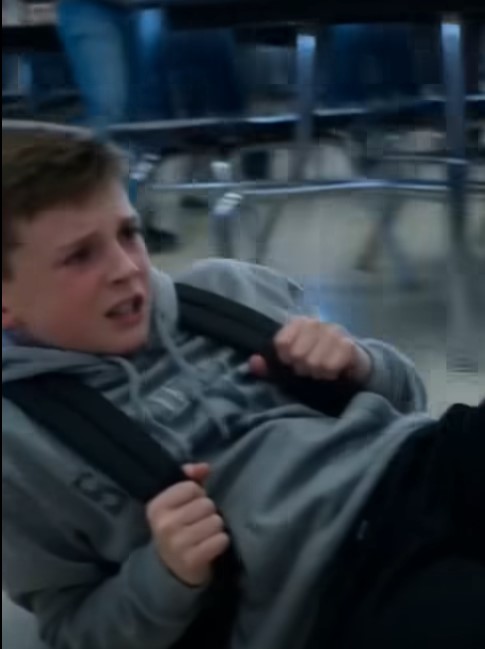
The cafeteria went silent the moment Tyler saw his little brother being dragged across the floor.
One second, Oakridge High was trapped in the ordinary noise of a Tuesday lunch period—plastic trays sliding across tables, chairs scraping against tile, music leaking from earbuds, students laughing too loudly, phones glowing in every direction.
The next second, everything changed.
A freshman hit the floor near the entrance.
His backpack twisted beneath him.
His sneakers scraped helplessly against the tile.
And a senior twice his size kept pulling him forward like he was nothing.
For a moment, nobody moved.
Then the cafeteria erupted.
Someone shouted.
Someone laughed.
Several students jumped up from their seats.
Phones rose into the air almost instantly, screens pointed toward the chaos before anyone even thought to call for help.
At the center of it all was Leo Bennett.
Fourteen years old.
Small for his grade.
Terrified.
And struggling to breathe as the strap of his backpack caught across his chest and twisted awkwardly against his neck.
The senior dragging him was Marcus Reed, a varsity athlete with a reputation that followed him down every hallway. Some students admired him. Others avoided him. Teachers described him as “competitive” and “intense,” which was the kind of polite language adults sometimes used when they did not want to say dangerous.
Marcus had Leo by the front of his hoodie.
“Say it again,” Marcus snapped.
Leo clawed at the fabric near his throat, trying to loosen it.
“I didn’t—” he gasped. “I didn’t say anything.”
Marcus yanked him harder.
The crowd roared.
Not all of them approved.
Some looked horrified.
Some backed away.
But too many were smiling.
Too many were filming.
Too many were treating the moment like entertainment.
Across the cafeteria, Tyler Bennett sat frozen with a fork in his hand.
For the first time in his life, the smartest thing to do and the right thing to do were not the same.
Tyler had spent years training himself not to react.
That was how he survived Oakridge.
That was how he protected his future.
He was the student teachers trusted, the one guidance counselors used as an example, the one whose name appeared at the top of honor rolls and scholarship lists. He had a near-perfect GPA, a stack of recommendation letters, and one final interview standing between him and a full scholarship to a university his family could never afford on their own.
His mother called it their doorway.
“This is how we get through, Ty,” she had told him more than once, rubbing exhaustion from her eyes after another double shift. “You keep your head down. You stay focused. No fights. No trouble. Your education is the way out.”
Tyler had promised her.
He had meant it.
After their father died, promises mattered more.
Their mother worked two jobs to keep rent paid and food in the refrigerator. Tyler handled the bills she was too tired to sort, helped Leo with homework, cooked when he could, and carried the quiet pressure of being the one who could not afford to mess up.
Rules were not just rules to him.
They were survival.
And Oakridge High had one rule everyone knew.
Zero tolerance.
Any fight.
Any physical confrontation.
Any violent involvement.
Suspension first.
Questions later.
Maybe expulsion.
Maybe a destroyed scholarship.
Maybe everything his mother had sacrificed for gone in one lunch period.
So when Marcus first shoved Leo through the cafeteria doors, Tyler’s body locked in place.
His brain tried to calculate.
Find a teacher.
Call security.
Don’t touch anyone.
Don’t throw your future away.
Then Leo’s face turned red.
His hands moved to the strap across his chest.
His mouth opened, but no real sound came out.
And all of Tyler’s calculations vanished.
Because Leo was not a rule.
Leo was his brother.
Tyler stood so quickly his chair fell backward.
The sound disappeared beneath the roar of the cafeteria.
He moved before fear could catch him.
Across the aisle.
Past the tables.
Between students who barely had time to step aside.
Someone shouted his name.
He didn’t hear it.
All he saw was Leo struggling beneath Marcus’s grip.
All he heard was the thin, broken sound of his brother trying to breathe.
“Let him go!” Tyler shouted.
Marcus turned just as Tyler reached him.
There was no plan.
No strategy.
No careful speech.
Tyler grabbed Marcus by the shoulder and drove him backward with everything he had.
Marcus stumbled into a lunch table.
Trays flew.
Milk cartons burst open.
A plate shattered against the floor.
The cafeteria went from chaos to stunned silence in a single breath.
Leo collapsed onto his side, coughing violently.
Tyler dropped beside him.
“Leo. Look at me. Are you breathing?”
Leo sucked in air and nodded weakly.
Tyler barely had time to feel relief before Marcus lunged.
Hands grabbed Tyler from behind.
Students screamed.
A teacher at the far end of the cafeteria shouted for everyone to move back.
Then two security officers burst through the side doors.
Within seconds, Tyler and Marcus were separated.
Marcus’s face was red with fury.
Tyler’s shirt was torn near the collar.
Leo remained on the floor, shaking and gasping while a cafeteria aide knelt beside him.
Principal Vaughn arrived moments later, his expression already hardened into administrative control.
“What happened here?” he demanded.
A dozen voices answered at once.
“He attacked Marcus!”
“Marcus was dragging Leo!”
“I got it on video!”
“Tyler started swinging!”
“No, Marcus started it!”
“Everybody quiet!” Vaughn shouted.
The cafeteria fell into a tense murmur.
His eyes moved from Marcus to Tyler, then to Leo on the floor.
“Office. Now.”
Tyler looked toward his brother.
“He needs the nurse.”
“He’ll be taken care of,” Vaughn said sharply. “You come with me.”
Tyler wanted to argue.
But two security officers were already guiding him away.
As he left the cafeteria, he saw phones still pointed at him.
Dozens of them.
Recording.
Judging.
Deciding what the story would be before anyone knew the truth.
Inside the administration office, the air felt too cold.
Tyler sat in a chair across from Principal Vaughn while Marcus leaned against the opposite wall, arms crossed, looking far calmer than he should have.
The assistant principal typed rapidly at her desk.
A security officer stood near the door.
No one spoke for nearly a minute.
Then Vaughn folded his hands.
“Mr. Bennett, do you understand how serious this is?”
Tyler stared at him.
“My brother couldn’t breathe.”
“That is not what I asked.”
Tyler’s chest tightened.
Marcus spoke before he could.
“Look, it got out of hand,” Marcus said, his voice smooth now. “We were messing around. Leo got dramatic. Then Tyler came out of nowhere and attacked me.”
Tyler turned toward him.
“Messing around?”
Marcus shrugged.
“He knows I was joking.”
“His backpack strap was across his neck.”
“I didn’t know that.”
“You were dragging him across the floor.”
Marcus rolled his eyes.
Principal Vaughn raised a hand.
“Enough.”
Tyler leaned forward.
“Check the cameras.”
“We will review all available information.”
“No,” Tyler said. “Review it now.”
Vaughn’s gaze sharpened.
“You are not in a position to make demands.”
The words landed heavily.
Tyler understood then.
This was not about what happened.
Not yet.
This was about procedure.
About controlling the situation.
About paperwork.
About the cleanest version of events.
Principal Vaughn continued, “Oakridge maintains a zero-tolerance policy regarding violence. Regardless of provocation, physical escalation cannot be ignored.”
Tyler felt the floor tilt beneath him.
“You’re going to suspend me?”
“That is one possible disciplinary action pending investigation.”
“My scholarship interview is Friday.”
“I am aware of your academic standing.”
“Then you know what this could do.”
Vaughn’s face softened slightly, but not enough.
“I also know you put your hands on another student.”
Tyler sat back.
For the first time since standing up in the cafeteria, fear truly hit him.
Not fear of Marcus.
Not fear of punishment.
Fear of going home and telling his mother he had lost everything because he had protected Leo.
The door opened.
The school nurse stepped in, speaking quietly to the assistant principal.
Tyler caught only pieces.
Bruising.
Panic response.
Possible throat irritation.
Mother contacted.
His stomach twisted.
Marcus kept staring at the floor.
Still calm.
Still confident.
As though he had been through this before and already knew how it would end.
That was the part Tyler couldn’t stop thinking about.
Marcus didn’t look scared.
He looked inconvenienced.
By the final bell, the incident was everywhere.
Clips spread across school group chats, then social media. Different angles showed different parts of the cafeteria. Some began with Tyler shoving Marcus. Others showed Marcus dragging Leo. A few captured Leo coughing afterward.
The internet did what it always does.
It chose sides.
By evening, parents were arguing in comment sections.
Students were posting edits, captions, accusations, defenses.
Some called Tyler a hero.
Others called him reckless.
Some said Marcus had finally gone too far.
Finally.
That word mattered.
Tyler saw it again and again.
Finally.
As though everyone already knew there had been other incidents.
As though the cafeteria had not been the beginning of a problem but the moment everyone could no longer pretend not to see it.
That night, Tyler sat at the kitchen table while his mother paced the room with her phone pressed against her ear.
She had left work early when the school called.
He had never seen her so frightened.
Not angry.
Frightened.
Leo sat on the couch with a blanket over his shoulders, quieter than usual, a red mark visible near his collarbone.
Tyler could barely look at him without feeling sick.
His mother ended the call and lowered the phone.
“They’re considering suspension,” she said.
Tyler nodded.
“I know.”
“Tyler…”
Her voice cracked, and that hurt more than yelling would have.
“I’m sorry,” he said.
She closed her eyes.
For a moment, he expected the lecture.
The scholarship.
The promise.
The future.
Instead, she walked over, took his face in both hands, and looked directly at him.
“Did you think your brother was in danger?”
Tyler swallowed.
“Yes.”
“Then don’t apologize for protecting him.”
His eyes burned.
“But the scholarship—”
“We will fight for that,” she said. “But I will not raise one son to watch another one suffer because a rule book tells him to stay seated.”
That was when Tyler finally broke.
Not loudly.
Just enough that his shoulders shook and he had to cover his face.
The next morning, everything escalated.
Before Tyler even arrived at school, he received a message from someone he barely knew.
Maya Chen.
Junior.
Student council secretary.
Known for being quiet, organized, and impossible to fool.
Her message contained only one sentence.
You need to see what they’re hiding.
Attached was a file.
Tyler stared at it for a long time before opening it.
Inside were screenshots, timestamps, incident reports, and notes.
Not rumors.
Records.
Marcus’s name appeared again and again.
A hallway shove written up as “horseplay.”
A locker room threat dismissed as “team conflict.”
A freshman complaint marked “resolved” without follow-up.
Two witness statements that had never made it into final reports.
And beneath the surface of it all, a pattern Tyler had suspected but never seen proven.
Athletes protected.
Quiet students ignored.
Problems softened until they disappeared.
Maya sent another message.
There’s more. Meet me somewhere public.
By that afternoon, Tyler, Leo, and Maya sat in the corner of the public library, surrounded by shelves of old reference books and the low hum of fluorescent lights.
Maya opened her laptop and spoke quickly.
“I’m not supposed to have all of this,” she said. “But I help organize student council records, and some files were shared with the wrong folder months ago. I thought someone would do something.”
Tyler looked at the screen.
“Why didn’t you report it?”
“I tried,” Maya said.
Her voice dropped.
“No one wanted to hear it.”
Leo sat beside Tyler, silent, his hands wrapped around a paper cup of water.
Maya clicked through folders.
“Marcus isn’t the only one. But he’s the easiest to prove. If the school suspends you and minimizes what he did, they bury the whole pattern.”
Tyler’s pulse quickened.
“So what do we do?”
“We make sure they can’t bury it.”
Before she could explain further, Leo stiffened.
Tyler followed his gaze.
Three boys had entered the library.
Two were Marcus’s teammates.
The third was Marcus himself.
He spotted them immediately.
His mouth curved into a humorless smile.
Maya closed the laptop halfway.
“Don’t run,” Tyler whispered.
Marcus walked toward them slowly.
“Studying?” he asked.
Tyler stood.
“This is a public place.”
Marcus glanced at Maya’s laptop.
“Looks like you’ve got something that doesn’t belong to you.”
Maya’s face paled.
The librarian looked up from the front desk, sensing tension but not yet understanding.
Marcus stepped closer.
“I’d hate for things to get worse for you, Bennett. Scholarship committees don’t like trouble.”
Tyler’s hands curled into fists.
Leo touched his arm.
“Don’t.”
That one word stopped him.
Because this time, Tyler understood the trap.
Marcus wanted him to react.
Needed him to react.
Another confrontation would finish what the first one started.
Maya slid a flash drive into her sleeve.
“We need to go,” she whispered.
The next few minutes moved like a nightmare.
They left the table, trying to stay calm.
Marcus and his friends followed.
Through the fiction section.
Past the computer stations.
Toward the side exit.
A chair toppled behind them.
Someone shouted.
The librarian called security.
Tyler pushed Leo ahead of him.
Maya clutched her bag to her chest.
They reached the side hallway just as the front doors opened.
Their mother rushed in, breathless, still wearing her work uniform.
“Tyler!”
He had never been so relieved to see anyone.
She took in the scene instantly.
Marcus.
The boys behind him.
Leo’s fear.
Maya’s laptop bag.
Tyler’s restraint.
Her expression changed.
Not panicked now.
Fierce.
“Go,” she told Tyler.
“Mom—”
“Go.”
Marcus tried stepping around her.
She moved in front of him.
“You don’t come near my sons.”
He laughed under his breath.
“You don’t know what’s going on.”
“I know enough.”
There was something in her voice that stopped him.
The voice of a woman who had worked too hard, lost too much, and was done watching powerful people intimidate children.
Tyler hesitated.
She looked back at him.
“Take the evidence where it needs to go.”
Maya grabbed his sleeve.
“The compliance meeting,” she said. “It’s today.”
“What meeting?”
“Athletic oversight review. Hotel conference center downtown. District officials, board members, outside representatives. If we get this in front of them, the school can’t control it.”
Tyler looked once more at his mother.
She nodded.
So they ran.
By the time they reached the hotel conference center, Tyler’s lungs burned.
Leo was limping slightly.
Maya’s hair had fallen loose from its clip, and her hands shook around the laptop bag.
The lobby was bright, polished, and completely unaware of the storm about to walk through its doors.
A sign near the elevator read:
District Athletic Compliance Review — Conference Room B
Tyler almost stopped.
His entire future seemed to narrow into one hallway.
If he walked in, there would be no going back.
No quiet resolution.
No private deal.
No letting the adults decide behind closed doors.
Maya looked at him.
“They’ll listen if you speak before they spin it.”
Leo’s voice was quiet.
“Ty.”
Tyler turned.
His little brother looked exhausted and scared, but there was trust in his eyes.
The same trust he had carried since they were kids.
The same trust that said Tyler would know what to do.
Tyler took a breath.
Then he opened the doors.
Inside, conversation died instantly.
Administrators sat around long tables with district officials and athletic representatives. Principal Vaughn was near the front, mid-sentence. The athletic director froze with a folder in his hand.
Every eye turned toward Tyler.
His shirt was wrinkled.
His face was flushed.
Leo stood behind him.
Maya stepped forward and placed the laptop on the nearest table.
“I’m Tyler Bennett,” he said, his voice shaking at first, then steadying. “Yesterday, I was told I might lose my scholarship because I stopped a senior from hurting my brother.”
Principal Vaughn stood.
“This is not appropriate—”
“No,” Tyler said.
The room went still.
He had never interrupted a principal before.
He continued anyway.
“What’s not appropriate is pretending this started yesterday.”
Maya connected the laptop to the display screen with trembling hands.
Documents appeared.
Incident reports.
Dates.
Names.
Videos.
Email screenshots.
A pattern too clear to dismiss.
Tyler spoke again.
“I’m not asking you to ignore what I did. I touched another student. I understand that. But I’m asking you to look at why. Look at what happened before I stood up. Look at what has been happening for months. Maybe years.”
His voice grew stronger.
“My brother was dragged across the cafeteria floor while people filmed. He couldn’t breathe. Staff didn’t reach him in time. And now the first thing the school wants to talk about is my discipline record.”
A woman from the district leaned forward.
“Who collected these materials?”
Maya lifted her chin.
“I did.”
Principal Vaughn’s face darkened.
“These are internal documents.”
“Then maybe internally,” Maya said, “someone should have cared.”
Silence followed.
Not empty silence.
The kind that meant something had shifted.
The kind that meant people in the room understood they were no longer managing a small disciplinary issue.
They were facing exposure.
Accountability.
Truth.
Within hours, the district opened a formal investigation.
Tyler’s suspension was placed on hold.
Marcus was removed from athletic participation pending review.
Multiple prior cases were reopened.
Parents were notified.
The school board requested an emergency hearing.
And the scholarship committee, after receiving the full context and witness footage, did not withdraw Tyler’s candidacy.
But those outcomes came later.
What Tyler remembered most was the ride home that evening.
His mother drove in silence for several minutes.
Leo slept in the back seat, his head against the window.
Maya had been picked up by her parents from the hotel.
Tyler stared at his hands.
“I thought I ruined everything,” he said.
His mother kept her eyes on the road.
“You protected your brother.”
“I almost lost the scholarship.”
“You may still have to fight for it.”
“I know.”
She reached over and squeezed his hand.
“But today you learned something important.”
He looked at her.
“What?”
“That a future isn’t worth much if you have to abandon who you are to keep it.”
Tyler looked out the window as the town passed by in fading evening light.
For so long, he had believed success meant staying quiet.
Keeping his head down.
Avoiding trouble.
Surviving.
But that day taught him something different.
Sometimes trouble finds the people who least deserve it.
Sometimes rules protect systems more than students.
And sometimes doing the right thing looks messy before anyone understands it.
Tyler had not walked into the cafeteria planning to become a symbol.
He had not wanted attention.
He had not wanted a fight.
He had only seen his younger brother in danger and moved.
That single decision nearly cost him everything.
But it also revealed the truth everyone else had been avoiding.
In the weeks that followed, Oakridge changed.
Not perfectly.
Not overnight.
But enough for people to notice.
New reporting procedures were created.
Cafeteria supervision increased.
Athletic discipline policies were reviewed by outside officials.
Students who had stayed silent began speaking.
And Leo slowly became himself again.
One afternoon, long after the videos had stopped trending and the headlines had faded, Tyler found Leo waiting for him outside school.
“You didn’t have to do that,” Leo said.
Tyler adjusted the strap of his backpack.
“Yeah,” he said. “I did.”
Leo smiled faintly.
“You still might get that scholarship?”
Tyler looked toward the road where their mother’s car would soon arrive.
“I think so.”
“And if you don’t?”
Tyler was quiet for a moment.
Then he said, “Then we keep going.”
Leo nodded.
For the first time since the cafeteria, he looked lighter.
Safer.
Like he believed that.
Oakridge High returned to its routines, as schools always do.
Lunch periods became noisy again.
Students laughed again.
Phones came out again.
But for those who had witnessed that Tuesday, something remained beneath the surface.
A memory.
A question.
A warning.
What would you do if the person being hurt was someone you loved?
For Tyler Bennett, the answer had come before he had time to think.
Before consequences.
Before rules.
Before fear.
He chose his brother.
And in choosing him, he forced an entire school to look at what it had allowed for too long.
Sometimes one act of courage does not just stop a single moment of harm.
Sometimes it pulls the truth into the open.
Sometimes it turns silence into testimony.
And sometimes, in the middle of an ordinary school cafeteria, it reminds everyone watching that protecting someone you love is not a mistake.