The internet has a remarkable talent for turning ordinary objects into mysteries.
All it takes is a single photograph.
No context.
No explanation.
Just an image of something unfamiliar posted online with a simple question:
“What is this?”
Within minutes, thousands of people begin investigating.
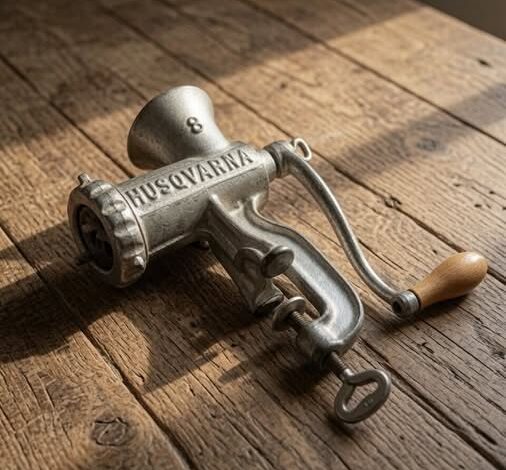
That is exactly what happened when a photograph of a heavy steel device appeared on social media and discussion forums. The object looked old, sturdy, and oddly complicated. It clearly had a purpose, but that purpose wasn’t immediately obvious to many of the people staring at the image.
The result was instant curiosity.
Some viewers were convinced it belonged in a factory.
Others believed it was part of farming equipment.
A few suggested it was a specialized industrial tool.
The theories multiplied rapidly.
Each new guess seemed plausible.
Until another user offered a completely different explanation.
Soon, the comment sections became a fascinating mix of speculation, debate, and detective work. People compared shapes, materials, moving parts, and historical designs. Some searched through old catalogs. Others consulted family members who remembered tools from previous generations.
What began as a simple mystery post evolved into a collaborative investigation.
And as often happens online, the answer eventually emerged through the combined knowledge of strangers.
The mysterious object was not industrial machinery.
It was not agricultural equipment.
It was something far more familiar.
A traditional meat mincer.
For older generations, the identification was immediate.
For younger viewers, however, the discovery came as a surprise.
Before food processors, stand mixers, and electric kitchen appliances became common, meat mincers were household essentials. Families relied on them to prepare meals from scratch, grinding meat, fish, and vegetables into usable ingredients for countless recipes.
What looked strange to modern eyes had once been found in kitchens around the world.
The device’s history stretches back to the nineteenth century, when mechanical food preparation tools began transforming home cooking. One of the earliest versions is often associated with Karl Drais, a German inventor known for developing several innovative mechanical designs.
His work helped popularize systems that could efficiently grind food using simple mechanical force.
The concept was straightforward but effective.
Food was fed into the top of the device and pushed through a rotating mechanism operated by a hand crank. As the crank turned, internal blades forced the food through metal plates perforated with small holes.
The result emerged as finely minced strands ready for cooking.
The design required no electricity.
No motors.
No advanced technology.
Just human effort and clever engineering.
Yet for generations, it accomplished exactly what families needed.
These tools became staples in home kitchens because they allowed people to process ingredients quickly and efficiently. Whether preparing sausage mixtures, meat fillings, fish cakes, or vegetable blends, the humble mincer handled tasks that would otherwise require extensive chopping by hand.
Its simplicity was part of its brilliance.
Over time, however, technology changed.
As electricity became commonplace in households, manual kitchen tools gradually gave way to powered alternatives. Electric meat grinders offered greater speed, increased convenience, and the ability to process larger quantities of food with far less effort.
What once required patient cranking could now be completed with the flip of a switch.
The evolution didn’t stop there.
Modern meat grinders expanded beyond their original purpose. Manufacturers introduced interchangeable plates, specialty attachments, sausage-stuffing accessories, and tools designed for preparing dishes from various culinary traditions.
Some machines now handle large quantities of meat in minutes.
Others can assist with specialty foods such as kibbeh, sausages, burgers, and custom ground blends.
Despite these advancements, the fundamental principle remains unchanged.
The goal is still the same as it was more than a century ago:
To break food into smaller, usable pieces efficiently and consistently.
The mystery surrounding the photograph eventually faded once the correct identification spread across the internet.
But the story became about more than a kitchen tool.
It became an example of how collective curiosity works.
One person asks a question.
Thousands of people contribute ideas.
Knowledge accumulates.
And eventually, the answer emerges.
In a digital world often criticized for misinformation and distraction, moments like these reveal a different side of online communities. People from different backgrounds, professions, ages, and countries come together to solve a puzzle simply because they are curious.
No one person knew the answer immediately.
Together, they figured it out.
The discovery also sparked renewed interest in historical household tools and the ingenuity behind them. Many users shared stories about grandparents who owned similar devices. Others posted photographs of vintage kitchen equipment passed down through generations.
What started as confusion became education.
What started as a mystery became history.
And perhaps that is why these moments capture so much attention.
They remind us that even the most ordinary objects often carry extraordinary stories.
A rusty tool.
An old machine.
A forgotten household item.
Each one represents a piece of everyday life from another era.
The meat mincer was never designed to be remarkable.
It was designed to be useful.
Yet decades later, a single photograph transformed it into a global puzzle, proving that curiosity has a way of finding wonder in the most unexpected places.
In the end, the internet didn’t just identify a strange object.
It uncovered a small piece of culinary history.
And it demonstrated something equally fascinating:
When people pool their knowledge, even the most baffling mysteries rarely stay mysteries for long.