Bl.eed:ing and terrified, a wife signs the emergency C-section papers to save her unborn triplets while her cruel husband turns off his phone to cut cake with his first love.

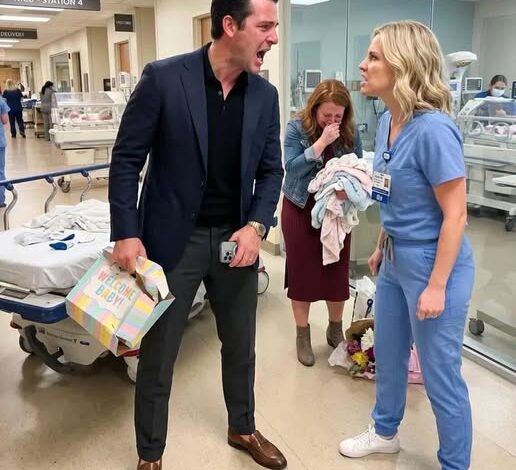
At 2:17 in the afternoon, Emily Carter signed the emergency C-section consent form across her own trembling stomach because there was nowhere else to place it.
The bedside table was crowded with medical supplies. Blood had already soaked through the towel beneath her hips. Three fragile heartbeats flashed across the monitor, uneven and frantic, while alarms cut through the room.
“Mrs. Carter,” Dr. Naomi Patel said, calm only because panic would help no one, “Baby B is in distress, and Baby C’s cord is compressed. We need to operate now.”
Emily stared at the empty chair beside her bed.
Her husband had promised he was stepping outside for one quick call.
Forty minutes had passed.
“Try him again,” she whispered.
Nurse Lauren dialed.
Straight to voicemail.
Across town, Mark Carter stood in a private country club dining room beside Madison Vale, the woman he had loved before marrying Emily. A white chocolate raspberry cake sat between them, decorated with the words:
To What We Should Have Been.
Mark’s phone vibrated in his pocket. Emily’s name glowed on the screen.
He frowned, switched it off, and slipped it away.
“Today is about us,” Madison said.
Mark smiled and helped her cut the cake.
Back at the hospital, Emily accepted the pen.
“If I sign, can you save them?”
“We will do everything we can.”
Her hand shook so badly that the signature barely looked like her name.
Under the surgical lights, Emily heard only fragments.
“Pressure falling.”
“Baby A delivered.”
“More suction.”
“NICU ready.”
“She’s losing too much blood.”
To remain conscious, she repeated the names she had chosen alone.
Grace.
Lily.
Hope.
The first cry came thin and furious.
The second followed moments later.
Then silence.
“Baby C?” Emily gasped.
“We’re working on her.”
She imagined Mark bursting through the doors, terrified and remorseful, finally understanding that his wife and daughters mattered more than anything else.
Instead, Nurse Lauren held her hand.
Four days later, Mark walked into the maternity ward carrying the faint scent of frosting and Madison’s perfume.
He had spent the weekend at her lake house with his phone abandoned in the car, dismissing every missed call as another attempt by Emily to control him. That morning, when he finally turned it on, the screen filled with hospital numbers and one message from Emily’s sister, Claire:
If you have one human bone in your body, come now.
He deleted it without reading the others.
The maternity room was empty.
The bed had been stripped. Flowers from his office sat untouched by the window.
Mark grabbed a passing nurse.
“Where is Emily Carter? My wife. She had triplets today.”
The nurse stared at him.
“Mr. Carter, the surgery was last Thursday. Today is Monday.”
His face went blank.
Nurse Lauren appeared behind the desk.
“Two babies are in the NICU,” she said coldly. “One was transferred for cardiac monitoring. All three are stable.”
“Where is my wife?”
“She discharged herself against medical advice after arranging temporary medical authority for her sister.”
“You let her leave?”
“She was conscious and legally competent. Unlike you, we answered when she needed help.”
Mark demanded access to the babies, but security stopped him. Emily had removed his name from the approved visitor list.
Twenty minutes later, Claire entered carrying a diaper bag.
“What did you do?” Mark shouted.
Claire gave a bitter laugh.
“I answered the phone.”
“She’s my wife.”
“She was your wife when she was bleeding out and begging for you.”
“Tell me where she is.”
“No. You can speak through lawyers.”
Beyond the glass, three incubators glowed beneath soft blue lights. Grace, Lily, and Hope had entered the world fighting to survive while their father celebrated another woman.
For once, Mark had no excuse large enough to hide behind.
Emily had gone to Claire’s townhouse, but she was far from safe. Her blood count was dangerously low, her incision was inflamed, and her blood pressure kept dropping. Within two days, she was admitted to another hospital.
There, with Claire beside her, she met attorney Daniel Ross.
Emily told him everything.
Mark’s affairs.
The financial control.
The insults during pregnancy.
The threats to take the children if she embarrassed him.
The way affection appeared only when she improved his image.
“To everyone else, he performs the role of a devoted husband,” Emily said. “At home, I am useful until I need something.”
Daniel listened carefully.
“He will fight,” he warned. “Not because he suddenly understands love, but because men like him hate losing control.”
Emily looked out at the gray parking lot.
“Then we fight harder.”
Mark did exactly what Daniel predicted.
First came rage. He threatened the hospital and accused Claire of kidnapping. When that failed, he became charming. He told staff that Emily had been unstable throughout the pregnancy.
But hospitals keep records.
There were unanswered calls, nursing notes, security reports, and the surgical consent Emily had signed while hemorrhaging.
Then Madison’s name appeared in subpoenas.
Country club receipts.
Lake house bookings.
The cake.
During her deposition, Madison admitted Mark had known Emily was at the hospital. She also repeated what he had said before switching off his phone:
“She’ll be fine. She always exaggerates when she wants attention.”
That sentence destroyed what remained of his defense.
Three weeks after the birth, Emily returned to the NICU in a wheelchair.
Grace frowned in her sleep, one fist beside her cheek.
Lily wrapped tiny fingers around Emily’s hand.
Hope lay beneath a warmer, the daughter whose silence had nearly broken her.
Emily leaned forward despite the pain in her incision.
“Hello, my little fighter,” she whispered. “I came back.”
From then on, she came every day.
She learned feeding tubes, oxygen levels, alarms, and the careful language of premature survival. She pumped milk in a beige room and sang the same quiet song until the nurses knew it by heart.
Mark filed for custody.
He described Emily as unstable, weak, and irresponsible. In court, he arrived in a polished navy suit, wearing the solemn expression of a devoted father.
Nurse Lauren testified about the emergency calls, the blood, and Emily repeating her daughters’ names while Mark remained unreachable.
Madison’s statement followed.
The judge granted Emily temporary sole physical and legal custody. Mark received only supervised visitation after completing a parenting evaluation.
Outside the courtroom, he cornered her near the elevator.
“You think this is over?”
For years, Emily had softened every sentence to avoid his anger.
This time, she looked directly at him.
“No,” she said. “I think it finally started.”
The divorce lasted eight months.
Mark fought over money, furniture, public statements, and sealed records. He wanted Emily to say they had simply grown apart.
She refused.
She did not give interviews. She did not seek revenge.
She only stopped protecting him from the truth.
His employer placed him on leave. The country club canceled his membership. Madison disappeared as soon as scandal replaced excitement.
Grace and Lily came home first.
Claire’s living room filled with bassinets, bottles, feeding charts, and exhaustion. Some nights, both babies screamed while Emily stood between them whispering, “I’m here. I’m here. I’m here.”
Hope remained hospitalized longer.
When she was finally strong enough to join her sisters, nurses arranged pillows so Emily could hold all three at once.
That photograph later sat on her mantel: Emily pale and exhausted, three tiny daughters against her chest, Claire standing behind her with both hands on her shoulders.
Mark began supervised visits in spring.
He brought expensive toys meant for older children and complained whenever the babies cried in his arms. The supervisor wrote:
Father appears more concerned with perceived unfairness toward himself than the infants’ needs.
After six visits, he began missing appointments.
After twelve, he moved to Chicago.
By the triplets’ first birthday, Emily had permanent custody. Mark’s support payments arrived late until the court began taking them directly from his wages.
Emily stopped waiting for him to become someone else.
She built a smaller life and made it stronger.
She returned to work part-time. Claire helped with the girls. A neighbor became their unofficial grandmother. The townhouse filled with laughter, arguments, spilled cereal, music, and ordinary miracles.
Grace became fearless.
Lily became gentle.
Hope, still smaller than her sisters, loved music and pressed her hands against piano keys as though she could feel secrets inside them.
On their fifth birthday, Mark called.
“I want to see my daughters.”
“Contact the visitation supervisor,” Emily replied.
“They’re mine too.”
“They are children, Mark. Not possessions.”
“You turned them against me.”
“No. You left before they learned your face.”
His voice softened into the familiar tone he used when trying to regain control.
“I was scared.”
“So was I.”
“I didn’t know it was serious.”
“You were told. You chose not to listen.”
“Do they ask about me?”
“Sometimes,” she said. “And I tell them the truth.”
He never arranged the visit.
At the girls’ sixth birthday, paper lanterns hung across the backyard. Grace raced everyone in sight. Lily stopped to help a younger child tie her shoe. Hope finished last and laughed hardest, blue frosting smeared across her chin.
For one brief moment, Emily remembered the operating room—the blood, the empty chair, the unanswered phone.
But the memory no longer owned her.
Claire touched her shoulder.
“You all right?”
Emily watched her daughters running through the yard.
“Yes,” she said.
Years earlier, she had signed a consent form believing she was making one desperate choice to save three unborn children.
Only later did she understand the truth.
That signature had also marked the beginning of her own rescue.