The eviction notice waited on Michael’s computer with the quiet certainty of routine.
One click.
One signature.
One more file cleared from a stack that never seemed to shrink.
He had completed hundreds like it over the years. Names changed. Apartment numbers changed. Amounts overdue changed. But the process rarely did. He had trained himself to see columns of figures instead of lives, balances instead of birthdays, case numbers instead of families.
It was the only way to survive the job.
At least, that’s what he had always told himself.
Tonight, that explanation no longer worked.
Every time his hand moved toward the keyboard, another image forced its way into his thoughts.
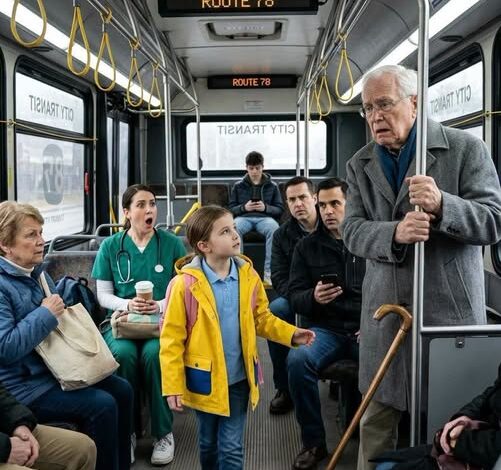
A little girl in a faded yellow raincoat.
The coat had clearly belonged to someone else first. Its sleeves had been shortened with uneven stitches, one pocket had been sewn back on with mismatched thread, and the knees of her trousers were damp from the rain that had soaked through long before she climbed onto the city bus.
She couldn’t have been more than eight.
She had stood near the back, gripping a cold metal pole with both hands as the bus lurched through traffic. Her shoes were too large, her backpack looked heavier than she did, and despite the storm raging outside, she never complained.
She simply held on.
Michael had noticed her only because she’d smiled at an elderly passenger before offering her seat without hesitation.
That smile had followed him home.
Later, while reviewing files, he’d recognized the address.
Torres.
Apartment 4B.
The same building.
The same neighborhood.
The same family.
The folder on his desk suddenly felt different.
No longer was it a collection of overdue notices, payment histories, and legal deadlines.
It became the sound of rain striking thin apartment windows.
A kitchen where groceries had to last one more week.
A secondhand winter coat hanging above a space heater that might soon have no electricity to warm the room around it.
A mother calculating impossible choices after her daughter had gone to bed.
Rent.
Medicine.
Food.
One bill paid meant another would wait.
For years, Michael had protected himself with a single sentence.
“It’s not personal.”
Whenever guilt crept in, he reminded himself that policies weren’t his invention. Rules existed for a reason. Contracts had to mean something. If he didn’t process the paperwork, someone else would.
He wasn’t responsible.
He was just doing his job.
But that night, the words sounded hollow.
Systems didn’t lie awake wondering whether a child had eaten dinner.
Systems didn’t remember frightened faces on crowded buses.
Systems didn’t picture patched raincoats drying overnight beside aging heaters.
People did.
And for the first time in a long while, Michael allowed himself to feel like one again.
The office was silent except for the soft hum of fluorescent lights.
His cursor blinked beside the signature line.
Waiting.
Expecting.
Demanding nothing more than another routine decision.
He picked up his pen.
Held it above the paper.
Then stopped.
His hand refused to move.
A strange heaviness settled over him, as though every eviction notice he’d ever approved had quietly gathered behind this one moment.
He lowered the pen without writing a single word.
His pulse quickened.
What was he doing?
There were procedures.
Protocols.
Deadlines.
Changing course wasn’t simple.
Still, another thought surfaced.
If rules included no room for compassion, then perhaps he hadn’t been looking closely enough.
With trembling fingers, he closed the eviction form.
He searched through menus he hadn’t opened in years, scrolling past options most employees ignored because they required extra documentation, additional meetings, and far more effort than simply pressing “Approve.”
Then he found it.
Hardship Review.
Attached beneath it was another option.
Temporary Extension Pending Financial Assessment.
He stared at the screen for a long moment.
The policies had always been there.
He had simply forgotten they existed—or perhaps convinced himself they weren’t worth using.
His hands shook as he completed the request.
Every box required another explanation.
Every page demanded another justification.
Income interruption.
Dependent child.
Request for emergency review.
Referral to rental assistance.
He filled them out one by one.
The work took far longer than signing the eviction would have.
For the first time that evening, he didn’t care.
When he finally clicked Submit, there was no dramatic fanfare.
No applause.
No certainty that the outcome would change.
Only the quiet knowledge that he had chosen to see a family instead of a file.
Outside, rain continued to sweep across the city streets.
A bus hissed to a stop at the curb.
Passengers climbed aboard, shaking water from umbrellas and jackets.
Among them, somewhere beneath the gray evening sky, a little girl in a worn yellow raincoat tightened her grip on the handrail as the bus pulled away.
She had no idea that a stranger across the city had spent the evening fighting paperwork instead of approving it.
She didn’t know that one decision had paused the countdown threatening her home.
She couldn’t have known.
Sometimes the most important acts of kindness happen without the people they protect ever learning the name of the person who made them possible.
Michael leaned back in his chair and closed his eyes.
The system hadn’t changed overnight.
The world was still imperfect.
Tomorrow would bring another stack of files.
Another list of impossible choices.
But tonight, for one family, procedure had made room for compassion.
And for the first time in years, Michael left the office believing that even within the largest systems, humanity still had the power to find its way through the smallest opening.