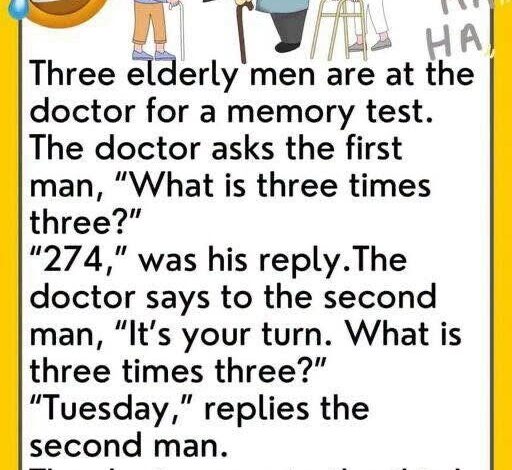
The three men entered the examination room one after another, each carrying the familiar mixture of quiet dignity, uncertainty, and reluctant optimism that so often accompanies advancing age. Their footsteps were slow, their smiles polite but cautious, and their eyes wandered anywhere but the diplomas hanging neatly on the walls. It was another ordinary afternoon at the memory clinic, where conversations often began with the simplest of questions and sometimes revealed the most profound truths.
Dr. Halpern had performed these evaluations countless times.
He knew the routine by heart.
Ask the patient’s name.
Ask today’s date.
Ask where they were.
Listen carefully—not only to the answers, but to the pauses, the expressions, and the subtle ways people tried to bridge the growing gaps in their memory.
The questions were intentionally uncomplicated. They weren’t designed to embarrass anyone. They were gentle landmarks, helping physicians understand how well a person’s orientation and recall remained intact.
Arthur volunteered to go first.
Despite his years, he still carried himself with a trace of confidence, adjusting his jacket before settling into the chair across from the doctor.
Dr. Halpern smiled reassuringly.
“Arthur, can you tell me today’s date?”
Arthur frowned thoughtfully, tapping one finger against the armrest as if the answer might emerge through rhythm alone.
Several long seconds passed.
Then his face brightened with complete certainty.
“Forty-two.”
The room fell silent.
The nurse looked down at her clipboard to hide an involuntary smile.
Dr. Halpern blinked once before responding gently.
“Forty-two?”
Arthur nodded proudly.
“That’s the number.”
He seemed perfectly satisfied, as though he had solved a difficult puzzle that everyone else was overcomplicating.
Dr. Halpern made a quiet note on the chart.
Not because the answer was correct.
Because Arthur had delivered it with such unwavering conviction that correcting him immediately seemed almost beside the point.
Next came Bernard.
He eased himself into the chair with visible effort, clasping his hands together as though preparing for an important interview.
The doctor asked the same familiar question.
“Bernard, what day is it today?”
Bernard stared at the window.
His lips moved silently.
One minute passed.
Then another.
The room remained patient.
Finally, he exhaled and looked up with unmistakable confidence.
“Tuesday.”
Nothing more.
No month.
No year.
No explanation.
Just one determined word, offered as though it contained everything necessary.
The nurse bit her lip to suppress a grin.
Bernard noticed the expression and gave a tiny shrug.
“I’ve always liked Tuesdays.”
The unexpected comment drew a soft laugh from everyone in the room, including Dr. Halpern.
Sometimes humor appeared in the most unexpected places.
Clarence was last.
He approached the chair with a mischievous sparkle that hadn’t faded despite the years.
Even before the doctor spoke, Clarence looked as though he were preparing for a game rather than a medical examination.
“Clarence,” Dr. Halpern began, smiling despite himself, “can you tell me how old you are?”
Clarence leaned back.
His eyebrows knitted together.
He appeared to be performing extraordinarily complicated calculations inside his head.
He counted softly on his fingers.
Stopped.
Started again.
Shook his head.
Counted once more.
Finally, after what felt like an eternity, he looked triumphantly at the doctor.
“I’m eighteen…”
He paused dramatically.
“…for the fourth time.”
The room erupted.
Even Dr. Halpern couldn’t help laughing.
Clarence’s expression remained perfectly serious for another heartbeat before the corners of his mouth curled into a knowing smile.
He had been waiting for that reaction.
When the laughter settled, a quiet stillness returned to the room.
Dr. Halpern looked at the three men sitting together.
Arthur still seemed pleased with his mysterious number.
Bernard quietly repeated “Tuesday” under his breath, perhaps reassuring himself.
Clarence sat with folded arms, clearly convinced his arithmetic deserved full marks.
The charts in front of the doctor told one story.
They documented hesitation.
Confusion.
Memory lapses.
The gradual changes that often accompany aging.
But the people sitting before him told another story entirely.
Arthur’s confidence.
Bernard’s gentle sincerity.
Clarence’s playful wit.
None of those qualities fit neatly into a checklist.
Medicine could measure memory with remarkable precision.
It could record forgotten names, missed dates, and uncertain answers.
What it couldn’t easily measure was the resilience that remained when memory began to fade.
It couldn’t quantify humor.
Or dignity.
Or the quiet determination to keep meeting life with a smile despite its growing challenges.
Dr. Halpern lowered his pen for a moment before writing his conclusion.
He chose his words carefully.
Yes, there were unmistakable signs that memory was slipping.
Yes, further evaluation and support would be important.
But those facts alone failed to capture the whole picture.
Because even as dates blurred and numbers lost their meaning, something essential endured.
Arthur still believed every question deserved an answer.
Bernard still searched patiently for his truth, no matter how long it took to find.
Clarence still found a way to make everyone around him laugh.
Those weren’t symptoms.
They were reminders.
Reminders that a person’s identity is larger than any medical test, and that even when memory begins to loosen its grip, character often remains astonishingly intact.
As the three friends slowly left the office together, teasing one another about whose answer had been “closest,” Dr. Halpern watched them disappear down the hallway with a quiet smile.
He realized the examination had revealed far more than cognitive decline.
It had revealed courage.
It had revealed friendship.
And above all, it had revealed a stubborn refusal to let the passing of years erase the joy of simply being human.
Sometimes, the most meaningful thing a memory test uncovers isn’t what people have forgotten.
It’s everything they still carry with them.