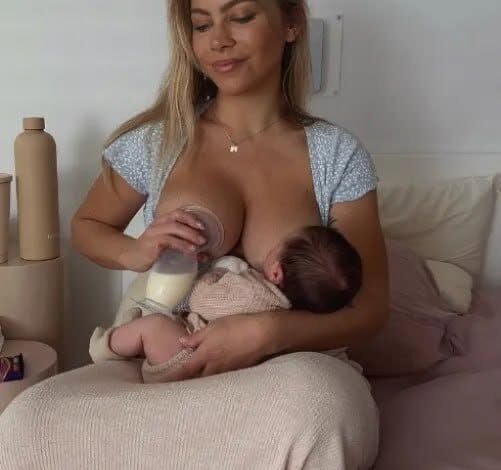
Few moments between a parent and newborn feel quite as intimate as feeding time.
For many families, breastfeeding becomes part of those earliest memories—the quiet hours after midnight, tiny fingers wrapped around a parent’s hand, and the extraordinary realization that a completely dependent little person is growing right before their eyes.
It is an ordinary biological process, yet for the people experiencing it, it can feel profoundly personal.
Breast milk provides infants with nutrients needed during an important stage of growth and development. It also contains antibodies and other protective components that help support a baby’s developing immune system.
For these reasons, major health organizations commonly recommend exclusive breastfeeding for approximately the first six months when possible and appropriate, followed by continued breastfeeding alongside complementary foods.
But statistics and recommendations tell only part of the story.
Breastfeeding can also create moments of closeness between a nursing parent and child.
The physical contact involved in feeding can offer comfort and reassurance to a baby while creating opportunities for bonding. For some parents, those quiet feeding sessions become treasured memories long after their children have grown.
There can be benefits for the breastfeeding parent as well.
Research has associated breastfeeding with certain maternal health benefits, including lower risks of some cancers. The postpartum period also involves significant physical and hormonal changes, and breastfeeding becomes one part of that recovery experience for many people.
Still, describing breastfeeding as “natural” should never be confused with describing it as effortless.
For some parents, nursing begins almost immediately without major difficulties.
For others, it can be exhausting, painful, frustrating, or simply impossible.
A baby may have trouble latching properly.
Milk supply can become a concern.
Parents may experience soreness, blocked ducts, infections, or exhaustion from frequent feeding.
Returning to work can create another layer of difficulty, particularly when someone needs time and privacy to pump or doesn’t have reliable access to appropriate facilities.
Then there is the emotional pressure.
New parents already face enormous expectations, and feeding decisions can become another source of judgment.
Those who breastfeed may receive unwanted comments about nursing in public or continuing beyond a certain age.
Those who use formula may encounter criticism for not breastfeeding.
Others combine breastfeeding and formula because that is what works best for their family.
None of those experiences can be understood simply by looking at a photograph.
That’s why compassionate support matters.
Lactation consultants, nurses, physicians, breastfeeding support groups, partners, relatives, and friends can all play valuable roles when difficulties arise.
Sometimes practical guidance makes the difference.
Other times, what a struggling parent needs most is reassurance that asking for help doesn’t mean they have failed.
That complicated mixture of nourishment, vulnerability, exhaustion, and affection may help explain why one mother’s breastfeeding photographs attracted so much attention online.
Rather than presenting feeding as something that needed to be hidden, the images captured it as part of everyday parenthood.
The response was immediate.
Some viewers praised the photographs for portraying breastfeeding openly and naturally.
Parents shared their own memories, with some recalling beautiful experiences and others describing the difficulties they had endured.
For people who had spent months waking throughout the night to nurse or pump, the images represented something deeply familiar.
Others had different reactions.
Breastfeeding photographs—particularly when shared publicly—can still generate debate about privacy and social expectations.
That disagreement demonstrates something interesting about the way breastfeeding is viewed.
Most people recognize that feeding an infant is necessary and normal, yet seeing breastfeeding depicted openly can still make some viewers uncomfortable.
For many advocates, greater visibility helps challenge that discomfort.
They argue that breastfeeding shouldn’t automatically become controversial simply because part of a breast may be visible while a child is eating.
At the same time, every parent has the right to decide how private or public they want their own feeding experience to be.
There is no requirement to turn an intimate family moment into a public statement.
Ultimately, the photographs resonated because they captured something larger than a feeding method.
They showed a relationship developing in real time.
A parent providing nourishment.
A baby seeking comfort.
A brief moment of stillness during one of life’s most demanding transitions.
And perhaps that is why images like these can travel so quickly across the internet.
Behind all the debates, recommendations, and opinions is something remarkably simple: a parent trying to care for a child.
Breastfeeding can be beautiful.
It can also be difficult.
Sometimes it is both within the same hour.
Families who choose it deserve practical support rather than unrealistic expectations, just as families who cannot or choose not to breastfeed deserve respect for making feeding decisions that work for their circumstances.
Because ultimately, successful parenting cannot be reduced to one feeding method or one perfect photograph.
It is found in the countless ordinary moments when parents show up, provide care, seek help when necessary, and do their best to give their children a healthy beginning.
And that may be the real reason these photographs struck such a powerful chord.
They didn’t merely capture breastfeeding.
They captured parenthood in one of its most vulnerable, demanding, and deeply human forms.