I Carried My Brother’s Baby as His Surrogate—Then He Looked at Her Back and Said, “I Can’t Take Her Home”

The baby had been alive for less than five minutes when my twin brother Ryan went white.
I was still trembling from labor, the hospital room washed in pale October light and smelling sharply of antiseptic, when Melissa held the daughter she had spent four years trying to have.
Ryan asked if he could take her.
He cradled Alice carefully, one hand beneath her head, the other supporting her back.
Then he turned her just slightly.
And froze.
Across her skin was a large reddish-purple birthmark shaped almost exactly like the butterfly-shaped mark that had appeared through generations of our family.
Our grandmother had one.
Ryan had one across his upper back.
Mine was faint, near my hip.
Melissa had nothing similar.
“Ryan?” I said.
He looked at Alice.
Then at Melissa.
Then at me.
“I’m sorry,” he whispered. “I can’t take her home.”
For one terrible second, none of us understood what he meant.
I was thirty-four then, a kindergarten teacher and single mother to my six-year-old son, Oliver.
When Ryan and Melissa first asked whether I would carry a child for them, I said no.
Not because I didn’t love them.
Because I knew exactly how complicated it could become.
Melissa’s eggs were healthy.
Ryan’s fertility testing was normal.
But a congenital uterine abnormality made pregnancy dangerous and extremely difficult for Melissa to carry to term.
They had already endured years of treatment, failed attempts, cautious hope, and disappointment.
Eventually, they chose gestational surrogacy.
And after months of counseling, legal work, medical screenings, and conversations that left all three of us emotionally exhausted, I changed my mind.
Ryan had spent his whole life showing up for me.
When Oliver’s father left, Ryan was the one who arrived with groceries before I admitted I needed help.
When I was afraid I couldn’t manage single motherhood, he sat on my kitchen floor with me until two in the morning and said, “Then we manage tomorrow first.”
So when he asked me to do something enormous for him, I wanted to believe I could.
The embryo was created from Ryan and Melissa’s genetic material.
It was transferred into my uterus through the clinic.
The first attempt worked.
Everyone cried.
Ryan and Melissa attended every appointment.
They built a nursery painted yellow.
Filled shelves with picture books.
Restored an old rocking chair.
Hung small wooden birds above the crib.
They chose the name Alice before she was born.
I knew carrying her would create feelings no contract could simplify.
I felt her kick.
Hiccup.
Turn.
I talked to her when I drove.
Oliver put his hand on my stomach and called her “Cousin Baby.”
But I understood my role.
I was carrying my brother and sister-in-law’s daughter.
I was shelter.
Temporary.
Loving, yes.
But temporary.
Then Alice was born.
And Ryan saw the mark.
At first, Melissa thought he was panicking over a harmless birthmark.
The nurse explained that pigmentation like that could be benign.
Ryan barely heard her.
“No,” he said. “You don’t understand.”
He looked at me.
“You see it too.”
I did.
The shape was unmistakable.
A birthmark is not proof of parentage.
We all knew that.
But the family pattern was distinctive enough to raise a question none of us wanted to ask.
What if the embryo transferred into me had not been the embryo the clinic told us it was?
Ryan was not rejecting Alice.
That became clear almost immediately.
He held her tighter.
But he was terrified.
Terrified that somewhere in the process, something had gone wrong.
Dr. Ahuja ordered genetic testing.
The clinic launched an internal review.
Then came forty-eight hours I will never forget.
Melissa barely spoke.
Ryan stayed near Alice whenever he was allowed.
I remained in the hospital because my body was still recovering and because no one knew yet what the test would say.
When the results arrived, Dr. Ahuja sat down before speaking.
That alone told us enough.
Alice was unquestionably Ryan’s biological daughter.
Melissa was not her biological mother.
The room seemed to lose sound.
Melissa stared at the wall.
Ryan gripped the edge of the chair.
I looked down at Alice and felt something inside me go cold.
The clinic eventually traced the error to a labeling failure involving two embryo samples during preparation.
Worse, multiple checkpoints that should have caught the mistake did not.
That meant another family had potentially been affected too.
What we had believed was a straightforward surrogacy had become something much larger.
Genetic testing.
Patient advocates.
Attorneys.
Clinic liability reviews.
Questions about parentage.
Custody.
Medical responsibility.
Disclosure obligations.
The rights of the other patient whose treatment had been entangled with ours.
Nothing about it was simple.
And Alice did not care.
She still needed to be fed.
Held.
Changed.
Comforted.
She still woke hungry.
Still curled her fingers around mine.
Still slept with her mouth slightly open.
While adults argued about biology and law, she simply existed.
That mattered.
I stayed with her initially because someone had to.
Ryan visited constantly.
He never once acted as though Alice was anything other than his daughter.
But he also refused to pressure Melissa.
He understood that love did not erase what had been taken from her.
Melissa had spent years imagining motherhood through one path.
Her egg.
Her embryo.
Her child carried safely by someone she trusted.
Now she had to process the fact that the baby she had already prepared a room for was genetically connected to Ryan but not to her.
There was no clean emotional script for that.
I admired Ryan most during those weeks because he did not demand one.
He did not say:
You should love her anyway.
He did not say:
Biology doesn’t matter.
He did not minimize Melissa’s grief because he feared losing Alice.
He simply stayed beside her.
Six weeks after Alice was born, Melissa called me.
I was sitting beside the bassinet.
Alice had just fallen asleep.
Melissa was quiet for a long time.
Then she said:
“I keep thinking about the yellow room.”
I waited.
“The books. The rocking chair. Those stupid wooden birds Ryan hung crooked.”
I smiled despite myself.
“They are crooked.”
“I know.”
Her voice cracked.
Then she said:
“I spent years preparing for motherhood.”
I closed my eyes.
“Not just for an embryo.”
Another pause.
“For the child who would need that room.”
I looked at Alice.
Melissa started crying.
“I know she didn’t come from me.”
Then she said the sentence I will remember for the rest of my life.
“But she came into a room full of people already waiting to love her.”
Three days later, Alice went home with Ryan and Melissa.
Not casually.
Not on sentiment alone.
The legal arrangements had been completed through counsel.
The clinic investigation continued separately.
The rights and responsibilities of everyone involved had to be addressed carefully.
None of us pretended the mistake had stopped mattering because the immediate family decision had been made.
That would have been dishonest.
The error was serious.
It affected more than one family.
It created damage that no heartwarming ending could erase.
But Alice finally went home.
The yellow room was waiting.
So were the books.
The rocking chair.
The crooked birds.
And Melissa.
Now, fourteen months later, Alice is determined to walk everywhere without help.
She is fierce.
Curious.
Impatient.
Ryan claims she gets that from me.
Melissa says that is impossible because apparently only biological relatives are allowed to be stubborn now.
They tease each other.
That feels like progress.
Melissa is Alice’s mother in every daily way that matters.
She is the one who knows which song calms her.
Which cup she refuses to drink from.
How long to wait before trying bedtime again after Alice decides sleep is a conspiracy.
Ryan is the father who noticed one detail and refused to ignore it.
And I am her aunt.
That role fits me better than I expected.
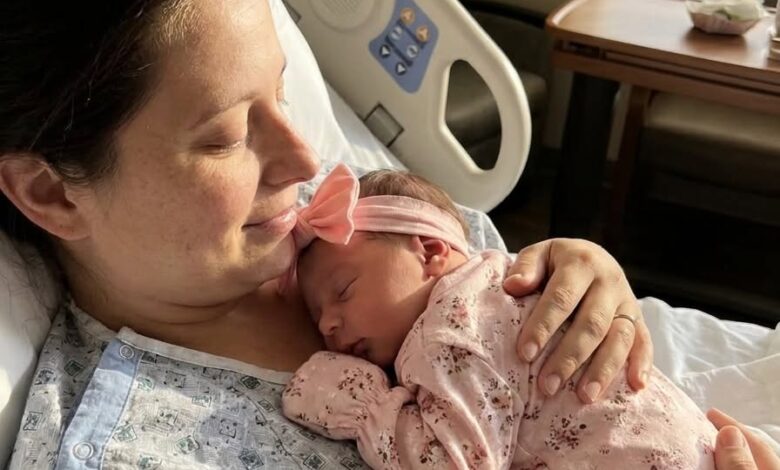
I have a photograph from the hospital.
Alice is lying against my chest shortly after birth.
My face is exhausted.
Her eyes are closed.
The butterfly mark is barely visible beneath the blanket.
I keep that photograph because it reminds me what carrying someone can mean.
Not possession.
Not claim.
Care.
You carry someone until it is time to hand them forward into the life waiting for them.
That was always supposed to be my role.
The clinic’s mistake made the handoff far more painful and complicated than any of us imagined.
But the truth allowed us to choose knowingly.
That mattered.
One day, Alice will know the story.
Not all at once.
Not before she can understand it.
But eventually.
She will learn about the clinic error.
About the testing.
About the other family whose experience was affected.
About why her genetic story is more complicated than most.
And she will learn about the butterfly on her back.
The mark that frightened her father enough to ask the question no one wanted to hear.
I hope we tell her carefully.
Without turning her into a symbol.
Without suggesting the mistake that surrounded her conception defines her.
She did not cause any of it.
She simply arrived.
The adults around her were responsible for deciding what honesty required.
That is the part of the story I carry most strongly now.
Ryan could have looked away.
He could have told himself the mark was coincidence.
He could have been too afraid of what testing might reveal.
He could have taken Alice home and built a life on an assumption.
Instead, he said the difficult thing.
He asked.
And because he asked, everyone involved got the chance to make informed decisions.
That did not make the truth painless.
Truth is not automatically kind.
Sometimes it devastates.
Sometimes it complicates everything.
But ignorance can be crueler because it takes choice away.
None of us would have chosen how Alice came into our family.
Melissa would never pretend otherwise.
I would never romanticize the clinic’s failure.
But I am grateful we found out.
Grateful Ryan looked closely.
Grateful the mistake did not remain hidden for years.
Grateful Melissa had time and support to decide what motherhood meant to her rather than being unknowingly carried into a life built on false information.
And grateful that when she made that decision, it was hers.
The butterfly remains on Alice’s back.
It has faded slightly but is still visible.
Whenever I see it, I no longer think first about the panic in that hospital room.
I think about recognition.
About how one small detail changed everything.
About how family can begin with biology, law, intention, caregiving, sacrifice, or some complicated combination of all of them.
And about how love, when it is healthy, does not require people to pretend facts do not matter.
It lets the facts be true.
Then asks:
What do we choose now?
Ryan chose to remain Alice’s father.
Melissa chose motherhood with open eyes.
I chose to return fully to being her aunt.
And Alice, someday, will get to decide what the story means to her.
That may be the most important part.
The adults do not own the meaning forever.
We only owe her the truth.
Carefully.
Honestly.
And with enough love that when she finally understands the butterfly on her back, she also understands something else.
She was never the mistake.
She was the child everyone had to learn how to love without lying about how she arrived.