My Son Left Me at the ER and Flew to Cancún During My Heart Attack — Then a Nurse Handed Me a Phone

At 7:15 on a Tuesday morning, my son dropped me at the emergency room and drove away before I was through the doors.
Danny didn’t park. He didn’t even shut off the engine.
He leaned across the passenger seat of the SUV I’d helped him buy and gave me the distracted smile people use when they’re already thinking about somewhere else.
“Text me when they discharge you, Pop. Just Uber home. There’s forty bucks on the counter.”
Then he pulled away.
He had a flight to Cancún.
I had a heart attack.
The triage nurse took my blood pressure, looked at the screen, and lost all color in her face. Within seconds, five people surrounded me. Someone pushed my chair backward. The ceiling tiles began sliding above me.
I heard fragments.
“Cath lab.”
“Possible blockage.”
“Right now.”
And through all of it, I had one ridiculous thought: I should text Danny so he doesn’t worry.
By that afternoon, doctors had placed two stents in my heart.
Over the next three days, the hospital called my son eleven times.
He answered none of them.
I still defended him.
“He’s traveling for work,” I told the nurses.
That wasn’t true.
Priya knew it wasn’t true.
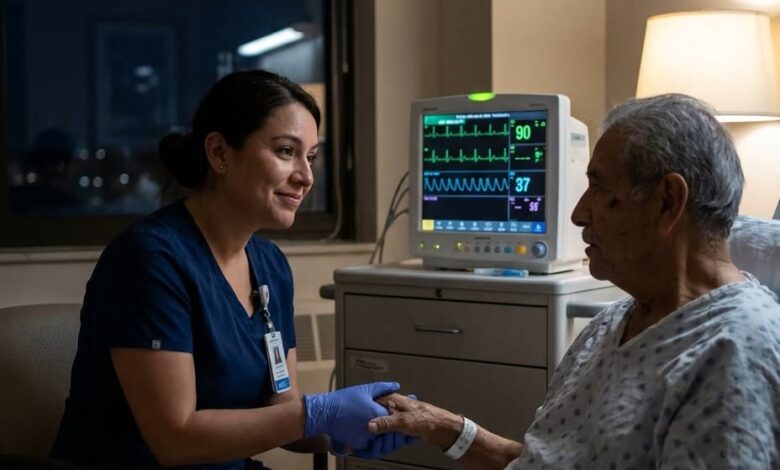
She was my night nurse on the cardiac floor, and by the second night she’d stopped hiding how angry she was for me.
On the third, she entered my room pushing a phone cart. Her expression stopped me cold. My wife used to get that same look when she’d decided something important and there was no changing her mind.
“Mr. Alvarez,” Priya said, “there’s someone you need to talk to. I need you to stay calm.”
That conversation would eventually give me back $214,000.
But first it destroyed the last excuse I’d been making for my son.
I’d raised Danny alone since he was nine, after his mother died.
For thirty-eight years, I drove a delivery truck. On weekends, I worked at a warehouse. Every morning, I packed lunches at 4:40 because that was what life required.
Danny needed shoes? He got them.
School trip? I found the money.
College problem? We solved it.
When he and Brianna wanted to buy a house in 2019, I gave them $61,000 from my retirement for the down payment.
I don’t regret that.
What I regret came later.
In 2024, they sat me at their kitchen table.
“You shouldn’t be alone at your age, Pop,” Danny said.
They convinced me to sell my little two-bedroom on Curtis Street—the house where Danny had grown up.
The sale brought $214,000.
Danny said he’d invest the money for me.
“Let me handle the paperwork.”
So I signed what he placed in front of me.
Because he was my son.
Afterward, I moved into their supposed in-law suite.
It was a basement room beside the water heater.
Then my Social Security started disappearing into “household expenses.”
My truck was sold.
Looking back, the warning signs seem enormous. At the time, they came one at a time, like stairs descending into darkness.
I stepped down each one telling myself it was normal.
Until the morning my chest felt filled with concrete and Danny stood drinking coffee, irritated because my medical emergency was interfering with his vacation.
Priya had heard pieces of this story during those long hospital nights.
When I mentioned selling my house and Danny “investing” the proceeds, something bothered her.
Her mother, Carol, had worked at the county recorder’s office for thirty-one years.
Priya asked her to check one public record.
Now Carol was on the phone.
Her voice was gentle.
“Sir, who is Brianna?”
My stomach tightened.
“My daughter-in-law.”
There was a pause.
Carol explained what she’d found.
Eight days after the closing on my Curtis Street house, my $214,000 had been used to purchase a duplex on the east side of town.
Cash.
No investment account.
No retirement fund.
No property held for my benefit.
The deed had one name on it.
Brianna’s.
Not mine.
Not even Danny’s.
Brianna’s alone.
My heart monitor erupted.
Priya immediately took the phone from me.
“Look at me, Mr. Alvarez.”
I couldn’t.
“Look at me. Breathe with me.”
She stayed beside me until the rhythm slowed.
Then she squeezed my hand.
“My mother says you need an attorney.”
I stared at her.
“And,” she added, “my brother-in-law happens to take cases like yours for free.”
His name was Sam.
He arrived the morning I was discharged.
Danny still hadn’t called.
Sam sat beside my hospital bed with a legal pad and explained terms I’d never expected to need: fiduciary duty, conversion of assets, constructive trust, financial exploitation of an elder.
The papers I’d signed at Danny’s kitchen table included limited power of attorney for the house sale.
Danny had used that authority to redirect my proceeds.
Sam’s expression barely changed as he reviewed everything.
“This isn’t complicated,” he finally said.
It felt complicated to me.
It was my son.
Sam filed within two weeks.
The court placed a lis pendens on the duplex, preventing it from being quietly sold or borrowed against. Closing records were subpoenaed. Bank transfers were traced.
Every dollar led from the sale of my home directly into Brianna’s duplex purchase.
The trail was almost embarrassingly clear.
Sam called it “a gift.”
Not my gift to them.
Their gift to our case.
Danny returned from Cancún and found a certified letter waiting.
Then my phone rang.
Nine times in one day.
Funny.
The hospital had needed eleven attempts to get nothing.
A lawsuit needed one.
I didn’t answer.
His lawyer claimed the $214,000 had been a gift from a loving father.
Sam responded with escrow paperwork.
Danny himself had described the money in writing as funds “held for my father’s care.”
That sentence ended most of the argument.
The case never reached trial.
With a judge involved, a forensic accountant documenting the transfers, and the possibility of a criminal referral for elder financial abuse becoming very real, Danny and Brianna settled.
The duplex was transferred entirely to me.
My diverted Social Security money was returned.
Their attorney wrote something about everyone regretting the “misunderstanding.”
I read that word several times.
Misunderstanding.
A basement beside a water heater.
A sold truck.
$214,000.
Eleven unanswered hospital calls.
Two stents.
Misunderstanding.
I live in the duplex now.
I took the upstairs unit because it has big windows and morning sunlight. After years of waking before dawn for work, I’ve discovered I like mornings better when I don’t owe them to anybody.
Downstairs lives a young nursing student.
She sometimes pays part of her rent in casseroles.
Technically, that’s not our agreement.
I haven’t complained.
She reminds me of someone.
Danny and I speak occasionally.
Our conversations are careful and uneven. Loving him didn’t disappear when the truth came out, which may be the hardest part to explain.
Trust is different.
Ours healed badly, like a broken bone that wasn’t set straight. You can still walk on it, but you never forget what happened.
Brianna and I don’t speak.
I’ve accepted that.
Priya still visits every few weeks on her days off. Sometimes she brings her kids, and we sit on the porch while I tell exaggerated stories about driving delivery trucks through blizzards.
“You’ve made that snowstorm worse every time you’ve told it,” she says.
“It was a historic storm.”
“It was three inches.”
Then she grabs my wrist and checks my pulse without asking.
People tell me I got justice.
Maybe they’re right.
The deed is in my name now. It’s kept safely in a drawer upstairs, and nobody has power of attorney over anything I own.
But justice isn’t what I think about when the house becomes quiet at night.
I think about that hospital room.
Three in the morning.
Machines blinking beside me.
My heart behaving badly.
No son in the waiting room.
No wife left to call.
Just a frightened old man trying to convince everyone—including himself—that his family hadn’t abandoned him.
Priya saw through the lie.
She didn’t embarrass me for telling it.
She simply pulled a chair beside my bed.
When the monitor jumped, she took my hand.
“You’re not alone,” she told me. “Not on my floor.”
And she meant it.
For most of my life, I believed family was something blood decided for you.
Then my own blood left me outside an emergency room to catch a plane.
A nurse who owed me nothing stayed.
She made eleven unanswered calls matter.
She listened closely enough to notice what I couldn’t admit.
And when something felt wrong, she refused to look away.
The duplex may be what the court returned to me.
But Priya returned something harder to recover.
She reminded me that being abandoned by someone you love doesn’t mean you’re alone.
Blood can make people related.
Showing up is what makes them family.