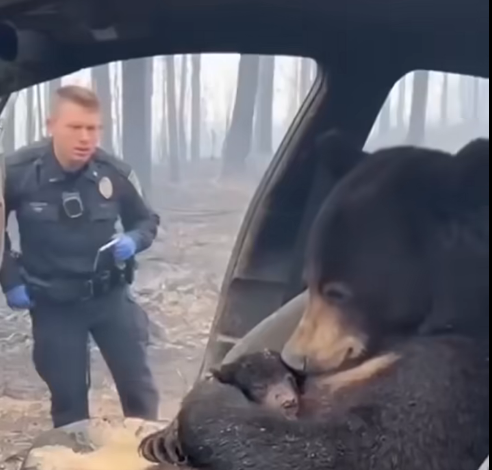
The officer thought the burned car was empty until something inside it moved.
Deputy Daniel Mercer stopped his cruiser on the shoulder and stared through the smoke drifting across the mountain road. The wildfire had passed through sometime before dawn, leaving blackened trees, scorched guardrails, and an abandoned sedan burned down to its metal frame.
Then he heard a sound.
Not a growl.
A cry.
Daniel grabbed his flashlight and approached carefully.
“Easy,” he whispered.
When he reached the driver’s side, he stopped.
Curled inside the ruined car was a black bear.
Her fur was singed along one shoulder. One paw appeared burned, and soot covered her muzzle. Yet she didn’t charge him or attempt to escape.
She was holding something against her chest.
A cub.
Daniel immediately reached for his radio.
“Dispatch, I need wildlife rescue at mile marker eighteen. Adult black bear, injured. There’s a cub with her.”
He moved closer.
Then he saw the cub wasn’t breathing.
The mother had wrapped both front legs around its tiny body.
“Oh, no.”
Daniel had worked accidents for seventeen years. He had seen things he wished he could forget.
But something about the bear made him lower his flashlight.
She wasn’t trapped.
The rear of the vehicle was open where the windows had shattered. She could have climbed out.
She simply wouldn’t leave.
Later, investigators would piece together what had probably happened.
The fire had moved quickly through the valley overnight. The cub may have crawled beneath the abandoned vehicle seeking shelter. Heat damaged the car, and flames eventually swept through its interior.
Nobody knew when the mother arrived.
But she had found her baby.
And stayed.
Daniel backed away when wildlife officers arrived.
They approached slowly, hoping to coax her out.
Food didn’t work.
Noise didn’t work.
Even when they gave her a clear escape route, she remained curled around the cub.
“She understands,” one rescuer whispered.
Daniel looked at him.
“Understands what?”
The man didn’t answer immediately.
“That the cub is gone.”
For almost two hours, they waited.
Eventually, the mother shifted.
She nudged the cub’s face with her nose.
Once.
Twice.
Then she licked the soot from its head.
Daniel turned away.
His own daughter had died eleven years earlier.
Emily had been six.
For years, people had told him that time would heal him.
It hadn’t.
Time had simply taught him how to carry something that couldn’t be fixed.
Watching the bear, Daniel remembered the hospital.
He remembered holding Emily after the machines stopped.
A nurse had eventually whispered, “Whenever you’re ready.”
He hadn’t been ready.
How could anyone ever be ready to put down their child for the last time?
Now, beside a burned car on a mountain road, Daniel realized he was watching another mother face the same impossible command.
Let go.
The bear finally climbed from the vehicle.
Her injured paw touched the pavement, and she recoiled.
Still, she turned back.
She reached inside and pulled the cub toward the opening.
“She wants to take it,” Daniel said.
The wildlife officer nodded.
The mother dragged the cub several feet before her injured paw failed.
She rested beside it.
Then tried again.
Nobody moved.
Finally, she carried the cub toward the tree line.
The rescuers followed from a distance.
Near a patch of earth untouched by the worst flames, she stopped beneath a surviving pine.
She placed the cub down.
Then she sat beside it.
Minutes passed.
The rescue team couldn’t wait forever. The mother’s injuries needed treatment.
When they approached again, she stood over the cub and gave a warning growl.
Everyone backed away.
Daniel understood.
“She hasn’t said goodbye.”
Another hour passed.
Then the bear lowered her head and pressed her nose against the cub’s forehead.
She remained like that for several seconds.
Afterward, she stepped away.
Three steps.
Then she turned around.
She came back and touched the cub again.
The second time she walked farther.
She looked back once more.
Daniel felt tears running down his face before he realized he was crying.
“Go on, Mama,” he whispered.
“It’s okay.”
Eventually, the bear allowed the wildlife team to sedate her.
They treated her burns and transferred her to a rehabilitation facility.
The cub was buried near the pine.
Daniel asked permission to stay.
He found two flat stones and placed them over the small grave so scavengers wouldn’t disturb it.
Then he sat beside it until sunset.
Before leaving, he removed something from his wallet.
A faded photograph of Emily.
He almost placed it beneath one of the stones.
Almost.
Instead, he held it in his hand.
For eleven years, Daniel had carried that photograph everywhere.
He had convinced himself that grief was something uniquely human—that memories and regret were the terrible price people paid for understanding love.
But the bear had changed something in him.
She didn’t need words.
She didn’t need photographs.
She didn’t need anyone to explain death.
She had known only that the little creature she had protected was suddenly still, and every instinct inside her had refused to leave it behind.
Months later, wildlife officials told Daniel that the mother had recovered.
She was released into another section of the forest.
Daniel drove out to watch from a distance.
The transport crate opened.
For several seconds, nothing happened.
Then the bear stepped into the sunlight.
Her fur had grown back over most of the burns. She sniffed the air and walked toward the trees.
Just before disappearing, she stopped.
Daniel knew it was foolish, but he wondered whether she remembered.
The burned car.
The smoke.
The tiny body beneath the pine.
Of course she remembered, he decided.
Maybe not as humans remember.
But somewhere.
She disappeared into the forest.
The following spring, Daniel returned to mile marker eighteen.
Green shoots had pushed through the burned ground. Tiny wildflowers grew around the stones covering the cub’s grave.
Daniel sat there for a while.
Then he took Emily’s photograph from his wallet.
“You would’ve loved this place, kiddo.”
Wind moved softly through the new leaves.
For the first time in years, he didn’t ask himself whether he should have moved on by now.
The bear hadn’t taught him how to stop grieving.
She’d taught him something gentler.
Leaving the place where someone died isn’t the same as leaving them.
Eventually, every grieving heart has to take those three impossible steps away.
Sometimes you turn back.
Sometimes you return.
And sometimes, when you’re finally strong enough, you keep walking—not because you’ve stopped loving what you lost, but because carrying that love forward is the only place left for it to go.