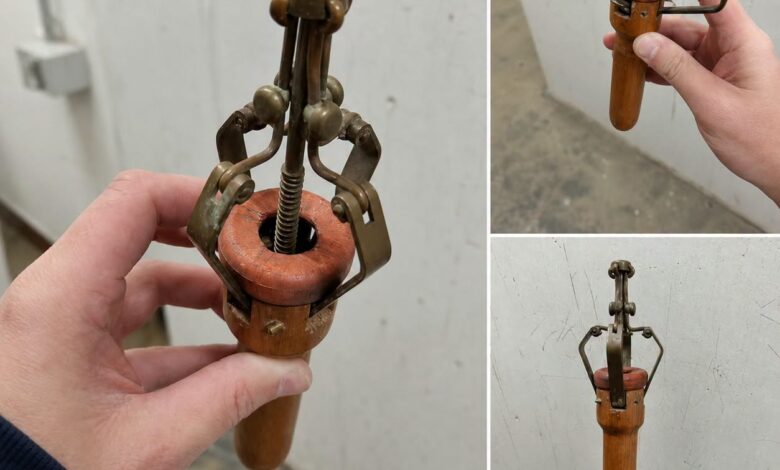
At first glance, it looks like something from a dentist’s office.
A wooden handle.
A compact metal mechanism.
Several oddly shaped jaws designed to spread outward when pressure is applied.
Pick one up at an antique market today and you could easily spend an afternoon guessing.
A leatherworking tool?
Something for repairing shoes?
A strange pair of pliers?
A forgotten medical instrument?
Its real purpose was considerably more ordinary—and surprisingly important.
The tool is commonly described by the French name “Écarteur de tétine de trayeuse,” essentially an expander associated with the rubber components of early mechanical milking equipment.
And for a brief period in agricultural history, a tool like this could solve a very specific problem created by one of farming’s biggest technological transitions.
The story begins before milking machines became ordinary equipment.
For thousands of years, milking was performed by hand.
The process was straightforward, but it demanded enormous amounts of labor.
A farmer with only a few cows could manage.
As herds grew, the mathematics became punishing.
Every cow had to be milked.
Usually more than once a day.
Morning after morning.
Evening after evening.
Regardless of weather, illness, holidays, or exhaustion.
Mechanization promised liberation from some of that work.
Early milking systems used vacuum pressure and teat cups to extract milk more efficiently.
It was revolutionary.
But early technology is rarely elegant.
The machines that eventually became dependable pieces of dairy equipment went through generations of refinement.
One of the most important components was deceptively simple:
The rubber liner inside the teat cup.
That liner formed the interface between animal and machine.
It needed to be flexible enough to work with the milking action while fitting correctly inside the surrounding shell.
If anything about that interface was rough, incorrectly seated, damaged, or badly shaped, the cow could pay the price.
And early rubber manufacturing wasn’t what it is today.
Modern consumers are accustomed to molded components emerging from factories with precise edges, predictable dimensions, and consistent flexibility.
Earlier farmers couldn’t necessarily assume that.
Rubber parts could require considerable handling and preparation.
Installing them could also be awkward.
Imagine trying to manipulate thick rubber into a rigid metal component using nothing but your fingers.
Now imagine doing it repeatedly.
Your hands are tired.
The barn is cold.
Several cows are waiting.
The equipment has just been cleaned.
And every badly seated component risks causing trouble during the next milking.
That is where specialized hand tools entered the picture.
The expander’s purpose was mechanical rather than mysterious.
Its jaws could spread the rubber component in a controlled way, helping the user manipulate or position it without relying entirely on finger strength.
The wooden handle provided leverage.
The metal mechanism supplied consistency.
Instead of wrestling with stubborn rubber by hand, the farmer could use a tool designed specifically for the job.
It seems trivial.
It wasn’t.
Dairy equipment operates on living tissue.
A poorly fitted or damaged liner isn’t comparable to a loose belt on a piece of machinery.
The cow feels the consequences.
Anything that reduced rough contact, pinching, improper positioning, or unnecessary irritation could therefore matter both for animal comfort and for the efficiency of the dairy.
Healthy udders mattered enormously.
They still do.
An injured or irritated teat could create difficulties far beyond one uncomfortable milking.
Damage could interfere with the process and potentially increase the risk of infection.
For a farmer dependent on milk production, protecting the animal wasn’t merely compassionate.
It was economically essential.
So a small implement designed to make rubber liners easier and safer to handle could earn a permanent place among the equipment.
And it would have lived a decidedly unglamorous life.
There were no dramatic moments.
No farmer stood in the barn admiring the brilliance of the liner expander.
It simply worked.
Use it.
Prepare the equipment.
Milk the cows.
Clean everything.
Repeat.
Again tomorrow.
And the day after that.
That repetitive usefulness is precisely why old agricultural tools can be so difficult to identify today.
The most common objects in one generation can become incomprehensible in another.
Their purpose disappears when the surrounding routine disappears.
Think about an old telephone switchboard plug.
A typewriter ribbon tin.
A hand-cranked washing implement.
A tool for adjusting equipment that hasn’t existed in ordinary homes for seventy years.
Remove the object from its environment and suddenly its shape stops making sense.
That is what happened to countless specialized dairy implements.
During the twentieth century, mechanical milking technology improved rapidly.
Machines became more standardized.
Materials improved.
Rubber manufacturing became more precise.
Replacement parts became more consistent.
Designers learned more about vacuum levels, pulsation, hygiene, liner performance, and animal comfort.
Manufacturers could increasingly produce components that required less preparation by the farmer.
The industry was gradually removing tiny manual tasks from the milking process.
And every time that happened, another specialized tool became unnecessary.
This is one of the quietest consequences of technological progress.
We usually notice what arrives.
We rarely notice what disappears.
A better component is invented.
Wonderful.
But somewhere, a toolmaker loses an order.
A hook disappears from a barn wall.
A farmer stops performing a tiny motion that generations before him repeated thousands of times.
Nobody holds a funeral for the tool.
It simply isn’t needed anymore.
Eventually, someone cleans out the barn.
“What is this thing?”
Nobody remembers.
Into the rubbish it goes.
That explains why surviving examples of obscure agricultural implements can seem so mysterious today.
They weren’t necessarily rare when they were useful.
They became rare because usefulness vanished before anyone thought they were worth preserving.
A farmer in the 1930s wouldn’t necessarily look at an ordinary milking tool and think:
A museum will want this someday.
Why would he?
It was equipment.
If a newer system made it obsolete, the rational response was to throw it away, recycle the metal, leave it in a drawer, or repurpose it.
The same thing happens today.
Consider how many charging cables, adapters, computer accessories, and specialized tools are sitting in drawers right now.
To us, they’re clutter.
To someone examining them a century from now, they may be archaeological puzzles.
That is what makes an object like a teat cup liner expander so interesting.
Its significance isn’t really the tool itself.
It’s the vanished world surrounding it.
Picture the barn before sunrise.
Cold air.
Cows shifting their weight.
Metal equipment clinking.
Steam rising from hot water used for cleaning.
A farmer whose hands already ache.
Rubber components waiting to be installed or adjusted.
There, among the larger machinery, is this little wooden-handled tool.
Pick it up.
Spread the rubber.
Position the component.
Move to the next one.
No ceremony.
Just another necessary movement in an endless agricultural routine.
Then manufacturing improves.
The liners change.
Equipment becomes easier to service.
The little tool stays on its hook.
At first, perhaps someone keeps it just in case.
Then it gets moved to a drawer.
Years pass.
The farmer retires.
The dairy changes hands.
The old milking system is removed.
The drawer is emptied.
And suddenly an object once understood without explanation becomes a mystery.
That transformation—from indispensable to incomprehensible—is one of the most fascinating things about antique tools.
They remind us that technology doesn’t advance only through spectacular inventions.
Progress often happens through tiny improvements.
A smoother molded edge.
A better rubber compound.
A standardized replacement component.
A more comfortable teat cup.
A part that arrives ready to install.
Each improvement may save only seconds.
But multiply those seconds across dozens of cows, twice a day, throughout an entire year.
Now multiply that across thousands of farms.
Tiny improvements become revolutions.
And somewhere inside that revolution, a little wooden-handled implement becomes extinct.
There is another lesson hidden in its design.
People often imagine earlier farmers as working with crude equipment and brute strength.
In reality, agricultural history is filled with extraordinarily specialized tools.
Farmers had implements for tasks so specific that modern observers can barely guess their purpose.
That specialization tells us something important.
People have always tried to make repetitive work easier.
If fingers struggled with a stubborn piece of rubber every morning, somebody eventually invented leverage.
If an edge could injure an animal, somebody looked for a way to make the process gentler.
If a task took five minutes, someone tried to make it take two.
That impulse is as modern as artificial intelligence and as old as the first shaped stone tool.
The technology changes.
The motivation doesn’t.
Save effort.
Reduce mistakes.
Protect what matters.
Do the job better.
Today, modern dairy operations can contain sophisticated automated systems capable of monitoring milk production and aspects of animal health with a precision early dairy farmers could scarcely have imagined.
Against that background, a little manual expander can look almost comically primitive.
But that isn’t the right way to see it.
It belonged to a transitional moment.
Hand milking was giving way to machines.
Machines were still imperfect.
Farmers needed tools to bridge the gap.
This was one of them.
For however long it remained useful, it represented progress.
Then progress overtook it.
That may be the most fitting fate any tool can have.
Not to fail.
To become unnecessary because the problem it solved has been solved better.
So the next time you encounter a strange wooden-handled object at a flea market, farm auction, or museum, resist the temptation to dismiss it as meaningless junk.
Look carefully at the worn handle.
The polished places where fingers repeatedly touched it.
The scratches on the metal.
Those marks are evidence.
Someone once reached for that object without wondering what it was.
They knew exactly what it did.
They may have used it hundreds or thousands of times.
And then one day, they stopped.
The humble teat cup liner expander is therefore more than an antique curiosity.
It is a fossil of technological change.
A reminder that some inventions don’t disappear because they were badly designed.
They disappear because they worked long enough for something better to replace them.
The cows still needed milking.
The equipment still needed to be safe.
The farmer still needed to finish before breakfast.
Only the little wooden-handled tool was no longer required.
And that is how an everyday necessity became, within a few generations, a mystery you could hold in your hand.