A Woman Sleeping in Seat 8A Was Asked to Help Save a Failing Jet—What She Revealed About Her Past Left the Entire Crew Stunned

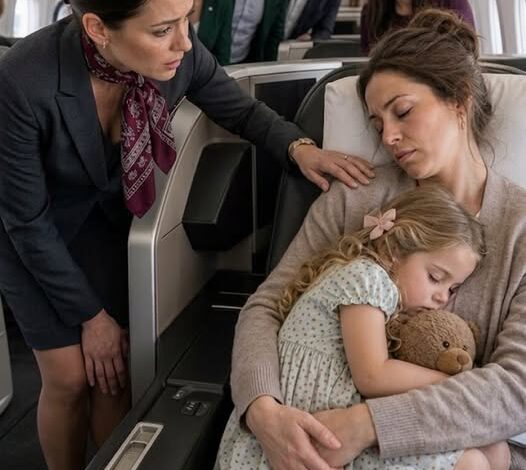
Two hours into the overnight flight from New York to Madrid, the captain’s voice came over the speakers.
“Ladies and gentlemen, if there is anyone onboard with military fighter-pilot experience, please identify yourself to a member of the cabin crew immediately.”
The entire aircraft seemed to stop breathing.
Nearly three hundred passengers looked up at once.
Some exchanged nervous glances. Others stared toward the front of the cabin as though the answer might appear there.
No one expected it to come from seat 8A.
Laura Vance opened her eyes slowly.
Until that moment, she had been almost invisible.
Green sweater.
Dark trousers.
A paperback resting closed in her lap.
She had declined dinner, asked only for water, and spent most of the flight facing the window.
To everyone around her, she was simply another exhausted traveler.
None of them knew she had once flown F-16s for the United States Air Force.
None knew she had led combat missions where a bad decision could kill people in seconds.
And nobody knew that eighteen months earlier, after losing the person she trusted most in the sky, Laura had walked away from military aviation entirely.
The captain spoke again.
This time, the calm in his voice sounded thinner.
“We are experiencing a technical problem requiring immediate assistance. If anyone onboard has fighter-aircraft experience, please contact the cabin crew.”
A mother across the aisle pulled her sleeping child against her chest.
An older couple clasped hands.
The man beside Laura leaned into the aisle, searching for someone else to stand.
Laura remained seated.
Not anymore.
That was what she had promised herself.
No more cockpits.
No more alarms.
No more responsibility for lives hanging on a decision made in half a heartbeat.
Then a flight attendant hurried down the aisle.
She stopped beside Laura’s row.
“Excuse me. Does anyone here have military aviation experience?”
Laura looked around.
Fear had changed the cabin.
No one was pretending anymore.
For eighteen months, she had lived by one rule:
Never again put yourself in a position where someone else’s life depends on you.
But beneath that rule was an older one.
A pilot does not stay in the back when people need help in the front.
Laura unfastened her seat belt.
“I do.”
The attendant blinked.
“You’re a pilot?”
“Former Air Force.”
“What did you fly?”
“F-16s.”
The man beside her turned sharply.
“You?”
Laura ignored him.
The moment she stepped into the aisle, something changed.
Her shoulders straightened.
Her eyes sharpened.
The quiet passenger disappeared.
By the time she reached the cockpit door, she looked like someone who had spent years walking toward emergencies instead of away from them.
She had no idea that the emergency waiting behind that door had been engineered.
And someone onboard already knew exactly who she was.
The cockpit smelled wrong.
Overheated electronics.
Sharp plastic.
Something metallic beneath it.
Captain Andrew Keller was gripping the controls.
Beside him, the first officer lay unconscious, an oxygen mask covering his face.
Andrew looked at Laura.
“You’re the military pilot?”
“Yes.”
“When did you last fly?”
“Eighteen months ago.”
His expression tightened.
“I need someone current.”
Before she could answer, the aircraft shuddered hard enough to throw Laura against the doorway.
It wasn’t turbulence.
She knew that immediately.
She stepped closer.
“How long has the control column been doing that?”
“About ten minutes. Autopilot disconnected. Flight computers keep giving contradictory commands.”
The aircraft rolled right.
Andrew corrected.
The controls pushed back.
Laura stared at the displays.
“Stop fighting it.”
He glanced at her.
“If I stop correcting, we bank.”
“You’re not fighting the airplane. You’re fighting a bad control input.”
“How do you know?”
“Because I’ve felt it before.”
Andrew hesitated.
Then isolated one secondary flight-control channel.
The jet jolted.
For a second, nothing happened.
Then the controls steadied.
Andrew looked at her differently.
“You were right.”
“We’re not finished.”
Laura glanced toward the unconscious first officer.
“What happened to him?”
“He said his arm felt numb. Then he collapsed.”
“Did you eat the same meal?”
“No. He brought coffee from the terminal.”
Laura looked toward the console.
“Where’s the thermos?”
Andrew looked.
Empty space.
A doctor entered moments later.
“Captain, I don’t think this is a stroke. His symptoms look more like toxic exposure.”
Nobody spoke.
Laura stared again at the place where the thermos should have been.
Then the lead flight attendant entered carrying a tiny plastic cap.
“We found this underneath his seat.”
Something inside Laura went cold.
“Lock the cockpit.”
Andrew looked at her.
“You think someone did this deliberately?”
“I think your first officer became incapacitated at the same time your flight systems began failing.”
A warning tone sounded.
Right-side hydraulic pressure was dropping.
Then the cockpit keypad chimed.
Someone outside was entering an override code.
Andrew checked the camera.
His face tightened.
“Richard Sterling.”
“Who?”
“Director of Flight Operations. He’s in first class.”
The interphone rang.
A flight attendant sounded frightened.
“Captain, Mr. Sterling is demanding access. He says he has executive authority and needs to enter immediately.”
Laura stared at the screen.
First officer poisoned.
Flight controls corrupted.
Missing thermos.
Now an airline executive demanding access during an emergency.
“Do not open that door.”
Andrew nodded.
The aircraft was already descending toward northern Spain.
Rain struck the windshield.
The runway ahead was barely visible.
Andrew lowered the landing gear.
Two green lights appeared.
The third stayed dark.
Right main gear.
Not confirmed.
Andrew exhaled slowly.
“If that gear collapses, we could lose the wing.”
Laura moved into the first officer’s seat and strapped herself in.
“I’ll back you up.”
“You’ve never landed an airliner.”
“No.”
She rested her hands on the secondary controls.
“But I know what it feels like when an aircraft stops behaving like the pilot expects.”
The runway came toward them fast.
Rain hammered the windshield.
Andrew flared.
The left gear touched.
Then the nose.
The right side dropped violently.
Passengers screamed.
Metal groaned beneath them.
Laura immediately applied corrective rudder and asymmetric thrust.
“Hold it.”
Andrew fought the controls.
The right gear folded partially.
Then came a violent mechanical slam.
It locked.
The aircraft straightened.
Reverse thrust roared.
The jet slowed.
Then stopped.
For several seconds, neither pilot moved.
Behind them, hundreds of passengers began cheering.
Laura did not.
Police vehicles were already racing toward the aircraft.
The landing had ended one emergency.
It had not ended the danger.
Spanish authorities boarded before most passengers had left their seats.
Richard Sterling was detained near the forward cabin.
As officers escorted him past Laura, he stopped.
His eyes settled on her face.
Then he smiled.
“Laura Vance.”
Every muscle in her body tightened.
“I never imagined you’d be sitting in 8A.”
Andrew turned.
“You know her?”
Sterling’s smile sharpened.
“I know far more about her than she realizes.”
The next forty-eight hours dismantled everything Laura thought she understood.
Investigators uncovered falsified maintenance records.
Counterfeit aerospace components.
Shell companies.
Millions diverted through accounts linked to Sterling.
Flight 412 had been carrying documents connected to an internal audit that could expose him.
Investigators believed he had tried to create a catastrophe large enough to bury the evidence permanently.
The first officer’s drink had been contaminated.
The flight-control system had been deliberately compromised.
The missing thermos was recovered from a service compartment after Sterling’s arrest.
But the investigation went further.
Sterling’s connection to Laura had begun years earlier.
Before joining the airline, he had worked for a defense contractor supplying avionics components to military aircraft.
The contractor had concealed defects in a shipment.
One of those components had reached Laura’s squadron.
One had been installed aboard the aircraft flown by Captain Gabriel Torres.
Her wingman.
Her closest friend.
The man whose death had ended Laura’s career.
For eighteen months, she had carried one memory above all others.
Gabriel losing control.
Her voice over the radio.
Her instructions.
His aircraft falling away from formation.
And the certainty that if she had reacted differently, he might have survived.
Then an investigator placed a classified transcript in front of her.
“We recovered this during the reopened inquiry.”
Laura stared at the page.
It was Gabriel’s final transmission.
Sent seconds before the ejection system failed.
She read it once.
Then again.
Tell Laura the controls locked. She did everything right.
Her hands began shaking.
For eighteen months, she had believed Gabriel died thinking she failed him.
Instead, his final concern had been making sure she knew she hadn’t.
Laura lowered her head.
The tears came before she could stop them.
Andrew sat beside her without speaking.
For once, silence did not feel like punishment.
Weeks later, Laura traveled to Texas.
Gabriel’s mother opened the door.
Laura barely managed to say his name before the older woman pulled her into an embrace.
“I thought I left him up there,” Laura whispered.
Gabriel’s mother held her tighter.
“You didn’t leave him anywhere.”
Laura broke.
“You carried him long enough,” the woman said.
Sterling’s case eventually spread far beyond Flight 412.
Sabotage.
Attempted murder.
Fraud.
Evidence tampering.
The investigation uncovered years of criminal activity and reopened questions surrounding multiple aviation failures.
Laura testified once.
Then stepped away.
She had already spent too much of her life letting Richard Sterling’s decisions determine what the sky meant to her.
She refused to give him anything more.
Laura never returned to active military service.
Instead, she accepted a position at a civilian flight academy.
On her first morning, twenty-two students waited for stories about combat missions and medals.
Laura placed her old helmet on the desk.
Then she turned toward the board and wrote:
THE AIRCRAFT DOESN’T CARE WHO YOU USED TO BE.
A student raised his hand.
“What does that mean?”
Laura looked around the classroom.
“It means reputation won’t save you in an emergency. Ego won’t either. You see what’s happening, trust your training, and help the person sitting beside you.”
Months later, a letter arrived.
It was from a seventeen-year-old boy.
Laura recognized the flight number immediately.
He had been sitting several rows behind her on the night Flight 412 nearly went down.
The letter was simple.
He said he had been terrified when the captain asked for a fighter pilot.
Then he saw Laura walk toward the cockpit.
She had looked back once and nodded at the passengers.
That small gesture convinced him they might survive.
He ended the letter with one sentence.
He had just taken his first flying lesson.
Laura folded the paper carefully.
Then she placed it inside a wooden box beside a photograph of Gabriel.
One year after Flight 412, she stood beside the academy runway watching one of her students complete his first solo flight.
The small aircraft climbed into a clear afternoon sky.
For years, the sound of an engine disappearing into the distance had dragged her back to Gabriel’s final mission.
That afternoon, it didn’t.
She still missed him.
She always would.
But grief no longer felt like an order telling her where she was allowed to go.
The student aircraft returned twenty minutes later and landed safely.
He climbed out grinning.
Laura applauded with everyone else.
Then she looked toward the empty blue sky.
Eighteen months earlier, she had chosen seat 8A because she wanted to disappear.
Instead, that flight forced her to become the person she had spent years running from.
Not the decorated pilot.
Not the hero passengers later described.
Just Laura.
A woman who had once believed survival meant never entering another cockpit.
Now she understood something different.
Survival meant accepting that Gabriel’s final flight would always be part of her story without allowing it to become the ending.
Laura picked up her helmet and walked toward the hangar.
For the first time in years, the sky above her did not look like the place where she had lost someone.
It looked like somewhere people could still go.
And this time, she was ready to help them get there.