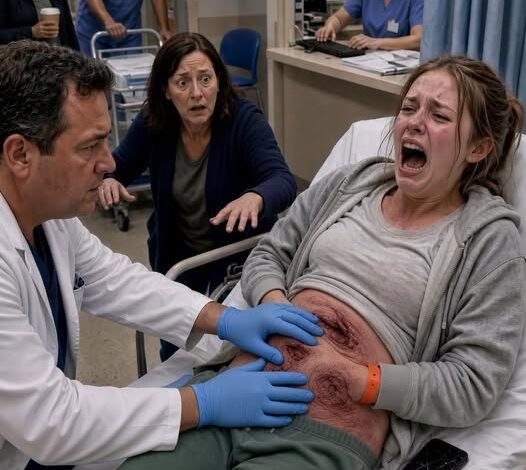
The hospital hallway changed the moment my daughter screamed from behind the curtain.
“Don’t let him in!”
Everything stopped.
The receptionist looked up.
A woman holding a paper coffee cup froze beside the wall.
Even Michael stopped walking.
For fifteen years, I had built my life around preventing moments like that.
I learned when to speak.
When not to.
How to soften a sentence before it reached him.
How to explain away anger.
How to tell myself that silence was protection.
Standing outside an emergency room while my fifteen-year-old daughter begged strangers not to let her own father near her, I finally understood what my silence had actually taught her.
Be afraid quietly.
Three days earlier, I still had not admitted that to myself.
It began at 3:18 in the morning.
I woke to the sound of Emily crying in the bathroom.
Not calling for me.
Not complaining.
Crying into the sink as if even being sick required permission.
When I opened the door, the room smelled of bleach, fever sweat and cheap soap.
Emily was bent over the sink with one arm around her stomach.
Her face was gray.
Her lips were dry.
Her fingers were white from gripping the counter.
“Emily?”
She looked up.
“I’m fine.”
She wasn’t.
She had been vomiting for nearly three days.
Fever.
Increasing abdominal pain.
No appetite.
But what frightened me most was how little she complained.
Normally, Emily was dramatic about every cold and headache.
This time, she apologized.
“Sorry, Mom.”
“For what?”
“For waking you.”
Then Michael appeared behind me.
He looked at Emily.
Then the clock.
Then sighed.
“She’s doing this again?”
I turned.
“She has a fever.”
“She has school stress.”
“She’s been throwing up.”
“She always gets dramatic when she’s overwhelmed.”
Emily lowered her eyes.
I saw the change in her body instantly.
Shoulders inward.
Voice gone.
Smaller.
Michael looked at me.
“If you take her to the emergency room over another performance, I’m not paying for it.”
He said it calmly.
That was one of the things that made him so difficult to explain to other people.
He rarely needed to shout.
Cruelty sounded practical in his voice.
Deductibles.
Missed work.
Bills.
Unnecessary tests.
He could turn concern into irresponsibility before I had time to defend it.
For years, I let his certainty override mine.
He had access to my paycheck.
My passwords.
My schedule.
Eventually, I stopped noticing how many decisions required his approval.
Emily noticed.
Children always do.
Don’t make Dad angry.
Don’t need too much.
Don’t make things expensive.
Don’t argue.
Then Emily bent over the sink again.
She coughed.
Something pink appeared in the basin.
My entire body went cold.
“We’re going to the hospital.”
Michael laughed once.
“No, we’re not.”
I looked at him.
“Yes.”
His face changed.
“You’re making her weak.”
I ignored him.
“Emily, get your hoodie.”
“Sarah.”
For years, the way he said my name had been enough.
A warning contained inside two syllables.
Not that morning.
Then Emily collapsed beside the shower.
Her phone slipped from her hand and struck the floor.
I dropped beside her.
“Emily!”
Her eyes opened slightly.
She grabbed my sleeve.
“Mom…”
“I’m here.”
Then she whispered something more frightening than the fever.
“Don’t tell Dad.”
I stared at her.
She wasn’t afraid of the hospital.
She was afraid of what happened after we came home.
That was the moment my last excuse for Michael broke.
At 4:06 a.m., I took cash I had hidden between towels, grabbed Emily’s hoodie and helped her out through the back door.
I didn’t turn on the lights.
I didn’t announce that we were leaving.
For the first time in years, I made a decision without first calculating how angry Michael would become.
During the drive, Emily leaned against the passenger door.
“Dad’s going to get worse.”
“It doesn’t matter.”
I said it too quickly.
Because I knew that sentence had to become more than reassurance.
It had to become true.
At the hospital, a nurse fastened an orange band around Emily’s wrist.
Three days of terror became four lines on a form.
Abdominal pain.
Fever.
Persistent vomiting.
Weakness.
Then the doctor examined her.
When he pressed lightly on the lower right side of her abdomen, Emily screamed.
The doctor stopped immediately.
Blood tests.
Imaging.
Ultrasound.
Everything accelerated.
While the staff focused on her body, one doctor began noticing something else.
Every time a man spoke in the hallway, Emily looked toward the curtain.
Every time footsteps stopped outside, her fingers tightened around my hand.
When someone knocked, she flinched.
Eventually, the doctor asked, “Can I speak with Emily alone?”
I hesitated.
Then nodded.
I stepped into the hallway.
My phone began vibrating almost immediately.
Michael.
Again.
Again.
Then messages.
Where are you?
A second arrived.
If you took her to the hospital, you’re going to regret it.
For years, messages like that had controlled me.
They made me explain.
Apologize.
Return.
This time, I took screenshots.
Then I turned the phone facedown.
Twenty minutes later, the doctor emerged.
His expression told me everything before he spoke.
“Mrs. Bennett?”
“Yes?”
“Emily needs surgery.”
My knees weakened.
“What?”
“She has a serious abdominal infection. The imaging strongly suggests complicated appendicitis, likely with perforation.”
I grabbed the back of a chair.
“Is she going to be okay?”
“We believe so. But she needs treatment urgently.”
He paused.
“Another significant delay could have become extremely dangerous.”
Michael had spent three days telling me I worried too much.
The truth was worse.
I had listened too long.
Then I heard his voice.
“Where is my daughter?”
Michael entered the reception area looking composed.
Reasonable.
He told the receptionist I had panicked.
He said Emily exaggerated.
He said he was her father and had a right to see her.
The doctor stepped between him and the curtain.
Then he turned to me.
“Is Emily safe if he comes in?”
My mouth opened.
Nothing came out.
Because answering honestly meant naming our life accurately.
Then Emily answered for me.
“DON’T LET HIM IN!”
The entire hallway fell silent.
Michael stared at the curtain.
“Emily, stop this.”
I moved closer to the doorway.
For once, I did not move aside for him.
Then Emily spoke again.
“He knows why it hurts.”
My stomach dropped.
The doctor looked at Michael.
Michael’s expression changed.
Barely.
But I saw it.
Fear.
Not fear for Emily.
Fear of what she might say.
I went inside.
Emily was gripping the blanket with both hands.
I sat beside her.
“What do you mean?”
She looked toward the curtain.
“Close it.”
The nurse did.
Then Emily started crying.
Not because of the surgery.
Because she had finally reached a room where she believed adults might listen.
She told us Michael had known she was getting worse.
Two nights earlier, she had begged him to let me take her to urgent care.
He told her that if she kept “performing,” he would make sure I blamed her for the bill.
Then she told us something else.
A week earlier, during an argument, Michael had shoved her.
Not hard enough to knock her down.
Hard enough to send her side into the kitchen counter.
Her stomach had already been hurting.
The impact made it worse.
When she told him, he said:
“Maybe next time you’ll stop talking back.”
I felt sick.
“Why didn’t you tell me?”
Emily cried harder.
“Because you always say Dad doesn’t mean things the way they sound.”
There are sentences that divide your life.
That was mine.
Because she was right.
I had translated Michael for years.
He’s tired.
He’s worried about money.
He had a bad day.
He loves you.
He didn’t mean it.
Every explanation I used to preserve peace had taught my daughter to distrust her own experience.
I took her hand.
“No more.”
She looked at me.
“What?”
“I’m not explaining him anymore.”
Then I walked back into the hallway.
Michael was waiting.
“What did she say?”
“You’re leaving.”
His face hardened.
“I’m her father.”
“And she’s afraid of you.”
“You’ve poisoned her against me.”
“No.”
My voice stayed calm.
“She spoke when you weren’t in the room.”
Hospital security arrived.
Then a social worker.
Then police.
For once, Michael could not control the room.
The screenshots mattered.
Emily’s statement mattered.
The bruising along her side mattered.
The hospital staff had already documented her fear before anyone knew the whole story.
There were witnesses now.
Outside our family.
People he could not intimidate into accepting his version.
Emily went into surgery shortly afterward.
I sat alone in the waiting room.
For nearly two hours, I replayed fifteen years.
Every apology I made when I had done nothing wrong.
Every time I told Emily to give her father space.
Every time I chose quiet because quiet felt safer than conflict.
I wanted to hate myself.
But guilt would not protect Emily either.
Action would.
So while she was in surgery, I called an attorney.
Then my sister.
Then I asked the hospital social worker exactly what I needed to do so Emily and I would not return to a house where Michael had access to us.
By the time the surgeon returned, our lives were already changing.
“The surgery went well.”
I covered my mouth.
Emily’s appendix had ruptured and infection had spread.
She would need several days in the hospital.
But she was safe.
Barely.
That word stayed with me.
Barely.
I was beside her when she woke.
“Mom?”
“I’m here.”
“Dad?”
“He isn’t coming in.”
She stared at me.
“Really?”
“Really.”
Her whole face softened.
That was when I knew there could be no return to the old version of our family.
Not because I suddenly hated Michael.
Because Emily’s body showed me what safety looked like.
She relaxed when he was gone.
In the days that followed, a temporary protective order was issued.
Michael was required to stay away while the investigation continued.
I changed where my salary was deposited.
Changed passwords.
Stopped sharing my location.
Collected documents.
Each task looked small.
Each one returned something to me.
Michael sent apologies.
Then anger.
Then apologies again.
He said the shove had been nothing.
He said Emily was exaggerating.
He said I was destroying fifteen years of marriage over one bad week.
But it had never been one bad week.
That was another lie I stopped telling myself.
It had been years of fear arranged so gradually that no single moment ever seemed large enough to justify leaving.
Until our daughter ended up on an operating table.
Months later, Emily and I moved into a small apartment.
Two bedrooms.
A narrow kitchen.
A balcony overlooking a parking lot.
Nothing impressive.
The first night, we ate pizza on the floor because the dishes were still packed.
Someone upstairs dropped something heavy.
Emily jumped.
So did I.
We looked at each other.
Then she laughed.
I started laughing too.
Not because it was funny.
Because a loud noise was finally only a loud noise.
Nobody was angry.
Nobody was coming down the hall.
Nobody needed to apologize.
Emily recovered.
Her scar faded.
Her appetite returned.
She went back to school.
Then something beautiful happened.
She started arguing with me again.
About curfew.
Laundry.
Her phone.
The first time she slammed her bedroom door, I almost cried with relief.
She wasn’t making herself small anymore.
Almost a year after the hospital, I heard her laughing with a friend in her room.
Loud.
Uncontrolled.
The same laugh Michael used to criticize.
I stood outside the door for a moment.
Then kept walking.
Later, Emily came into the kitchen.
“Mom?”
“Yeah?”
“Do you ever wish we stayed?”
I looked at her.
“No.”
“Not even a little?”
“I wish your father had been someone we could safely stay with.”
She thought about that.
“That’s different.”
“Yes.”
Then she asked the question I had known would come eventually.
“Why did it take the hospital?”
I could have defended myself.
I could have explained coercive control.
Financial dependence.
Fear.
How people adjust slowly enough that each new violation begins to look normal.
All of that was true.
But she deserved something simpler.
“Because I kept believing that if the worst thing hadn’t happened yet, things weren’t really that bad.”
She watched me.
“And then?”
“Then I heard you begging strangers not to let your father into the room.”
My throat tightened.
“And I realized my idea of keeping the family together had stopped including whether you felt safe inside it.”
Her eyes filled.
She came around the counter and hugged me.
For years, I thought courage would look dramatic.
A perfect confrontation.
A door slamming.
Some speech where I finally said everything.
It didn’t.
Courage looked like taking screenshots.
Opening a bank account.
Signing hospital forms.
Changing passwords.
Telling security that someone was not allowed past a curtain.
And refusing, finally, to keep translating a man whose behavior had taught everyone else to fear his reaction.
Emily went to the hospital because her appendix was dangerously infected.
But something else had been festering in our home too.
Our definition of love.
We had confused peace with silence.
Patience with endurance.
Family with unlimited access.
The surgery removed what was making Emily physically sick.
Leaving Michael removed something different.
The belief that fear was simply the price of keeping a family together.
And nearly a year later, when Emily laughed loudly enough that I could hear her from the kitchen, I didn’t ask her to quiet down.
I stood there smiling.
Because after years of watching my daughter shrink whenever her father entered the room, the loudest sound in our new home was proof of something I should have understood much sooner.
She finally believed she was allowed to take up space.