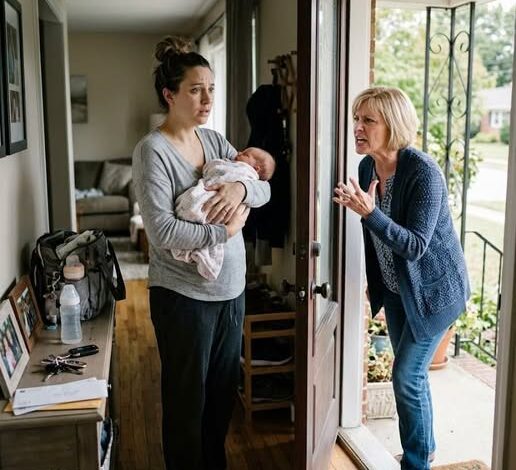
My phone was recording in my right hand, Ava was pressed against my chest, and the front door was still open behind my mother.
I held out my left palm.
“Key.”
Janet stared at my hand as if I had asked her to surrender something far more important than a piece of metal.
Then she dropped the spare key into it.
I closed my fingers.
I didn’t thank her.
She didn’t leave.
Instead, she stepped farther into my living room and lowered her voice.
“You need sleep,” she said. “You’re overwhelmed. You’re making decisions while you’re emotional.”
Ava shifted against me. My shoulder ached. The burp cloth beneath her chin smelled faintly of formula.
“The door is behind you.”
Janet folded her arms.
“Clara’s kids have birthdays once a year. You have a stable job, benefits, a husband, a house. Nobody is asking you to sacrifice anything serious.”
“Two thousand dollars is serious to me.”
She laughed.
“Not to you.”
That hurt more than the amount.
“You don’t get to decide what money means to me.”
Her expression hardened.
“I’m trying to keep this family together.”
Then she said the sentence that changed everything.
“I already told Clara you’d pay for the phones.”
I stared at her.
“You promised my money before asking me?”
“The kids are expecting them now.”
I opened the door wider.
“Leave.”
She grabbed her purse and walked out.
I locked the deadbolt.
Then I saved the recording.
Only after feeding Ava did my hands begin to shake.
I opened a note on my phone labeled FAMILY MONEY.
Rent.
Utilities.
Tires.
School supplies.
Birthday dinners.
Repairs.
Summer activities.
Years of requests I had answered because Janet always presented them as emergencies.
That afternoon, Clara called.
I ignored her twice before she texted:
Mom says you threw her out because she asked you to help the kids.
I replied with one question.
Did Mom tell you I had already agreed to buy the phones?
Her answer came slowly.
No. She said you knew about it.
I called her.
“You seriously didn’t know?” Clara asked.
“No. Mom brought it up three hours after I gave birth.”
Silence.
“She told me she had it handled.”
“Handled by whom?”
“She didn’t say.”
That answer opened something neither of us could close.
I asked about the $725 rent payment Janet had requested months earlier.
“How much were you actually short?”
Clara hesitated.
“Maybe five hundred.”
Then I asked about the $1,200 utility emergency.
“I wasn’t twelve hundred behind,” Clara admitted.
I didn’t accuse Janet of stealing. I couldn’t prove what happened to every dollar.
I simply sent Clara screenshots.
One transfer after another.
Eventually she whispered, “Did you pay for my tires too?”
“Yes. Four hundred.”
Another silence.
“She told me she paid for those.”
That was the first moment I trusted.
Not because Clara suddenly took my side.
Because she stopped defending Mom and started asking questions.
Before hanging up, she said, “I think she’s been putting us against each other.”
“I think so too.”
Clara wanted the full recording.
I refused.
That confrontation had happened in my home with my newborn against my chest. I wasn’t ready for every ugly minute to become family entertainment.
I sent forty-three seconds instead.
The part where Janet admitted promising my money.
That was enough.
The next morning, I woke to the sound of the interior garage door opening.
My entire body went cold.
I picked up Ava and stepped into the hall.
Janet was standing in my kitchen with grocery bags.
“Don’t start,” she whispered. “You need food. I’m helping.”
She had used the garage keypad.
The key she returned had never been her only access.
“Put the bags down.”
She smiled.
“See? You’re exhausted.”
“Put them down.”
She did.
An orange rolled beneath a chair.
Neither of us picked it up.
I opened the garage.
“Out.”
“You’re throwing me out while I’m bringing food to your child?”
“I’m telling you to leave after you entered my house without permission.”
She looked at Ava.
“You think shutting out her grandmother is healthy?”
“Go.”
She left the groceries.
I watched her reach her car, then closed the garage and immediately reset the keypad.
Then the alarm code.
Then the neighborhood pickup permissions.
By the time I sat beside Ava’s bassinet, my knees were shaking.
When Ryan called, his first instinct was practical.
“Maybe send the two thousand and end this one fight.”
“No.”
He went quiet.
“This stopped being about phones when she entered our house without permission.”
I sent him the entire recording.
For several days afterward, nothing happened.
The silence felt suspicious.
Then it felt wonderful.
Clara bought one refurbished phone and told her older child the second would wait until payday.
The children survived.
Nobody’s birthday collapsed.
Nobody stopped loving anybody.
When Ryan came home, he listened to the recording again.
That night he sat beside me.
“Did you hear what your mom said near the end?”
He played a section I had barely noticed because Ava had been crying.
Janet’s voice came through quietly.
“I already told those kids Grandma was getting them the phones. What am I supposed to do now, tell them you made me a liar?”
Ryan stopped the audio.
I stared at him.
“Play it again.”
He did.
This time I heard the word.
Grandma.
Not Auntie.
Grandma was buying the phones.
I called Clara.
“Who did the kids think was paying?”
“Mom.”
Then I started asking.
The tires?
Mom said she paid.
The utilities?
Mom said she handled them.
School supplies?
Mom.
Rent?
Mom.
Same answer.
Again.
And again.
The pattern was finally undeniable.
Janet had repeatedly asked me to fund Clara’s emergencies, then allowed Clara to believe the generosity came from her.
The phones were simply the first time I refused before the performance could be completed.
Clara cried.
I didn’t apologize for discovering it late.
I gave her one rule.
“If you ever need help, ask me yourself. No middleman. If I pay something, I pay the bill directly.”
“I don’t want your money.”
“Good.”
She laughed through her tears.
The next day she told Janet the same thing.
Janet responded with a long message about disrespect, postpartum emotions, family loyalty, and everything she had supposedly done for us.
I read it once.
Then archived it.
For years, arguments had been another service I provided.
She demanded.
I defended.
She challenged.
Eventually I paid just to make it stop.
This time, there was nothing to debate.
There was only access.
Access to my house.
Access to my money.
Access to my attention.
I closed all three.
Janet stayed away.
The garage code remained private.
The $2,000 stayed in our account and eventually paid for diapers, groceries, and a pediatric bill.
Nothing dramatic happened to my mother.
She wasn’t punished by the universe.
She simply lost the ability to enter my home, promise my money, and depend on my silence afterward.
That was enough.
Weeks later, Ryan carried Ava outside while I cleared dead leaves from the porch planter.
The little flag someone had placed there when Ava came home was still leaning sideways in the dirt.
I started to straighten it.
Then stopped.
I pulled it out, wiped the mud from the wooden stick, and carried it inside.
Ryan looked at me.
“What are you doing with that?”
“Keeping it for her.”
I placed it inside Ava’s memory box beside her hospital bracelet, her first knit cap, and the card stamped with her tiny footprints.
The spare key went into the trash a few days later.
The flag stayed.
Because one belonged to the version of family I had finally learned to stop protecting.
The other belonged to the daughter who taught me what was worth protecting instead.