My thumb hovered over the final video segment.
Everyone in the dining room was watching me.
I knew that once I pressed play, nobody would be able to call what happened to my newborn a misunderstanding again.
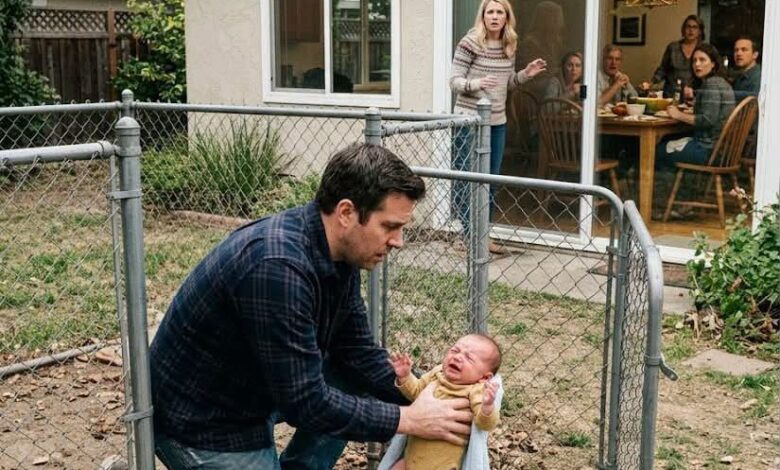
My daughter was pressed against my chest in a clean receiving blanket. Dust still streaked one side of her yellow onesie. The tiny plaster from her newborn screening remained on her heel.
Before that afternoon, I wouldn’t have looked twice at either thing.
After finding her crying inside an unused dog enclosure, every mark looked like evidence.
“Turn it off,” my stepmother said.
My father looked at her.
Not at me.
Not at his granddaughter.
Her.
So I pressed play.
The camera had already been removed from the nursery wall. The image tilted sideways as someone carried it down the hallway.
Then my father appeared.
He was holding my daughter.
My stomach dropped.
On-screen, he carried her carefully toward the back door while my stepmother walked ahead.
“You said just a few minutes,” Dad said.
“That is what I said.”
“She was asleep.”
“She isn’t now.”
My stepmother opened the door.
“I have twelve people trying to eat in peace.”
Dad stopped.
For one hopeful second, I thought he was going to refuse.
Instead, he followed her outside.
The image bounced across the patio until the old dog enclosure came into view.
A blanket had already been placed inside.
Dad bent down.
And put my daughter on it.
He wasn’t confused.
He wasn’t rushing.
He knew exactly where he was placing her.
“She can’t stay out here.”
“She won’t. Go inside.”
Dad hesitated.
Someone called him from the dining room.
My stepmother said, “I’ll bring her in when she settles.”
My father went inside.
I paused the video.
Silence filled the room.
Dad stepped toward me.
“I carried her out.”
My stepmother spun around.
“You were helping me.”
I looked at him.
“You knew you were putting my newborn in a dog enclosure?”
“I thought it would be a minute. The blanket was there. I thought she’d stay outside with her.”
“You thought that made it acceptable?”
His eyes dropped.
“No.”
A guest murmured that everyone should calm down because the baby appeared unharmed.
I looked at her once.
She noticed the dust on my daughter’s clothes.
Then she looked at the frozen image on the camera.
She didn’t repeat herself.
My stepmother did.
“She was never in danger. This was a temporary solution.”
“A solution to what?”
“The crying.”
“My daughter is a newborn.”
“I know what she is.”
Dad closed his eyes.
Then he said something that changed the room again.
“I saw you remove the camera before lunch.”
My stepmother froze.
He continued.
“You told me there was no reason to keep it running with everyone here.”
“That isn’t what I said.”
“It is.”
“You agreed with me.”
“I didn’t know what you were planning.”
I stared at my father.
“You watched her remove the nursery camera. Then you carried my daughter outside when she told you to.”
“Yes.”
That single word destroyed the last distinction I’d been trying to preserve.
Until then, I had divided the room into people who acted and people who failed to notice.
Dad belonged in neither category.
He had known enough to stay silent.
My stepmother reached for the camera.
“Give me that.”
I stepped back.
Murphy, lying near the doorway after bringing the missing camera back, raised his head.
“No.”
“It belongs in this house.”
“It was monitoring my daughter.”
“You’re creating a spectacle.”
Dad finally looked at her.
“Stop talking about the spectacle.”
She stared at him.
“Tell her why you moved the camera,” he said.
“I already did.”
“No. You’ve changed your story three times.”
She said nothing.
So I pressed play again.
The camera had been left on a low patio table.
Most of the image showed a chair leg and a section of fence.
But the microphone worked perfectly.
My daughter started crying.
I recognized the sound instantly.
Not sleepy fussing.
The thin, rising cry that meant she wanted someone.
The door opened.
Dad’s shoes appeared.
He approached the enclosure and bent down.
His hand reached toward my daughter.
Even knowing what happened next, every part of me silently begged him.
Pick her up.
My stepmother’s voice came from behind the camera.
“Leave her.”
His hand stopped.
“She is crying.”
“She has been crying all day.”
“She shouldn’t be out here alone.”
“Then go tell everyone dinner has to stop because one baby can’t settle down.”
Dad withdrew his hand.
Then he went inside.
I couldn’t breathe.
My stepmother appeared next.
She crouched beside the enclosure.
For one second, I thought she might pick up my daughter.
Instead, she adjusted the blanket beneath her legs, let part of it fall onto the enclosure floor, and stood.
Before returning indoors, she called toward someone outside the frame.
“Don’t go near there. The baby finally needs quiet.”
Now I understood.
She hadn’t merely left my daughter somewhere inappropriate.
She had discouraged other people from checking on her.
The recording continued.
Murphy appeared as a dark blur.
He sniffed the camera.
Nudged it.
Later, the image jolted when he apparently picked it up.
The dog my stepmother had blamed for stealing the nursery camera had actually recovered it.
I stopped playback.
Dad sank into a chair.
My stepmother remained standing.
“So you’ve seen it. Nothing happened to the child.”
Dad looked up.
“Don’t.”
“She is fine.”
“You didn’t know she would be.”
“You carried her outside too.”
“I know.”
His voice broke.
That finally silenced her.
“I carried her out,” he said. “I heard her crying. I went back. I could have picked her up, and I didn’t.”
He looked at me.
“I was wrong.”
I wanted those words to repair something.
They didn’t.
But they were the first words anyone had spoken that didn’t require me to question what I’d witnessed.
I recorded the entire playback on my phone. I photographed my daughter’s dusty clothing and the enclosure exactly as I’d found it.
My stepmother watched.
“You’re documenting your own family?”
“I’m documenting what happened to my daughter.”
“You’re going to destroy this family over a few minutes?”
Dad answered before I could.
“She didn’t do this.”
I put the camera into my bag.
Then I left.
Outside, I called the pediatric line. Because my daughter was a newborn and had been left outdoors unattended, they advised me to have her evaluated.
Dad offered to drive.
“No.”
“Let me come.”
“No.”
He stopped beside my car.
“I’ll stay here.”
“That is probably the first useful thing you can do.”
At the hospital, my daughter was examined carefully.
No obvious injury.
Normal temperature.
Normal breathing.
The little plaster on her heel was exactly what I’d known it was before fear made every detail terrifying.
When the doctor told me she appeared okay, I cried.
For ten seconds, relief erased everything.
Then my phone started vibrating.
My stepmother was already rewriting the afternoon.
The enclosure had been clean.
The baby had only been outside briefly.
Dad had misunderstood.
I was emotional because I’d recently given birth.
I sent one message to the family group.
“The recording shows what happened. Dad has seen it. My daughter is being evaluated. I will not argue about this tonight.”
Then I silenced my phone.
Dad called before we left.
I nearly ignored him.
Instead, I answered because I wanted to know which version of himself he would choose without me standing in front of him.
His first words were, “I told everyone the truth.”
I said nothing.
“I told them I carried her outside. I told them I went back when she cried and left her there. I told them the camera had been removed beforehand.”
“What did she say?”
“That I betrayed her.”
“Did you?”
A long silence.
“No.”
His voice cracked.
“I betrayed you first.”
My anger shifted into something heavier.
Grief.
Dad had spent his life avoiding conflict.
At birthdays, weddings, funerals, holidays—his answer was always to keep everybody calm.
I’d called that patience.
Now I understood what it became when protecting someone required making a scene.
He had seen something wrong and chosen the quieter room.
“If she had kept crying,” I asked, “how long would you have left her outside?”
“I don’t know.”
That answer hurt more than a lie.
Two days later, Dad asked to meet without my stepmother.
I agreed.
My daughter stayed home.
He brought a written timeline comparing his memory with the camera timestamps.
Then he said something I hadn’t expected.
“She pressured me. But I picked up your baby. I carried her outside. I left her there. Those were my choices.”
Believing him didn’t make them smaller.
Then came another confession.
After I’d gone outside looking for my daughter—but before Murphy returned with the camera—my stepmother had whispered that if the camera appeared, Dad should claim the dog had knocked it down.
He had known about the lie before she told it to me.
I stared at him.
“You had another chance to protect us.”
“I know.”
“No. Tell me what that means.”
He was quiet for a long time.
Finally:
“It means I don’t get to ask you to trust me with her.”
That was the first consequence he named himself.
“You won’t be alone with my daughter.”
“I understand.”
My stepmother didn’t.
When she eventually got me on the phone, she repeated everything.
The enclosure was clean.
Babies cried.
She had raised children.
I’d humiliated her.
I asked one question.
“Why did you remove the camera before putting my daughter outside?”
Silence.
Then:
“Because I knew you’d watch it later and turn five minutes into some kind of crime.”
There it was.
She had hidden the camera because she already understood I would object to what she intended to do.
“You knew you needed to hide it from me.”
“I knew you’d overreact.”
“You hid the camera.”
“I wanted one peaceful Sunday dinner!”
“My newborn was ruining your dinner?”
“She would not stop crying!”
“She was asking to be held.”
“And everyone had spent the entire day revolving around that baby!”
Even she seemed surprised by what she’d just admitted.
Then came the sentence that ended the argument forever.
“I was not going to let a crying baby ruin another Sunday.”
I ended the call.
After that, I stopped trying to convince her.
My job wasn’t to make her understand.
My job was protecting my daughter.
Dad respected the boundary.
He didn’t ask to babysit.
When relatives tried to excuse him by saying he’d merely followed his wife’s instructions, he corrected them.
“She didn’t force me. I made the choice.”
That didn’t restore trust.
But it gave me something more useful than apologies.
Behavior.
My stepmother continued telling relatives I’d torn the family apart.
Eventually Dad started answering that too.
“She didn’t tear anything apart. We made a decision about her baby without her.”
Weeks passed before I returned to his house.
I left my daughter home.
The old enclosure remained in the yard.
Empty.
Murphy wandered over, sniffed it once, then followed me back.
Dad had bought a replacement nursery camera.
“Take it down,” I told him.
He did.
No argument.
When I eventually allowed him to see his granddaughter again, it happened at my house with me beside them.
He cried when he held her.
He didn’t ask me to comfort him.
He didn’t ask whether I trusted him yet.
He seemed to finally understand that regret did not erase memory.
Trust would have to be rebuilt through what he did next.
My stepmother received no dramatic reconciliation.
There was no family meeting where relatives voted on whether my boundary was fair.
My daughter was not a family decision.
Months later, I was rocking her beside the nursery window when Murphy stretched across the doorway.
He had developed a habit of sleeping there during late-night feedings.
I thought about the Sunday I’d found my daughter crying where that dog used to sleep.
About twelve adults sitting inside.
About my father choosing silence.
About my stepmother hiding the camera because she knew exactly how her actions would look.
And about Murphy walking back into that dining room with the missing camera gently held between his teeth.
Everyone else had spent that afternoon trying to preserve something.
Dinner.
Comfort.
A marriage.
A reputation.
Family peace.
The dog was the only one who brought back what they were trying not to see.
The truth.
I reached down and scratched behind his ear.
“Come inside, boy,” I whispered. “You don’t have to guard that empty enclosure anymore.”
Murphy stood and followed me deeper into the nursery.
I looked down at my sleeping daughter.
The enclosure was empty.
The camera was mine.
And from that day forward, nobody would ever again ask me to sacrifice her safety just to keep a family gathering peaceful.