The nurse had barely finished checking the bandage over my five-year-old daughter’s eye when my phone buzzed again.
I expected another excuse from my wife.
Instead, the message on the screen made my stomach turn cold.
COME HOME. WE NEED TO GET OUR STORIES STRAIGHT BEFORE PEOPLE START ASKING QUESTIONS.
I read it twice.
Then once more.
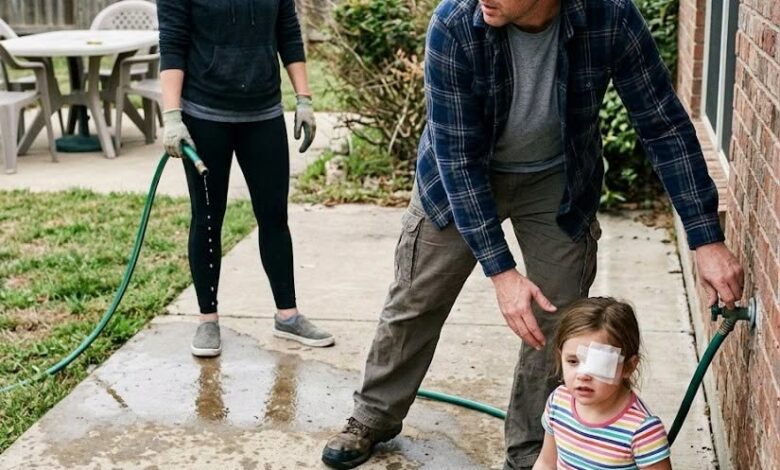
Across the urgent-care room, Chloe sat beside my sister beneath a thin paper blanket. One eye was swollen around the fresh stitches. Scrapes covered both knees, and she looked exhausted enough to fall asleep sitting upright.
My wife had not asked whether she was okay.
She had not asked how many stitches she needed.
She had not asked whether the bleeding had stopped.
She wanted our stories to match.
That mattered because, less than twenty minutes earlier, I had watched a video that showed why they didn’t.
Our neighbor’s security camera faced part of our backyard. He had saved the footage before I even called him because he had heard Chloe screaming.
The first clip was short.
I watched it in the hallway outside the exam room with the volume almost muted.
Chloe stood near the flower bed.
My wife came through the patio door carrying the garden hose.
The camera couldn’t capture whatever had happened inside before that moment, and I refused to invent anything it couldn’t show.
But what happened next was clear.
The water started.
Chloe backed away.
My wife moved the hose with her.
Chloe raised both arms over her face.
Then she slipped.
The side of her head struck the edge of a low planter.
Even after she hit the ground, the hose continued for another few seconds.
Then my wife turned it off.
I watched again with headphones.
The wind distorted most of the sound, but Chloe’s voice came through once.
“Stop!”
That one word nearly destroyed me.
Earlier, before I knew the video existed, Chloe had told the doctor:
“The water made me move backward.”
She had told me:
“I fell after she started spraying me.”
Now the footage placed those sentences into sequence.
She had not been confused.
She had not mixed up the order.
And she had not invented what frightened her.
But there was something else.
Just before my wife went inside for the gauze, she raised her phone toward the patio.
Chloe had already told me about that.
“She took a picture first.”
At the time, I had wondered whether fear had scrambled the memory.
Now I stopped wondering.
I saved the footage in two separate places and forwarded another copy to my sister.
Then I returned to the room.
Chloe looked up immediately.
“Daddy?”
“I’m here.”
“Are we going home?”
“Not tonight.”
Her whole body loosened.
That reaction told me more than any argument could have.
Then she glanced toward the door.
“Is she coming here?”
“No.”
Chloe lowered her voice.
“Don’t tell her I told you.”
I crouched beside her.
“You did nothing wrong.”
Her mouth trembled.
“I told.”
“I know.”
“Is she going to be mad?”
“That is not your job to worry about.”
She stared at me for several seconds as though she wanted permission to believe that.
Then she leaned into my sister.
My phone vibrated again.
Another message.
YOU’RE MAKING A SIMPLE ACCIDENT LOOK LIKE SOMETHING ELSE.
Then:
SHE’S FIVE. SHE DOESN’T UNDERSTAND WHAT HAPPENED.
I looked at my daughter.
She was five.
She might not understand legal language, adult motives, or the complicated excuses people make when they know something has gone wrong.
But she understood a hose being aimed at her.
She understood backing away.
She understood falling.
She understood pain.
And she understood enough to be frightened of telling me.
That was sufficient.
I didn’t answer.
Instead, I called our neighbor again.
“I need the original file.”
“I already sent you the clip.”
“The original. Unedited.”
A pause.
“I still have it.”
“Keep it exactly as it is.”
“I will.”
Then he added, “There’s more.”
My hand tightened around the phone.
“How much?”
“The camera started recording about twelve minutes earlier.”
“Send everything.”
A few minutes later, the longer file arrived.
I stepped into an empty consultation room.
The first several minutes were ordinary.
Chloe wandered near the flower beds.
She crouched beside one plant.
Picked something up.
Moved to another section of the yard.
Nothing looked unusual.
Then the patio door opened.
My wife stepped outside holding her phone.
She stopped several feet from Chloe and raised it.
A photograph.
Chloe stood still.
Then my wife put the phone away.
She picked up the hose.
The water began.
I watched Chloe recoil.
One step.
Another.
Arms rising.
The stream following.
Then the fall.
I froze the video immediately afterward.
Chloe lay on the patio.
My wife stood over her.
The hose was still in her hand.
That single image stayed on the screen.
I didn’t need rage to complete it.
I didn’t need to guess what had been said.
The timeline was enough.
My sister came into the room.
I handed her the phone.
“Watch.”
She did.
When the clip ended, she looked at me.
“You need to protect this.”
“I made copies.”
“Make another.”
“I will.”
Then she frowned.
“The picture.”
“What about it?”
“If she took that before Chloe fell, it might still be on her phone.”
I stared at the paused video.
The photograph could establish exactly when it was taken.
It might even show Chloe before the injury.
Before the blood.
Before the gauze.
Before the story became that she had fallen first and been sprayed only because she was dirty afterward.
I wasn’t going to call my wife and warn her I knew about it.
Not after the message asking me to get our stories straight.
Instead, I preserved everything I already had.
The neighbor’s original footage.
The shorter clip.
Screenshots of every message.
The doctor’s notes.
The times.
The sequence.
The changing explanations.
Because that was the pattern beginning to emerge.
At home, my wife had said Chloe had gotten dirty after she fell.
Then she said Chloe had been throwing dirt.
Then the hose became a way to rinse mud from her legs.
Then it supposedly swung upward accidentally.
Each explanation appeared after the previous one became harder to defend.
Now she wanted me home so we could agree on one.
That wasn’t confusion anymore.
It was coordination.
When I returned to the exam room, Chloe was drifting toward sleep.
I sat beside her.
Her good eye opened.
“Daddy?”
“Yes?”
“Are you mad at me?”
The question broke something inside me.
I leaned closer.
“No.”
“Promise?”
“I promise.”
She closed her eye.
I stayed there until her breathing became slow and even.
For the first time since I had found her soaked on the patio, I stopped waiting for my wife to explain herself.
I already had what mattered most.
Chloe’s account had come before she knew there was a video.
The doctor had documented her injuries.
The neighbor’s footage matched the sequence she described.
And my wife’s own messages were showing something the camera never could.
She wasn’t asking what happened.
She was trying to decide what everyone should say happened.
That difference changed everything.
I still didn’t know what took place inside the house before the patio.
I didn’t know why she took the photograph.
I didn’t know whether there were other incidents Chloe had been too afraid to mention.
Those questions would have to be answered carefully.
But I knew one thing.
I was not going home to help anyone build a cleaner story.
The story already existed.
A five-year-old backed away from a stream of water.
She fell.
She was hurt.
She told the truth.
And this time, before any adult could rearrange the afternoon into something easier to live with, I was going to preserve it exactly as it happened.