The bank manager held Grandma Maggie’s muddy blue passbook as if it had suddenly become evidence in a murder case.
For the first time since I walked into the branch, nobody was asking why I had brought it.
They already knew enough to be afraid of what it meant.
“Ms. Henderson,” the manager said quietly, “please come with me.”
I followed him behind the teller line, still wearing the black dress from Grandma’s funeral.
Mud had dried along the hem.
Dirt remained beneath my fingernails from digging the passbook out of her grave after everyone else had driven away.
The teller came with us, carrying a printed sheet against her chest.
Inside a small office, the manager placed the passbook on the desk.
“What’s going on?” I asked.
He pulled his chair around so he was sitting beside me rather than across from me.
That somehow frightened me more.
“I need to verify a few details.”
He asked my full name.
“Chloe Marie Henderson.”
My date of birth.
My address.
Then:
“Margaret Henderson was your biological grandmother?”
“Yes.”
“And Richard Henderson is your father?”
“Yes.”
The teller looked down.
I caught it.
“So say it.”
The manager exhaled.
“Several years ago, this bank placed a restriction on an account connected to your identity.”
“I don’t have an account here.”
He met my eyes.
“Yes, Ms. Henderson. You do.”
My stomach dropped.
Grandma’s final note flashed through my mind.
Your father didn’t only take money from me. He tried to take something that has belonged to you since you were born.
“What account?”
The manager opened the passbook to the faded red circle Grandma had marked near the back.
“This notation references a protected savings account opened when you were an infant.”
“By Grandma?”
“She was appointed to safeguard it.”
“And my father?”
A pause.
“Richard Henderson was never authorized to control it.”
The room suddenly felt too small.
The teller laid the printed page down.
Dates ran along one side.
The manager pointed to the first.
“Someone attempted to change the mailing address.”
Another.
“Then someone tried to add an authorized signer.”
Another.
“Later, there was an attempted withdrawal.”
I already knew.
“My father.”
The manager did not say yes.
He simply turned Grandma’s passbook toward me and tapped the initials beside several entries.
R.H.
Richard Henderson.
But what came next hurt more.
The large deposits I had spent the night trying to understand were not proof that Grandma had secretly become wealthy.
She had been replacing money.
Money that had already disappeared from the account meant for me.
“She was paying it back?” I whispered.
“It appears she believed funds had been removed improperly and spent years restoring what she could.”
I stared at the little blue book.
Grandma’s baking money.
Money from sewing hems.
Laundry.
Birthday gifts she never bought herself.
All those tiny deposits I remembered from childhood.
She had been repairing damage she hadn’t caused.
The manager turned another page.
Beside one entry, Grandma had written three words:
For Chloe. Replace.
I covered my mouth.
For years, Dad called Grandma paranoid.
Controlling.
Impossible.
He said she wrote everything down because she trusted nobody.
Maybe she had simply learned who not to trust.
A knock sounded.
Two police officers stood outside.
I immediately rose.
The manager lifted a hand.
“You’re not in trouble.”
That did not make me feel better.
One officer asked how I had obtained the passbook.
So I told them.
Grandma squeezing my hand two nights before she died.
“Don’t let Richard find it.”
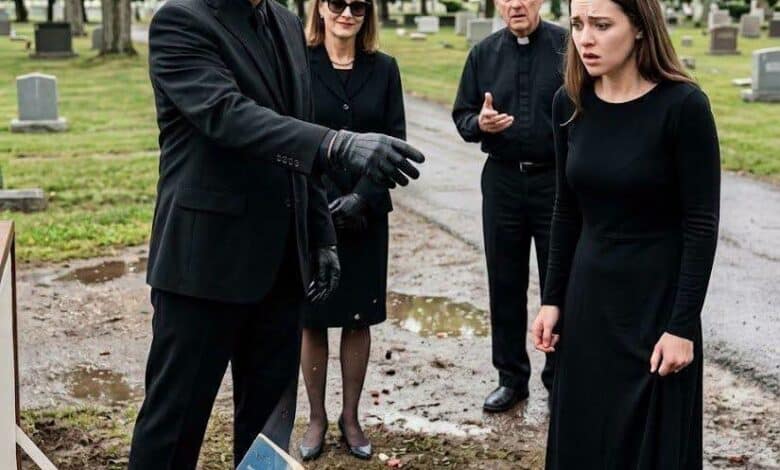
Dad throwing the book into her open grave and laughing.
“There’s your inheritance, Chloe. Worthless.”
The family leaving.
Me kneeling in wet cemetery dirt and pulling the book back out with my bare hands.
The note inside.
The red mark.
The officer’s pen moved faster when I described Dad throwing it into the casket.
“You have witnesses?”
“Half my family.”
For once, Dad had done something cruel in front of an audience.
The officer asked for Grandma’s handwritten letter.
I handed it over.
He read silently until he reached the line saying Dad had tried to take something that belonged to me.
Then he looked toward the manager.
“Consistent with your records?”
The manager nodded carefully.
“That appears consistent with why the account was restricted.”
And suddenly I understood why the teller had turned pale.
The bank had already been watching something.
Grandma had died.
I had appeared carrying a physical record tied to an old fraud concern.
And that record was covered in cemetery dirt because the very person suspected of wanting it gone had thrown it into her grave.
Grandma hadn’t sent me there to collect money.
She had sent me there to complete the evidence.
The manager asked if I wanted to know the balance.
For a moment, Dad’s voice returned.
No money.
No inheritance.
Just an old notebook.
“Tell me.”
He explained that some funds might remain restricted while previous transactions were reviewed.
Then he showed me the figure.
I barely saw the number.
It was far more money than Dad had ever admitted existed.
But all I could picture was Grandma sitting at her kitchen table in that old cardigan, flattening a few worn bills beside the porcelain angel.
I used to think she was saving.
Now I knew she had been rebuilding something stolen from me.
Then the manager showed me the old account notes.
Once I became an adult, requests supposedly made by me had begun appearing.
Address changes.
Signer additions.
Withdrawal questions.
But something kept failing.
Signatures didn’t match.
Identification was inconsistent.
Whoever answered verification questions knew family details—but not details specific enough to actually be me.
Eventually, the bank flagged the account.
Grandma apparently came in soon afterward.
She demanded that nobody be added unless I personally appeared with identification.
Then she began keeping her own paper record.
The same record Dad had thrown into the grave.
My phone vibrated.
Dad.
Three missed calls.
Then:
Where are you?
Another message followed.
Did you take something from the cemetery?
The younger officer noticed my face.
“Is that him?”
I nodded.
Then another message appeared.
That book belongs to the estate.
I almost laughed.
Yesterday, it was worthless.
Today, apparently, it mattered.
The officer told me not to delete anything.
Five minutes later, Susan called.
Then Tyler texted:
Dad is freaking out. What did Grandma leave you?
Not Are you okay?
Not Why was Grandma afraid?
What did she leave you?
I turned the phone facedown.
The manager returned with paperwork.
He explained that the bank needed time.
I would not leave with money that day.
That didn’t disappoint me.
I wanted something more valuable.
The truth.
Then he told me one last thing.
Grandma had come to the branch less than two weeks before she died.
She asked whether the protection on my account remained active.
Then she asked what would happen if I personally brought in the old passbook.
“She knew you might come,” he said.
My throat tightened.
“She knew I’d have to.”
Outside, the bank continued like any normal morning.
People deposited paychecks.
A toddler cried.
Someone complained about an ATM charge.
I stood there in a funeral dress with dirt beneath my nails, realizing my grandmother had spent years fighting a battle she never allowed me to see.
My relatives began calling by noon.
One uncle told me not to “turn grief into a legal mess.”
Susan said Dad was devastated.
Dad finally left a voicemail.
Calm.
Calm was always worse.
“Chloe, your grandmother was confused near the end. Bring me whatever she gave you, and we’ll handle this as a family.”
Bring me whatever she gave you.
He didn’t ask what I found.
He already assumed something existed.
I forwarded the voicemail to the officer handling my statement.
Over the next several weeks, Dad’s story kept changing.
First, the passbook meant nothing.
Then it belonged to Grandma’s estate.
Then he claimed Grandma had asked him to manage her finances.
Then he said the withdrawals had been authorized.
Every explanation contradicted the one before it.
I did not have to scream.
The paperwork was louder.
Eventually, the bank confirmed what mattered most.
The protected account belonged to me.
Grandma had been safeguarding it.
And her later deposits had restored money she believed should never have disappeared in the first place.
When the passbook was finally returned, I took it home.
The cover was warped.
Mud stained the edges.
I opened it to Grandma’s warning.
If Richard says it’s worth nothing, it’s because he already tried to cash it.
Dad thought he had thrown an old woman’s useless notebook into the ground.
Instead, he buried the one thing that finally made me stop believing him over my own eyes.
I wrapped the passbook in Grandma’s embroidered napkin and placed it back inside her rusted butter-cookie tin.
Not hidden from me.
Protected by me.
A few days later, I went grocery shopping.
Bread.
Coffee.
Eggs.
Nothing dramatic.
I carried the bags into my apartment, locked the door, and stood there for a moment in the quiet.
No chair under the knob.
No father demanding my documents.
No one telling me what belonged to me.
And for the first time in my life, something with my name on it truly felt like mine.