I had been a widow for three years. Then I made the unthinkable decision to marry my late husband’s identical twin.

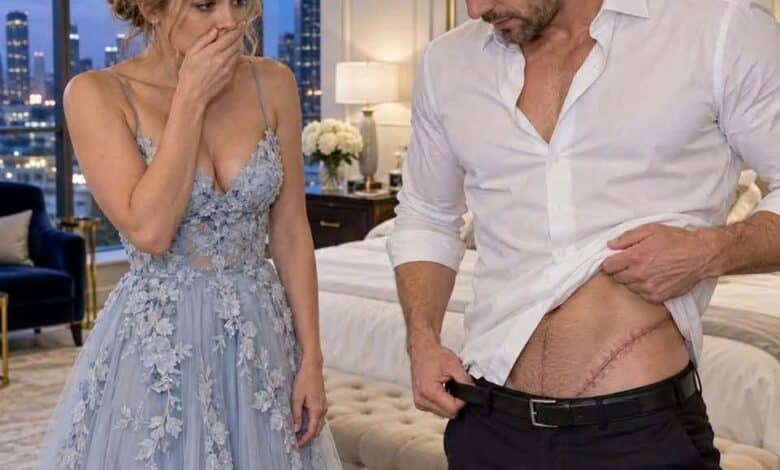
The scar was the first thing that betrayed him.
Not his voice.
Not the way he laughed.
Not the tiny habits I had spent three years explaining away.
A scar.
A pale, curved line on his left hip shaped like a fishhook.
The exact scar my dead husband had carried.
I was standing in my bedroom on my wedding night, one hand near the waistband of Sebastian Morales’s trousers, when I saw it.
My entire body went cold.
“What happened there?” I asked.
Sebastian glanced down.
For half a second, he hesitated.
Then the answer came too smoothly.
“Motorcycle accident. Years ago.”
I knew immediately something was wrong.
Sebastian had never owned a motorcycle.
I walked into the bathroom, locked the door, and stared at my reflection until one impossible thought became impossible to ignore.
Maybe the man I had mourned for three years had never died.
Maybe I had just married him again.
My name is Mariana Lopez. I was thirty-five then, a high school English teacher in Austin and the mother of a seven-year-old daughter named Camila.
Three years earlier, in 2019, my husband Santiago had supposedly died in a fiery highway crash.
His identical twin, Sebastian, survived.
The body recovered from the vehicle had been burned beyond recognition. Identification came from Santiago’s wedding band, personal belongings, and Sebastian’s account of what happened.
I buried a closed casket.
Then I spent three years learning how to live without my husband.
Sebastian never pushed himself into that grief.
He brought meals from his mother. Fixed a leaking faucet. Replaced broken light bulbs. Helped with Camila when I was overwhelmed.
He was gentle where Santiago had been loud.
Patient where Santiago had been impulsive.
When Sebastian eventually admitted he loved me, I rejected him.
“Every time I look at you,” I told him, “I’m afraid I’m just seeing Santiago.”
“Then don’t choose me,” he said. “I won’t spend my life being my brother’s shadow.”
We stayed apart for months.
And I missed him.
Or rather, I missed the man I believed he was.
So in November 2022, I married Sebastian.
That night, I found Santiago’s scar on his body.
I said nothing.
If I was wrong, grief had turned me paranoid.
If I was right, then someone had built an entire life on a corpse.
So I started testing him.
Two days later, I mentioned an old bed-and-breakfast.
“Remember that place Santiago and I stayed in? Room 204?”
“207,” Sebastian answered automatically. “204 faced the parking lot. You wanted the courtyard.”
He froze.
“Santiago told me.”
He hadn’t.
A few days later, I deliberately named the wrong favorite dish at a restaurant Santiago and I had loved.
Sebastian corrected me without thinking.
Then Camila found a toy watch her father had hidden years before.
“Daddy Sebastian knew where it was,” she said.
That sentence nearly stopped my heart.
Finally, I contacted Courtney, a woman Sebastian had dated in college.
She agreed to casually meet him at a coffee shop while I watched from across the street.
She mentioned his old football injury.
“With this cold weather, that wrist you broke must ache.”
He smiled.
“Sometimes.”
Courtney came back to my car pale.
“Mariana,” she whispered, “we weren’t dating yet when Sebastian broke his wrist. Santiago drove him to the hospital. That man knows the fact, but not the memory.”
Then she added:
“And when he laughs, that’s Santiago.”
I went to the Travis County Sheriff’s Office.
Detective Lucia Hernandez listened while I explained everything.
The scar.
The hotel.
The toy.
The wrist.
She didn’t dismiss me.
But she warned me.
“Memories won’t get us a warrant. Don’t confront him yet.”
Then Santiago made his first serious mistake.
He realized I was pulling away.
One evening, I came home and found both sets of parents sitting in my living room.
On the coffee table were photocopies of my old therapy records from after the crash.
Sebastian stood beside them looking devastated.
“I’m worried about Mariana,” he said. “After Santiago died, she struggled badly. She used to say she saw him in me.”
I understood immediately.
He was trying to turn my suspicions into mental illness.
“I know what I saw,” I said.
Then I looked at Teresa, the twins’ mother.
“Santiago’s scar is on his body.”
Sebastian went gray.
Teresa stood.
“What did you say?”
“I think Santiago is alive.”
Her mouth opened.
Then one terrible question left her.
“Then who did we bury?”
I left that night.
The next morning, my former therapist confirmed I had suffered grief and insomnia after my husband’s death, but no delusions, psychosis, or history of misidentifying people.
Meanwhile, investigators found the motive.
Before the crash, Santiago had been stealing from the commercial electrical supply company where he worked.
He had lost money trading stocks.
Then more.
Eventually he began moving company funds, forging invoices, and falsifying approvals.
More than two hundred thousand dollars disappeared.
Sebastian discovered it.
Days before the crash, he emailed copies of the records to his best friend Diego.
The message read:
Hold onto these. If everything gets sorted next week, I’ll tell you to delete them.
Santiago had supposedly agreed to confess.
The brothers got into a car together.
Only one came back.
Then Detective Hernandez found the proof.
Fingerprint records.
Identical twins can share extremely similar DNA profiles, but fingerprints are unique.
She placed a folder on the desk.
“The man living as Sebastian Morales is Santiago Morales.”
I couldn’t speak.
Then she opened another file.
“And the man buried under Santiago’s name was Sebastian.”
The crash itself had been real.
Investigators reconstructed what most likely happened.
The brothers argued while driving.
The car left the highway and rolled down an embankment.
Santiago escaped.
Sebastian was trapped.
Smoke began filling the vehicle.
That was when Santiago made the decision that destroyed all of us.
He exchanged their belongings.
Wallets.
Identification.
Wedding ring.
He left the things identifying him on Sebastian.
Then he walked away claiming to be his brother.
Whether Sebastian died immediately or remained alive while the fire spread could never be proven.
That uncertainty haunted Teresa most.
“You left him there?” she screamed when police later confronted Santiago at the family home.
“It was an accident!”
“The crash was an accident,” she sobbed. “The next three years were not.”
That sentence silenced everyone.
I looked at the man I had loved twice under two different names.
“You watched me mourn you.”
He cried.
“I was scared.”
“You watched your daughter mourn you.”
“I loved you both.”
“You stole Sebastian’s name because you were afraid of prison.”
“I was going to fix it.”
“For three years?”
He reached toward me.
I stepped back.
Then Camila appeared in the hallway.
She had slipped away from the relative watching her.
“Daddy?”
Santiago collapsed.
Camila stared at him.
“Are you Daddy Santiago?”
Nobody answered quickly enough.
Her face changed.
“Then Uncle Sebastian is dead?”
I pulled her into my arms.
Santiago was arrested.
The legal process lasted months.
He faced fraud, grand larceny, identity theft, obstruction, and related charges. Prosecutors could not prove homicide because forensic evidence could not establish whether Sebastian died from the collision or the fire.
Eventually Santiago received a lengthy prison sentence.
Our marriage was annulled.
Then came the day that hurt almost as much as learning the truth.
The grave had to be corrected.
For three years, the stone had carried Santiago’s name.
On a cool spring morning, we watched it replaced.
SEBASTIAN MORALES.
Teresa laid white roses beneath it.
“For three years,” she whispered, touching the stone, “I called you by your brother’s name.”
Camila stood beside me.
She had started therapy by then.
So had I.
One afternoon, she asked me something I had known would eventually come.
“Was Daddy a bad person?”
I thought carefully.
“Your father made terrible choices.”
“Did he love me?”
“Yes.”
“Then why did he lie?”
“Because telling the truth would have cost him something. And every time he had another chance to be honest, he chose another lie instead.”
She was quiet.
“What about Uncle Sebastian?”
“He was afraid too. But he tried to do the right thing even though it was hard.”
That answer seemed to satisfy her.
People sometimes say truth destroys families.
I don’t believe that anymore.
The truth did not destroy ours.
The lie did.
The truth simply turned on the lights.
I still visit Sebastian’s grave.
Not because he was ever my husband.
Because he deserved to have his own name back.
The last time Camila came with me, she placed a white rose on the stone.
Then she studied the photograph attached beside his name.
“He looked exactly like Dad.”
“Yes.”
She slipped her hand into mine.
“But he made different choices.”
I squeezed her fingers.
Two brothers entered the world with the same face.
But eventually I learned that identity has very little to do with what someone looks like.
Santiago stole his brother’s wallet.
His name.
His future.
He even stole the right to be mourned honestly.
But there was one thing he could never successfully steal.
Character.
Because in the end, Sebastian and Santiago were not separated by scars, fingerprints, or names.
They were separated by the choices they made when telling the truth became expensive.