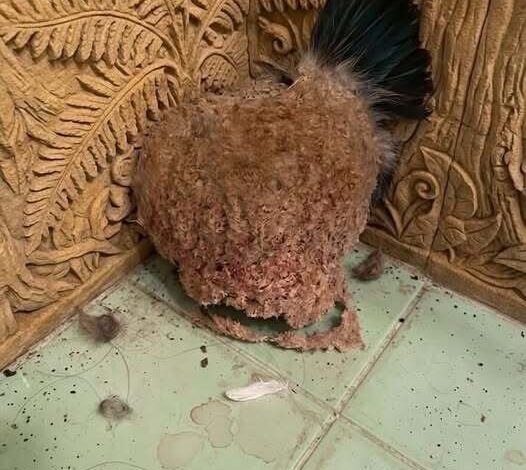
What was supposed to be a simple return home after a relaxing week away quickly became the beginning of a mystery that left an entire family puzzled, concerned, and searching for answers.
After days spent traveling, enjoying a break from daily routines, and looking forward to the comfort of their own home, the family expected nothing more dramatic than unpacking suitcases, sorting laundry, and settling back into normal life.
Instead, they found themselves staring at something they couldn’t explain.
The discovery happened almost by accident.
One family member entered the bathroom while unpacking and immediately noticed that something looked different.
At first, it was difficult to identify exactly what had changed.
The room appeared normal.
The sink was where it had always been.
The mirror reflected the familiar surroundings.
The towels hung neatly in place.
Yet something seemed out of place.
Then their eyes moved toward the upper corner of the room where two walls met near the ceiling.
There, attached securely to the surface, was an object none of them remembered seeing before.
It wasn’t large enough to dominate the room.
But it was unusual enough to command immediate attention.
From a distance, it looked almost like a carefully folded piece of textured paper.
The object possessed a strange layered appearance, with repeating patterns and subtle ridges that seemed far too deliberate to be accidental.
Its shape was oddly symmetrical.
Its surface looked organized.
Its construction appeared purposeful.
Most importantly, it absolutely had not been there before the family left on vacation.
That realization transformed a minor curiosity into a genuine mystery.
How had it gotten there?
What exactly was it?
And perhaps most importantly, should they be worried?
Within minutes, family members gathered in the bathroom to examine the strange object.
Everyone had a theory.
Everyone had an opinion.
And none of them matched.
One person suggested it might be a piece of insulation that had somehow become exposed.
Another wondered whether moisture damage had caused part of the wall to deteriorate in an unusual way.
Someone else considered whether it could be debris that had somehow become stuck in the corner during a storm or ventilation issue.
The longer they stared at it, the stranger it seemed.
The structure did not resemble anything typically found inside a home.
Its layered texture appeared almost architectural.
Like something had been built rather than deposited.
The more closely they examined it, the more convinced they became that whatever it was, it had not appeared by accident.
Someone—or something—had created it.
That possibility introduced an entirely new level of concern.
Could insects be responsible?
The idea initially seemed unlikely.
After all, the object looked surprisingly sophisticated.
Its design appeared organized.
Its construction seemed intentional.
Yet the more they considered the possibility, the more plausible it became.
Nature, after all, is capable of creating astonishing structures.
Birds build intricate nests.
Spiders weave remarkably complex webs.
Various insects construct colonies, tunnels, and shelters that rival human engineering in efficiency and precision.
Perhaps this strange object belonged to that category.
Perhaps it represented the work of an unexpected visitor.
Even so, uncertainty remained.
And uncertainty can be unsettling when it appears inside your own home.
Many people faced with such a discovery might have acted immediately.
They might have grabbed a broom.
Reached for a vacuum cleaner.
Scraped the object from the wall without a second thought.
The family considered those options briefly.
Then decided against them.
The object’s unusual appearance made them cautious.
Nobody wanted to risk disturbing something potentially dangerous.
Nobody wanted to accidentally release insects into the house.
Nobody wanted to damage something without understanding what it was.
The decision proved wise.
Instead of reacting impulsively, they chose patience.
They would investigate first.
Act later.
That evening, their search for answers began.
Like millions of people confronted with unfamiliar situations, they turned to the internet.
Photographs were taken.
Search terms were entered.
Image comparisons began.
At first, the process only deepened the mystery.
The internet offered countless possibilities.
Paper wasp nests.
Mud dauber structures.
Insulation fragments.
Mold formations.
Construction materials.
Decorative elements.
Each explanation seemed plausible for a moment before revealing important differences.
Hours passed.
Family members scrolled through article after article.
They compared photographs.
Read descriptions.
Examined diagrams.
Studied examples.
The object remained frustratingly difficult to identify with complete confidence.
Yet certain patterns began emerging.
Repeatedly, they encountered images that shared similarities with their discovery.
The layered texture.
The curved shape.
The distinctive paper-like appearance.
Again and again, the same possibility appeared.
Hornets.
At first, the family hoped the resemblance was coincidental.
Hornets carried implications they did not particularly enjoy considering.
Unlike many insects, hornets can become aggressive when their nests are disturbed.
Their stings can be painful.
In some cases, dangerous.
The prospect of having a hornets’ nest inside the home was not reassuring.
Still, the evidence continued accumulating.
Professional pest-control websites displayed photographs that looked remarkably similar to the structure attached to their bathroom wall.
Scientific resources described construction methods matching what they observed.
The layered paper texture turned out to be one of the most distinctive characteristics of hornet nests.
Many species create these structures by chewing wood fibers and mixing them with saliva.
The resulting material resembles paper.
Over time, insects carefully build layer upon layer, creating intricate shelters that appear surprisingly engineered.
Suddenly, the mystery began making sense.
What looked like folded paper wasn’t paper at all.
What seemed like an abandoned object was actually architecture.
The product of countless hours of insect labor completed while the family was away.
The realization was both fascinating and alarming.
Fascinating because of the extraordinary craftsmanship involved.
Alarming because of what might still be living inside.
The family now faced a decision.
They finally understood what the object likely was.
The question became what to do next.
Fortunately, they resisted the temptation to handle the problem themselves.
The internet had provided another important lesson during their research.
Hornet nest removal is not a do-it-yourself project for most homeowners.
Disturbing an active nest can provoke defensive behavior.
What begins as a simple removal attempt can quickly become a dangerous situation.
Instead, they focused on safety.
Access to the bathroom was limited.
Doors remained closed whenever possible.
Family members avoided unnecessary interaction with the area.
Then they contacted professionals.
Within a short time, a licensed pest-control specialist arrived to inspect the structure.
The expert’s reaction confirmed everything the family had discovered during their research.
It was indeed a hornets’ nest.
Fortunately, the situation appeared manageable.
The technician explained that nests can sometimes develop surprisingly quickly, especially when homes remain quiet and undisturbed for extended periods.
Vacations occasionally provide ideal conditions.
Reduced activity allows insects to establish themselves without interference.
The bathroom corner had offered shelter.
The family’s absence had provided opportunity.
The result was the structure now attached to their wall.
Using specialized equipment and proper safety procedures, the pest-control team removed the nest.
The surrounding area was carefully inspected.
Additional entry points were evaluated.
The house received a thorough examination to ensure no other colonies had been established elsewhere.
Fortunately, none were found.
The problem was resolved before it could become significantly larger.
The experience left the family with a story they would undoubtedly tell for years.
What began as a routine return home had transformed into an unexpected lesson about caution, observation, and the value of expert guidance.
More importantly, it reinforced an important principle many homeowners overlook.
Not every unusual discovery requires immediate action.
Sometimes the safest response is patience.
Curiosity.
Research.
And the willingness to seek professional advice before acting.
Had the family rushed to remove the object themselves, the outcome might have been very different.
Instead, they approached the situation thoughtfully.
They observed before reacting.
Learned before intervening.
Asked questions before making assumptions.
That approach ultimately protected both their safety and their peace of mind.
The strange object that first appeared as an unexplained mystery turned out to be an impressive example of nature’s engineering.
A carefully constructed hornets’ nest built quietly in their absence.
And while nobody was particularly happy to discover insects living inside the house, the experience served as a valuable reminder.
The unfamiliar often appears frightening at first.
But understanding almost always begins with curiosity.
And sometimes the smartest thing a person can do when confronted with a mystery is simply pause long enough to learn what they’re actually looking at.
In this case, that pause made all the difference.