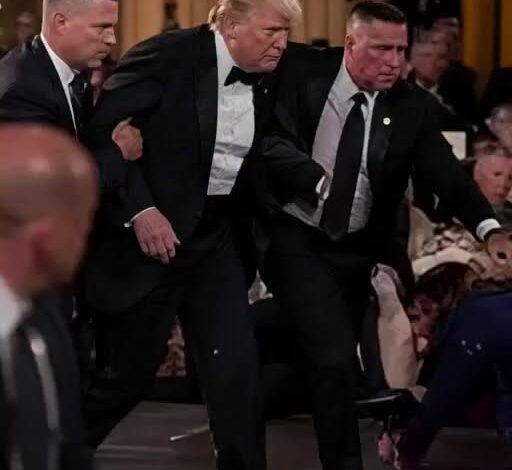
What began as one of Washington’s most anticipated nights of politics, media, and tradition reportedly descended into confusion and alarm within moments, turning an evening of celebration into a dramatic security emergency.
On April 25, 2026, the annual White House Correspondents’ Association Dinner was being held at the Washington Hilton in Washington, D.C. The event, known for bringing together journalists, elected officials, administration figures, and prominent guests from across the political spectrum, was expected to follow a familiar script of speeches, humor, and high-profile appearances. Instead, according to accounts provided afterward, the evening took an unexpected and unsettling turn when a serious security incident unfolded near the venue.
Inside the packed ballroom, attendees were focused on the event itself. President Donald Trump, First Lady Melania Trump, senior administration officials, members of the press, and invited guests had gathered for what many viewed as one of the capital’s signature annual traditions. Few inside the room were aware that outside the ballroom, security personnel were confronting a rapidly developing threat.
Law enforcement officials later stated that a 31-year-old man identified as Cole Tomas Allen allegedly attempted to breach a security checkpoint positioned within the extensive protective perimeter surrounding the event. Given the concentration of high-ranking government officials and other notable figures in attendance, security measures had been particularly robust, with multiple layers of screening and law enforcement personnel stationed throughout the area.
According to investigators, the situation escalated quickly.
As officers moved to stop the individual from advancing beyond the checkpoint, a confrontation reportedly occurred that resulted in an exchange of gunfire. The incident immediately triggered emergency protocols that had been established precisely for scenarios involving potential threats to protected government officials.
Within seconds, what had been a routine security operation transformed into a full-scale protective response.
Authorities later reported that one Secret Service agent was struck during the encounter. Fortunately, officials said the agent’s ballistic vest absorbed the impact, preventing what could have been a far more serious injury. Emergency medical personnel responded immediately, and the wounded agent was transported for treatment. Subsequent updates indicated that the agent was alert, stable, and expected to recover.
Inside the ballroom, however, many attendees initially had little understanding of what was unfolding.
Guests began noticing unusual movement among security personnel as agents and protective teams rapidly repositioned themselves. Conversations quieted. Attention shifted away from the stage and toward the entrances and exits of the room. What had moments earlier been an atmosphere of formal speeches and social interaction suddenly became charged with uncertainty.
Witnesses later described seeing protective details move with urgency and precision.
President Trump and other senior officials were quickly surrounded by security personnel and escorted from the area according to established protective procedures. Attendees were instructed to remain calm while law enforcement secured the building. Portions of the hotel were reportedly placed under lockdown as officers worked to determine whether any additional threats existed.
For many in attendance, the abrupt transition was jarring.
One moment, guests were participating in a familiar Washington tradition. The next, they found themselves watching security teams rush through hallways, hearing urgent instructions, and waiting for information about an event they did not yet fully understand. The contrast between the elegance of the evening and the seriousness of the security response made the experience especially unsettling.
As information gradually emerged, officials confirmed that President Trump had not been injured.
After being moved to a secure location, he later addressed the public and praised the actions of the Secret Service and other law enforcement agencies involved in the response. He specifically highlighted the injured agent’s condition, noting that the individual was alert and doing well under the circumstances. Trump also expressed gratitude to the security personnel whose rapid actions, he said, prevented the situation from becoming even more dangerous.
His remarks sought to reassure both attendees and the broader public while underscoring the gravity of the incident.
In the aftermath, organizers announced that the remainder of the evening’s program would be canceled. The decision reflected concerns for the safety of guests, staff members, journalists, and security personnel. While officials later indicated that plans for a future event could be considered, they emphasized that any such discussions would take place only after a thorough review of what had occurred.
Meanwhile, federal authorities launched a comprehensive investigation.
The FBI, Secret Service, and other agencies began examining every aspect of the incident. Investigators reportedly focused on the suspect’s background, communications, travel history, and activities leading up to the attempted breach. Security camera footage, physical evidence collected at the scene, and witness interviews were expected to play key roles in reconstructing the sequence of events.
Authorities also sought to determine whether the suspect acted alone and whether any additional individuals may have had knowledge of or involvement in the incident. Early assessments reportedly suggested the possibility that administration officials were the intended focus of the threat, though investigators stressed that determining motive would require a detailed examination of all available evidence.
The location itself added another layer of significance to the story.
The Washington Hilton occupies a unique place in American political history. It is widely remembered as the site of the 1981 assassination attempt against President Ronald Reagan, an event that permanently influenced presidential security procedures. For many longtime observers of Washington politics, the fact that another serious security incident had reportedly unfolded at the same venue made the evening feel especially disturbing.
That historical connection amplified public attention and fueled discussions about the continuing challenges faced by those responsible for protecting national leaders.
Yet some of the most compelling accounts came from the journalists who attended the dinner.
Unlike most major stories they cover, this was not an event they observed from a distance. They were participants in it. Reporters later recalled the sudden shift from ordinary conversations and professional networking to confusion and concern. Many described hearing fragmented information, seeing security teams mobilize, and struggling to understand exactly what had happened while events continued unfolding around them.
Several witnesses noted that the uncertainty itself was among the most unsettling aspects of the experience. For a period of time, attendees knew only that something serious had occurred and that protective measures were being implemented at extraordinary speed.
As the evening came to an unexpected close, many reflected on how quickly circumstances had changed.
What had been planned as a night celebrating journalism, politics, and public discourse reportedly became a vivid reminder of the risks that continue to accompany public life. The incident highlighted the immense responsibilities carried by security personnel, the importance of rapid emergency response, and the reality that even the most heavily protected venues can become the focus of sudden threats.
In the end, the evening was remembered not for speeches, humor, or political pageantry, but for the dramatic interruption that overshadowed them all. For those who were there, it served as a powerful reminder that moments of normalcy can be disrupted without warning—and that behind every major public event stands an extensive network of people working tirelessly to keep others safe.