Reports Emerge of an Incident Involving Donald Trump’s Granddaughter After NBA Finals Appearance

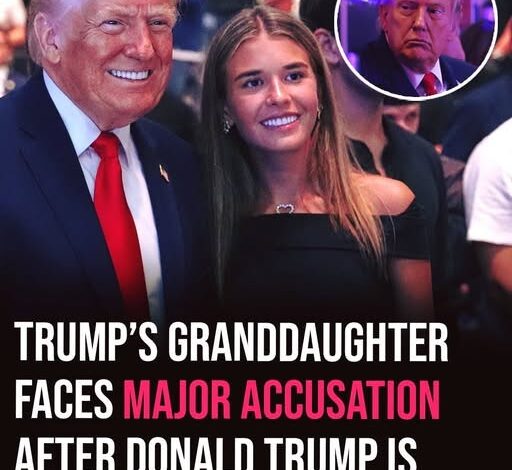
What began as a simple social media post from Donald Trump’s granddaughter quickly evolved into a much larger online debate, proving once again how even the briefest public moments can become the center of intense scrutiny in the digital age.
Kai Trump recently shared a personal video from her attendance at an NBA Finals game alongside her grandfather, former President Donald Trump. The clip captured the pair standing together during the national anthem before one of the most highly anticipated games of the season.
In the caption accompanying the video, Kai expressed appreciation for the production team that recorded the moment, describing it as a special experience she was grateful to share with her grandfather. What appeared to be a straightforward family memory soon attracted widespread attention across social media platforms.
As the video circulated, viewers began comparing Kai’s footage with broadcasts from the live event. Before long, online discussions emerged over what some users claimed were differences between the audio heard in her post and the sound featured during television coverage of the game.
Much of the conversation focused on the crowd’s reaction when Donald Trump appeared on the arena’s jumbotron. Some users argued that the atmosphere reflected in the televised broadcast seemed different from what could be heard in Kai’s video. These observations quickly fueled speculation, with commenters debating whether the audio had been altered, edited, or sourced differently before being uploaded.
The discussion spread rapidly.
Comment sections filled with competing theories and opinions. Some critics questioned the authenticity of the audio track, suggesting that changes in crowd noise affected how viewers perceived the moment. Others argued that removing or reducing certain sounds could potentially create a different impression of audience reactions inside the arena.
At the same time, many people came to Kai Trump’s defense.
Supporters pointed out that videos uploaded to social media frequently differ from live broadcasts for perfectly ordinary reasons. Television networks use professional microphones, audio mixing equipment, and production techniques that often produce a very different sound profile from personal recordings. In addition, social media platforms sometimes compress, modify, or filter audio automatically during the upload process.
Others noted that licensing restrictions, background noise reduction, and editing software can all influence how sound is presented in online videos. To them, the differences being discussed were not necessarily evidence of manipulation but simply the result of two separate recordings captured and processed in different ways.
Despite those explanations, the debate continued to gain traction.
The incident highlighted a growing reality of modern public life: every image, video, and social media post involving high-profile figures can become the subject of detailed analysis within minutes. What may begin as a personal memory often transforms into a broader discussion about perception, authenticity, and media presentation.
Neither Kai Trump nor representatives associated with her publicly addressed the online speculation surrounding the video. Nevertheless, interest remained high, partly because Donald Trump’s appearance at the NBA Finals was already drawing significant attention from both supporters and critics.
Crowd reactions to his presence became a major talking point throughout the event, generating countless social media posts, video clips, and discussions across various platforms. As a result, even seemingly minor details from the evening attracted heightened public interest.
While much of the online conversation centered on the video controversy, the game itself delivered plenty of drama on the court.
Fans witnessed one of the most memorable contests of the NBA Finals as the New York Knicks mounted an extraordinary comeback against the San Antonio Spurs. Facing what appeared to be an overwhelming deficit, the Knicks battled back throughout the game and ultimately secured a narrow victory in thrilling fashion.
The comeback was remarkable not only because of the final result but because of the scale of the turnaround. The Knicks erased one of the largest deficits seen in recent NBA Finals history, keeping their championship hopes alive and energizing their fan base.
As the clock wound down, tension filled the arena.
The game’s outcome remained uncertain until the final moments, when a dramatic sequence led to a last-second basket that sealed the victory. After a missed attempt in the closing seconds, the decisive score sent fans into celebration and instantly became one of the defining highlights of the series.
The victory also strengthened New York’s position moving forward, giving the team a valuable advantage as the Finals continued. Analysts and fans immediately began discussing the implications of the comeback and what it could mean for the remainder of the championship battle.
Yet even as basketball dominated headlines, the conversation surrounding Kai Trump’s video continued to circulate online.
The overlap between sports, politics, celebrity, and social media ensured that attention remained divided between the action on the court and the discussions taking place off it. In today’s media landscape, major events rarely exist in isolation. A single moment captured on camera can generate almost as much attention as the competition itself.
Ultimately, the situation served as a powerful example of how quickly narratives form online. A short video intended to commemorate a shared experience between a granddaughter and her grandfather became the subject of widespread analysis, debate, and speculation within hours.
Whether discussing crowd reactions, video editing, or public appearances, the episode underscored a larger truth about modern digital culture: perception often becomes part of the story itself.
In an era where every clip can be replayed, dissected, and debated by millions of people, even the smallest details can spark conversations far beyond their original context. What began as a personal social media post ultimately evolved into a broader discussion about authenticity, media interpretation, and the speed at which public narratives take shape in the online world.