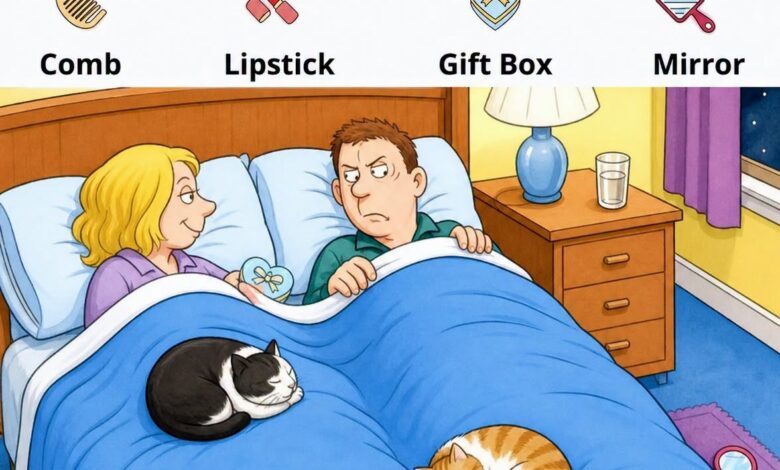
At first glance, there is nothing suspicious about the bedroom.
The lights are low. The bed looks undisturbed. A husband and wife appear to be sleeping peacefully, surrounded by the ordinary objects people barely notice before closing their eyes for the night.
But somewhere inside that calm scene, four objects are hiding.
A comb.
A lipstick.
A heart-shaped gift box.
And a hand mirror.
The challenge looks easy until you actually begin searching.
Your eyes immediately move toward the obvious places. You inspect the nightstand. You search around the pillows. You trace the folds of the blanket and study the floor.
Nothing.
That’s because the objects haven’t simply been placed in the room.
They have been disguised by it.
Their shapes have been worked into existing patterns, shadows, edges, and textures so cleverly that the brain initially interprets them as ordinary parts of the scene.
The trick is to stop looking for objects and start looking for shapes.
Begin with the nightstand.
Near the edge of a book or box is a vertical pattern that appears completely harmless. At first, it resembles nothing more than another set of lines in the furniture or an ordinary decorative detail.
Look closer.
Those lines are too regular.
They resemble teeth.
That’s the first hidden object.
The comb.
Its narrow body has been aligned with the surrounding edges, while the teeth echo the vertical lines already present nearby. Instead of announcing itself as something separate, the comb borrows the visual language of the nightstand.
Your brain sees wood, books, boxes, straight edges, and shadows.
So another narrow object containing straight lines doesn’t immediately register as unusual.
Once the outline clicks into place, however, the disguise collapses.
Suddenly, the comb seems obvious.
You may even wonder how you missed it.
That’s one of the most satisfying—and frustrating—features of hidden-object puzzles.
Before recognition, the object feels invisible.
After recognition, it feels impossible not to see.
Now move your attention upward toward the wife’s pillow.
This is where the second object is hiding.
You’re searching for lipstick, so instinctively you may imagine a familiar cosmetic tube sitting horizontally on the bed or resting somewhere on the nightstand.
Forget that expectation.
Instead, examine the border of the pillow.
There is a slim colored section that initially looks like part of the fabric’s design.
It’s narrow.
Straight.
Perfectly positioned.
Almost too perfect.
That stripe is the lipstick.
The disguise works because of alignment.
The lipstick has been positioned so that its long body follows the existing border of the pillow. Rather than interrupting the pattern, it continues it.
Your brain therefore categorizes the shape as decoration before considering the possibility that it might be an object.
This reveals the central trick behind the puzzle.
The hidden items aren’t necessarily tiny.
They are camouflaged.
That distinction matters.
People often solve these images by repeatedly scanning every inch and hoping something jumps out. But size isn’t always what makes an object difficult to find.
Context does.
The brain is constantly predicting what belongs in a scene.
A stripe belongs on a pillow.
Lines belong in wooden furniture.
Curves belong in rumpled blankets.
Circular patches belong in decorative fabric.
The puzzle exploits those assumptions.
Once you’ve located the comb and lipstick, move toward the center of the bed.
The third object may be the most romantic-looking item on the list:
a heart-shaped gift box.
Surely a heart should be easy to recognize.
Not here.
The blanket is full of folds, curves, highlights, and shadows. Your visual system interprets all of them as natural consequences of fabric bunching around sleeping bodies.
But somewhere among those folds, two curves meet.
Follow them carefully.
One curves inward from one direction.
The other mirrors it.
At the bottom, they narrow toward a subtle point.
There it is.
The heart.
The gift box has been blended into the blanket so that its silhouette appears to be created by folds in the fabric.
A slightly brighter section helps define the shape, but not enough to make it immediately obvious.
This is where changing the way you look at the image can help.
Don’t search for a box.
Search for symmetry.
Fabric wrinkles tend to be irregular.
A heart, by contrast, has recognizable structure.
Two rounded upper sections.
An indentation between them.
A tapering lower point.
Once your eyes detect that geometry inside the seemingly random folds, the hidden object emerges.
And again, the transformation is immediate.
What looked like meaningless bedding suddenly becomes unmistakably heart-shaped.
Three found.
One remains.
The hand mirror.
This one can be particularly deceptive because the puzzle separates its recognizable features visually.
When most people imagine a hand mirror, they think of the entire object at once:
a round reflective surface attached to a narrow handle.
So that’s what they search for.
But near the edge of the mattress is a pale circular shape that doesn’t initially seem important.
It could be part of the bedding.
A highlight.
A decorative spot.
A patch of light.
Look at it again.
Then stop concentrating on the circle and search immediately beside it.
A thin shape extends away.
That’s the handle.
Part of it disappears into the darker area surrounding the mattress, making the mirror difficult to perceive as a complete object.
The circular portion blends into the pattern while the handle blends into shadow.
Each half is camouflaged differently.
Together, however, they form the final hidden item.
The hand mirror.
And just like that, the bedroom changes.
The comb is no longer part of the nightstand.
The lipstick is no longer part of the pillow.
The heart is no longer an accidental blanket fold.
The pale circle is no longer meaningless decoration.
All four objects are suddenly visible.
Comb: near the nightstand, disguised among vertical lines.
Lipstick: close to the wife’s pillow, aligned with its border.
Heart-shaped gift box: near the center of the bed, camouflaged within the blanket folds.
Hand mirror: near the mattress edge, with its circular surface blending into the pattern and its handle fading into shadow.
But finding them is only half the fun.
The more interesting question is why they were so difficult to notice in the first place.
The answer has surprisingly little to do with eyesight.
It has to do with perception.
Human beings don’t process every visual detail independently.
If we did, simply walking through a room would become overwhelming.
Instead, the brain organizes information rapidly.
Bed.
Pillow.
Blanket.
Nightstand.
People.
Bedroom.
Safe.
Ordinary.
Once the scene has been categorized, smaller details are interpreted according to that larger expectation.
That’s why the comb’s teeth become “lines.”
The lipstick becomes “pillow trim.”
The heart becomes “wrinkled fabric.”
The mirror becomes “pattern.”
The brain isn’t failing.
It’s actually doing its job efficiently.
The puzzle succeeds because it uses that efficiency against us.
It places familiar objects where their shapes can be mistaken for something the brain already expects to encounter.
And that’s why staring harder doesn’t always work.
Sometimes the solution appears only when you stop asking, “Where is the lipstick?” and instead ask, “Which straight shape could be a lipstick?”
You’re changing the brain’s instructions.
Once that happens, camouflage begins falling apart.
There’s another reason these puzzles can become strangely addictive.
Recognition produces a tiny moment of revelation.
One second, you see nothing.
The next:
There!
It’s similar to recognizing a face inside an optical illusion.
The pixels haven’t changed.
The drawing hasn’t changed.
You have.
Your interpretation has shifted.
And once the brain has categorized the shape correctly, returning to the previous interpretation becomes surprisingly difficult.
Try looking at the pillow again after finding the lipstick.
Good luck convincing yourself it’s merely a colored stripe.
The same happens with the heart.
Before finding it, there are only folds.
After finding it, there’s a heart sitting right in front of you.
That’s why people often pass hidden-object puzzles to someone else immediately after solving them.
“Find the four objects.”
Then they watch.
The temptation to point is almost unbearable.
The other person scans the obvious locations.
Nothing.
They move closer.
Still nothing.
Meanwhile, you’re sitting there wondering how anyone could possibly miss the enormous heart you’ve already discovered.
But moments earlier, you missed it too.
That’s the joke.
And perhaps that’s what makes this particular image so effective.
The setting looks peaceful.
Everything appears ordinary.
The visual noise comes from completely familiar things: bedding, furniture, shadows, decorative patterns.
There is no obvious reason to distrust what you’re seeing.
Yet four objects are sitting there in plain sight.
Not invisible.
Not removed.
Simply misunderstood.
So if you’re still searching, remember the route.
Start at the nightstand and ignore what appears to be an innocent collection of vertical lines.
Find the teeth.
That’s your comb.
Move toward the wife’s pillow and inspect the narrow colored border.
Find the tube hiding inside the stripe.
That’s the lipstick.
Then shift toward the middle of the blanket.
Ignore the wrinkles and search for two matching curves meeting at a point.
There’s the heart-shaped gift box.
Finally, move toward the edge of the mattress.
Find the pale circular shape.
Then trace the narrow extension disappearing into darkness.
That’s the hand mirror.
Four objects.
Four disguises.
One seemingly ordinary bedroom.
And once you’ve found all of them, something strange happens.
The puzzle is over, but the image never returns to normal.
Your brain has learned its secret.
The furniture can no longer hide the comb.
The pillow can’t swallow the lipstick.
The blanket can’t disguise the heart.
The shadows can’t erase the mirror.
They were always there.
Your eyes saw every one of them.
It was your brain that decided they were something else.
And that’s the cleverest trick of all:
The puzzle never really hid anything from you.
It simply convinced you that what you were looking directly at wasn’t worth seeing.