Ready for a deceptively simple brain teaser?
At first glance, this one looks almost too easy.
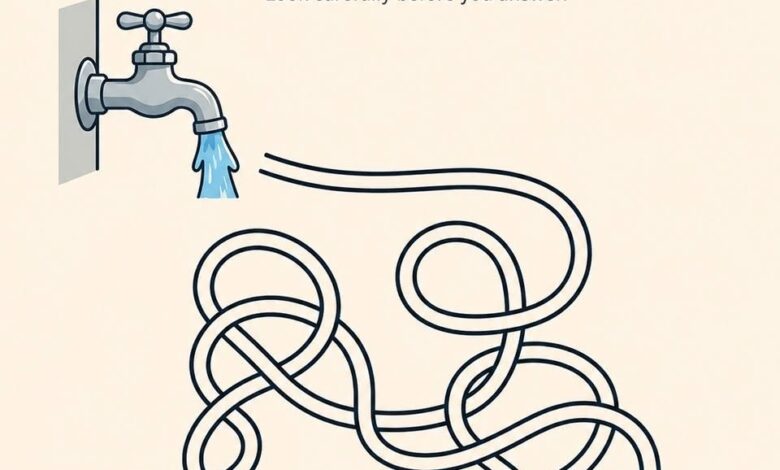
Water pours from a faucet toward a maze of twisting pipes. Beneath the network sit four buckets labeled A, B, C, and D.
The challenge seems straightforward:
Which bucket fills first?
Most people answer within seconds.
That is exactly why the puzzle works.
The drawing is designed to make your eyes move faster than your reasoning. The pipes twist, overlap, cross, and appear to connect in several places, encouraging your brain to make quick assumptions before you have actually traced the route.
So before choosing a letter, slow down.
Start at the faucet.
Follow the water.
Not the pipe you think it enters.
The actual path.
Move through the drawing one section at a time and pay attention to every crossing.
That is where the puzzle becomes interesting.
Our brains are excellent at seeing patterns. Usually, that helps us understand complicated scenes quickly. But in puzzles like this, the same ability becomes a weakness.
Two lines touch?
We assume they connect.
One pipe crosses another?
We mentally merge them.
A route points downward toward a bucket?
We start treating that bucket as the obvious answer.
But visual contact is not always a real connection.
And the puzzle takes advantage of that.
Bucket A is usually one of the first choices.
Its route appears to head downward early, making it feel like the water has a short and direct journey. If you glance rather than trace, A looks convincing.
But follow the route carefully.
The pipe leading toward A passes through sections where lines cross without actually joining. What looks like an open route at first breaks once you pay attention to how the pipes are drawn.
So A is out.
Then there is D.
D attracts people for a different reason.
The right side of the diagram appears cleaner. The pipe seems to travel in a relatively direct direction toward the bucket, and after staring at the tangled middle, a simple-looking route feels reassuring.
But again, appearances are doing most of the work.
Trace the water from the beginning rather than starting near D and working backward.
The apparent route does not connect to the flowing water in the way your eyes initially suggest.
So D does not receive the water either.
Now look toward C.
This is where many people change their minds.
After realizing A and D are not as obvious as they first appeared, the middle route starts looking more plausible. C seems connected through a sequence of bends and intersections that appear to create a complete path.
But the same visual trick appears again.
A pipe passes over another pipe without opening into it.
That tiny difference matters.
In a pipe puzzle, a crossing is not automatically a junction.
If there is no actual opening between the two sections, water cannot simply jump from one pipe into another because the lines happen to touch in the drawing.
So the route toward C fails too.
That leaves B.
If you trace the pipe system carefully from the faucet through every legitimate opening and ignore the false crossings, B is the only bucket with a continuous path.
No imaginary connections.
No jumping between overlapping lines.
No blocked route disguised as an intersection.
Just one uninterrupted channel from the top of the system toward the bucket.
So under the normal rules of this type of puzzle, the answer seems clear:
Bucket B fills first.
And if you stopped there, you would already have solved the main visual challenge.
But this puzzle has another layer.
A much smaller one.
And depending on how literally you interpret the drawing, it changes the answer completely.
Go back to the beginning.
Not the pipes.
The faucet.
Look at the water falling from it.
Then look at the top of the pipe network.
There is a tiny gap.
The stream is falling downward, but the pipe itself does not actually meet the faucet.
That means something important.
The water never enters the network.
Everything we just traced—every intersection, every blocked route, every argument over A, B, C, or D—becomes irrelevant if the water never reaches the first pipe.
It simply falls outside the system.
Which means the cheekiest answer is:
None of the buckets fill.
The pipes are not connected to the faucet.
That tiny gap is what makes the puzzle so satisfying.
The obvious challenge asks whether you can trace a complicated path without being fooled by false intersections.
That gives you B.
But the hidden challenge asks something even more basic:
Did you check the starting assumption?
Everyone is so busy studying the maze that they automatically accept one thing without verifying it.
The faucet must be connected.
Why else would the pipe system be there?
And that is exactly how the trick works.
Your brain supplies the missing connection because the picture strongly suggests one.
Once that assumption is accepted, your attention moves immediately to the complicated part.
Which branch is open?
Which pipe crosses another?
Where does the water turn?
Which bucket has the shortest route?
You can spend several minutes solving a problem the water never enters.
There is something wonderfully familiar about that.
We do the same thing outside puzzles.
A problem looks complicated, so we attack the complicated middle.
We compare options.
Trace consequences.
Debate outcomes.
Look for hidden obstacles.
And sometimes we never stop to ask whether the basic premise was correct.
Are these two things actually connected?
Did the problem begin where we assumed it did?
Is the system even operating?
Are we solving the right question?
Sometimes the overlooked detail at the beginning matters more than every complicated detail that follows.
That is why this little pipe puzzle can produce two satisfying answers.
If the intended challenge is to follow only genuine pipe connections, Bucket B wins.
It is the only bucket reached by a complete open route through the network.
But if you treat every visible detail literally, including the gap beneath the faucet, then the answer is even simpler.
None.
No water enters.
No bucket fills.
And that second answer tends to make people laugh because it exposes how thoroughly their attention was manipulated.
You might have spent several minutes staring at A.
Then C.
Then D.
Then deciding confidently on B.
All while ignoring the one piece of the picture that mattered most.
The first centimeter.
That is the charm of good visual brain teasers.
They are not really testing intelligence in some grand sense.
They are testing attention.
Can you resist the urge to answer immediately?
Can you distinguish what you actually see from what your brain assumes?
Can you notice the small gap while everyone else is staring at the complicated maze?
The trick works because humans are built to complete incomplete patterns.
Usually, that is useful.
Here, it makes us invent a connection that isn’t there.
So look at the puzzle one more time.
Trace the water.
Check every crossing.
Check the routes.
Then, before giving your final answer, return to where everything supposedly starts.
Does the faucet actually feed the pipes?
That one question changes the entire game.
So what did you choose first?
A?
B?
C?
D?
Did you trace your way to B?
Or did you spot the gap and decide that none of them would receive a single drop?
Either way, the puzzle has done its job.
It made you look once.
Then look again.
And sometimes that second look is where the real answer was hiding all along.
Bucket B fills first.